
From Folders to Answers: How a Knowledge Compiler Keeps a Company Brain Accurate
This article is for: owners and managers whose know-how sits in folders, inboxes and a few heads.
You will recognize: the AI that quotes last year’s price list with total confidence.
You will take away:
✔ A simple way to stop old versions from competing with current ones
✔ The one habit that keeps answers true after people and prices change
✔ What a buyer looks for when checking how your business stores what it knows
Reading time: 9 minutes · Time to act: 30 minutes
You have spent years building a business that works.
Somewhere inside it sits the knowledge that makes it work: the price list your sales lead actually uses, the supplier terms you renegotiated two winters ago, the reason you stopped taking a certain kind of client. Most of it lives in folders, inboxes and a few heads.
When someone needs a straight answer, they still come to you.
A Company Brain is meant to change that. Yet a brain that simply points AI at your old folders inherits every problem those folders have: three versions of the same price list, a contract nobody marked as expired, a policy that changed in a meeting and never made it into writing.
The AI will answer with confidence from whichever file it reads first.
This post explains the idea that fixes this, often called a knowledge compiler, in plain language for owners and managers of a 10 to 80 person firm. It covers what a compiler does, why it matters to an owner, how ExValu designs it, what a buyer sees, and what you can start this week.
If you have not yet read our list of the nine parts every owner's Company Brain needs, start there: The Company Brain Checklist: 9 Things a Business Owner Can't Skip. This post goes one level deeper, into how those parts stay accurate month after month.
What a knowledge compiler does
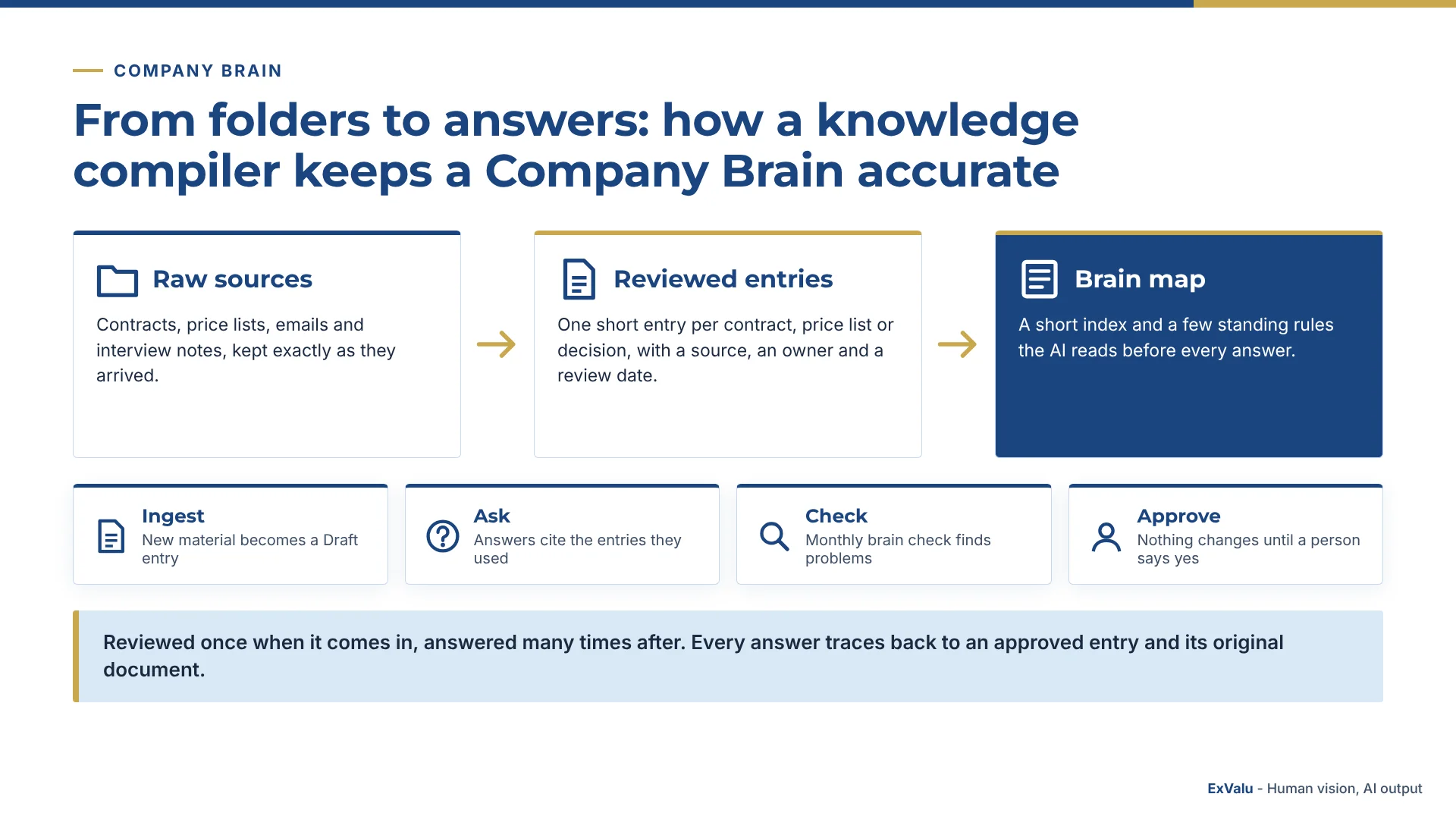
A software compiler takes code that people wrote and turns it into something a machine can run. A knowledge compiler does something similar with company knowledge. It reads raw material once, carefully, and turns it into short, reviewed entries that answer questions directly.
The hard thinking happens when knowledge comes in, so every later question draws on work that has already been checked.
The idea got wide attention in April 2026, when AI researcher Andrej Karpathy published an "LLM Wiki" idea file. He describes three layers: raw sources that the AI reads but never changes, a wiki of pages the AI writes and maintains, and a schema file that tells the AI how to keep that wiki in order. He also describes three routine jobs: ingest a new source, answer questions from the wiki, and lint, a health check that looks for contradictions, stale claims and pages that nothing links to.
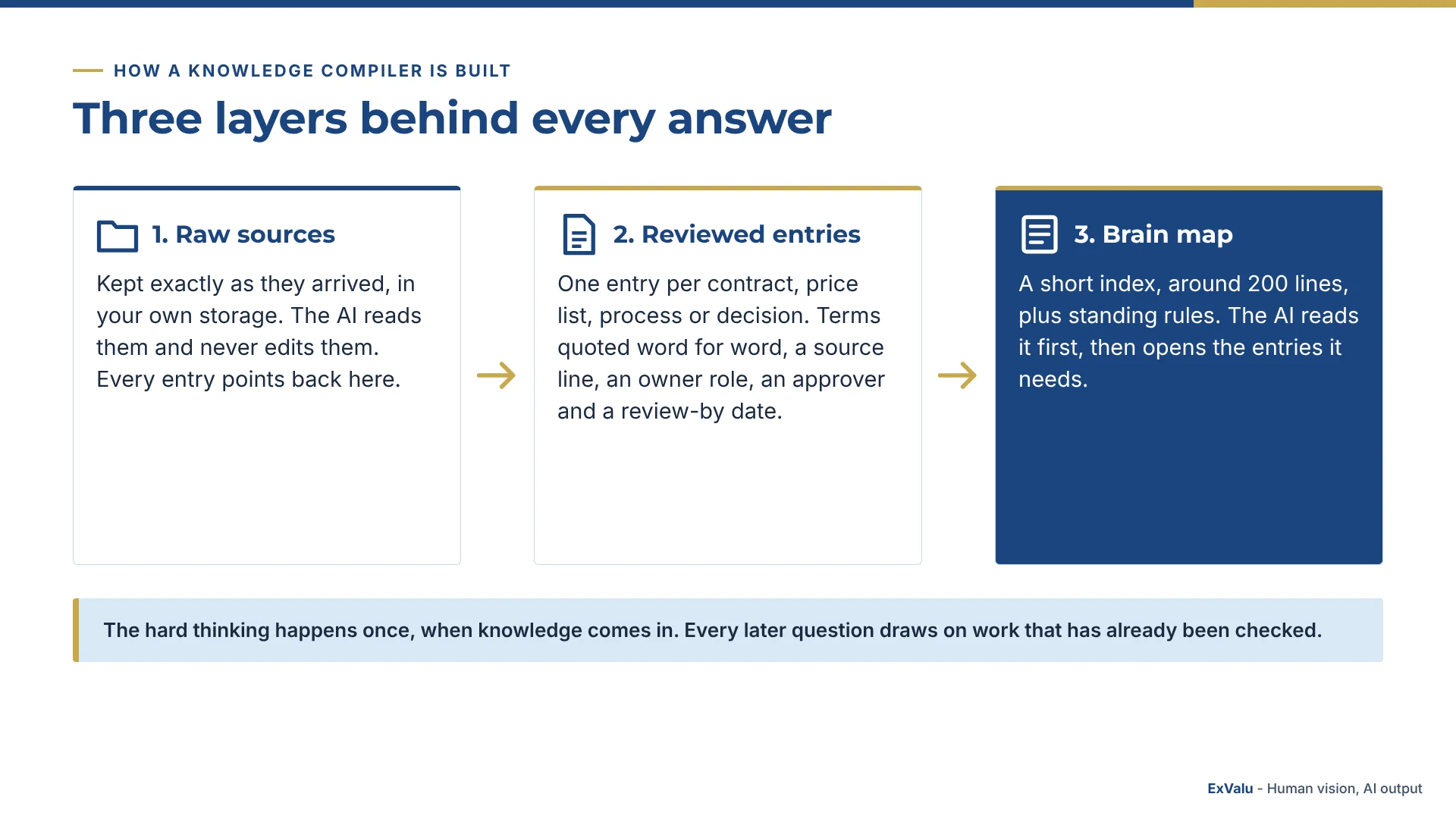
For a 30-person firm, the three layers translate into something you can picture:
Raw sources: the contracts, price lists, emails and interview notes, kept exactly as they arrived.
Reviewed entries: one short page per contract, price list, process or decision, written from the source and approved by a named role.
The brain map: a short index plus a few standing rules that the AI reads before it answers anything.
Why it matters for value: anyone can trace an answer back to an approved entry, and from there to the original document. That traceability turns company knowledge into something that stays with the business when people change, and it lowers the risk of undocumented operations.
Answers that stay true when people and prices change
Most owners we work with have plenty of documents. The trouble is that there are too many, with no reliable way to tell which one is current.
Two things tend to go wrong.
The first is conflicting files. The 2024 price list and the 2025 price list both sit in the shared drive. A proposal template still carries last year's payment terms. A search tool, human or AI, finds both and has no way to know which one you meant.
The second is quiet aging. A discount agreed with a key client is replaced in a phone call. A supplier changes its minimum order. The old email is still there, still readable, still wrong. Nobody deletes it, because nobody knows it is out of date.
A compiler handles both at the moment knowledge comes in.
It decides what is current, records who approved it, and sets a date when it must be checked again.
Why it matters for value: fewer wrong answers on prices, terms and commitments protects margin, which supports EBITDA quality. Answers drawn from approved entries also make sales and service behave the same way whoever is on shift, which supports revenue predictability.
What the research shows, and where it stops
On 6 November 2026, Anthropic published "The components of agent memory" by Lance Martin, describing how AI agents keep and organize what they learn. The figures below come from Anthropic's own evaluations. Three findings matter for owners.
Structure helps most where judgment is needed. On merger questions that required reasoning across several documents, a compiled wiki met 87% of graded criteria, against 73% for search alone. On a task answered from a single document, the article reports no clear gain.
Large collections need both structure and search. On a corpus of about 350,000 files, a wiki on its own rose from 13% to 48% of graded criteria as the number of maintenance sessions grew from 2 to 128. Search alone reached 53%. Wiki plus search reached 54% to 61% and used about 20,000 fewer tokens per question.
Quote the source, one page per contract. When each contract got its own page with the terms quoted word for word, 57 of 57 contract facts came through correctly. A shared table written by parallel agents kept 41 of 57.
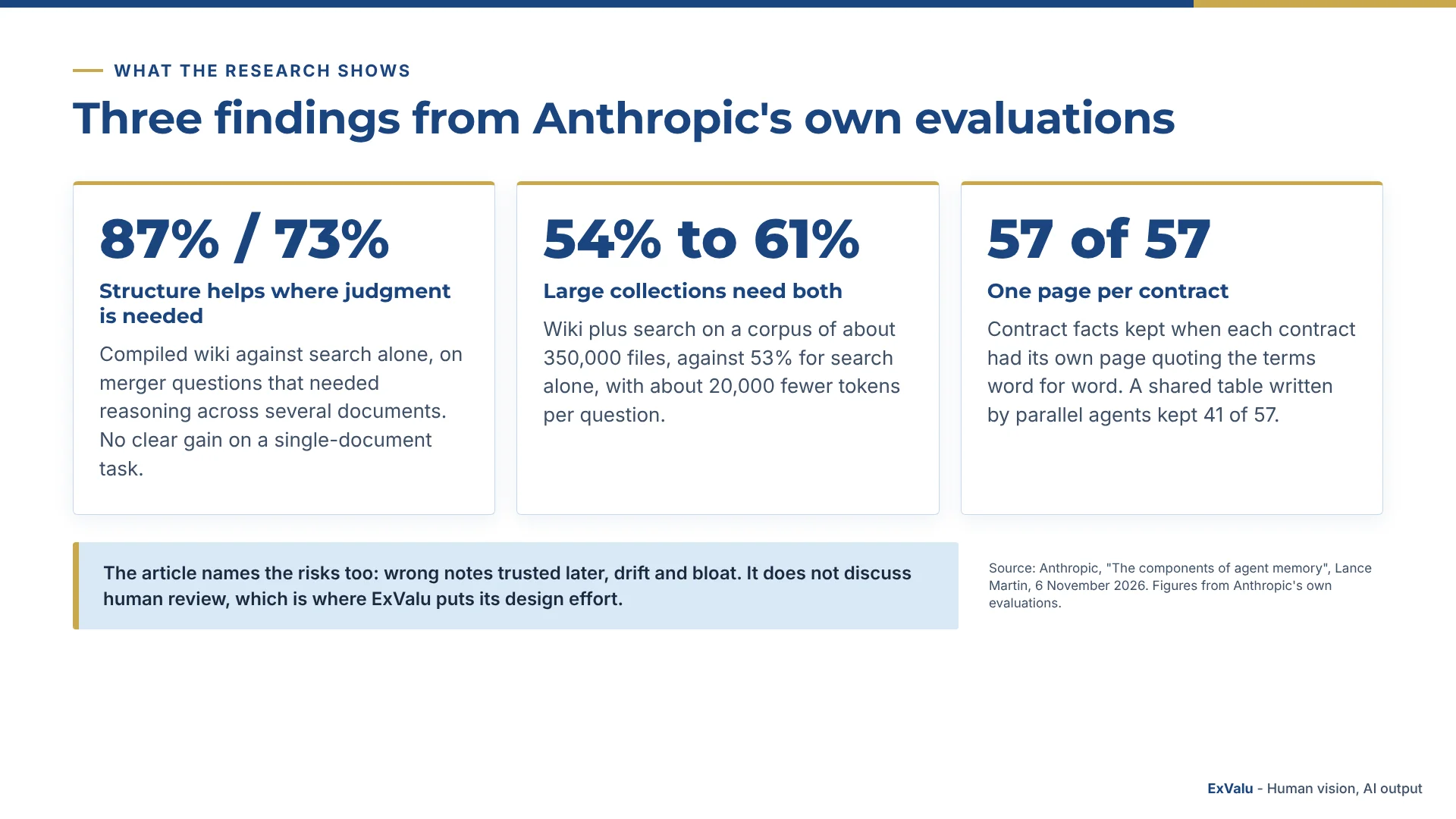
The same article names the risks: wrong notes that are trusted later, drift, and bloat, with one test wiki growing to 1.77 times the size of the documents it summarized. It advises keeping the context loaded into every session small, because a wrong note there spreads to every answer.
The article does not discuss human review.
For an owner's business, that is the part that matters most, and it is where we put our design effort.
Why it matters for value: compiled, sourced entries make answers consistent. Ask your people the same question twice, and the business gives the same answer.
How ExValu designs the compiler for a 30-person firm
Our Company Brain follows the three layers, with choices made for a small firm and a future buyer. This is our design, and we are testing it with our first pilot. The pilot acceptance tests have not passed yet, so read what follows as what we build toward and what an owner should ask of any provider.
Raw sources stay untouched. New files land in an inbox folder in your own storage and are never edited. Every entry points back to the file it came from.
One entry per contract, price list or decision. Terms are quoted word for word, with a source line, an owner role and an approver. We avoid shared tables that several people or agents write into at the same time.
A small brain map. The index the AI reads first stays short, around 200 lines, with the detail in linked entries.
Ingest, ask, check. New material becomes a Draft entry. Answers cite the entries they used. A check pass looks for problems.
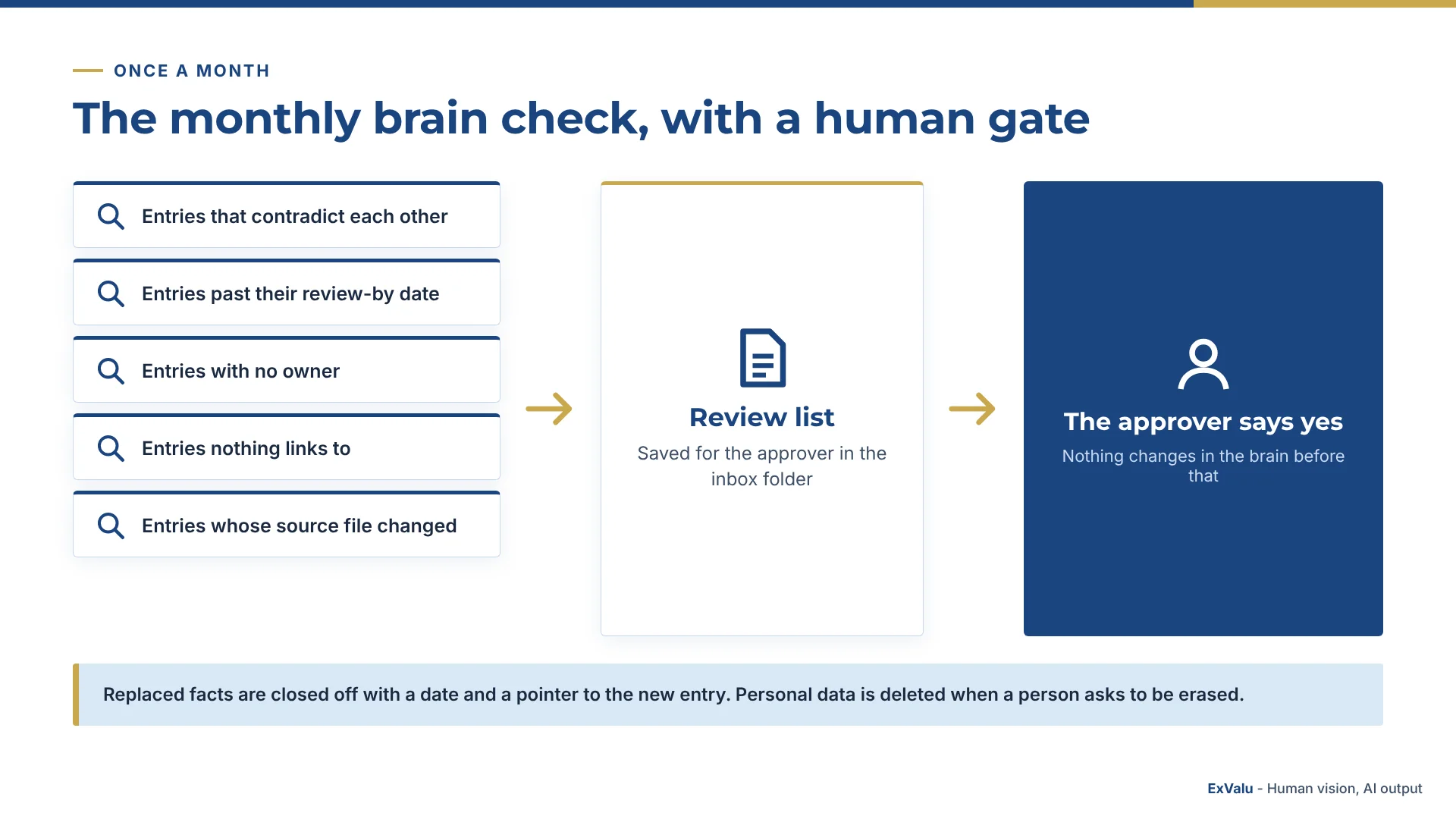
A monthly brain check with a human gate. The check lists contradictions, entries past their review date, entries with no owner, entries nothing links to, and entries whose source file has changed. The result is a review list for the approver.
Nothing changes in the brain until that person says yes.
Facts are closed off with a date. When a price or a term is replaced, the old entry is marked as superseded, with the date and a pointer to the new one. The history stays readable. Personal data is the one exception: when a person asks to be erased, their data is deleted.
Good answers come back as drafts. An answer the owner approves can be filed back as a Draft entry for review. It never becomes a fact on its own.
Two fields carry most of this work: a review-by date and a superseded-by pointer on every entry. We are adding both to our brain map, and we recommend that any owner requires them, whoever builds the brain.
Why it matters for value: a dated, reviewed brain reduces the risk that the business acts on stale terms. It also keeps a record of how knowledge is maintained when the owner is not in the room.
What we deliberately leave out, for now
Much of what is written about knowledge compilers assumes a large company: a vector database for search, a knowledge graph to map relationships, custom connectors so agents can query everything. For a 30-person firm, we make a different design choice. A client's brain is plain Markdown files with a brain map, stored in the client's own storage.
Our reasons:
Fewer vendors. Every added tool is another processor of your data and another point of failure.
Readable by a buyer. A due diligence team can open plain files without special software or our help.
It outlasts its builder. If ExValu or any tool provider disappeared tomorrow, the files would still be there and still make sense.
We add a search index when a brain needs one: when it passes about 100 source files or a few hundred entries, or when the monthly test questions start to show misses. That threshold matches Karpathy's own note that an index-only approach works at moderate scale, around 100 sources and hundreds of pages.
Why it matters for value: a brain that only one technician can run is a new key person risk. Keeping it simple keeps owner dependence from moving to a new place.
What a buyer sees in due diligence
When a buyer's team looks at a business with a compiled Company Brain, they can review:
Entries with a source line, an owner role, an approver and a review-by date.
An append-only log showing what was added, changed or retired, by whom and when.
Monthly brain check reports with the approver's sign-off.
A fixed set of test questions, re-run each month and after every AI model change, with the results kept over time.
Retention periods and records of deletion requests handled.
Each item answers a question buyers ask early: does this business know how it works, and will that knowledge still be here after the owner leaves?
A note on staff and GDPR
A Company Brain holds what your people know, so treat their knowledge with care. Tell staff what the brain is for before you start, set the legal basis, and involve the works council where one exists. Interviews focus on business reasoning, entries use role labels where possible, and each folder has a retention period. Access follows the audience: owner, leadership and team see different things. Recording conversations needs the knowledge and agreement of the people involved, so we do not recommend recording calls by default. When a person asks for their data to be erased, it is erased, even though business facts are only closed off with a date. Please check the details with your data protection advisor.
What you can start this week
Pick one area where a wrong answer costs money. Pricing and discounts are a good first choice.
Find the current version of each document in that area. Move older versions into an archive folder so they stop competing.
Write one short entry per price list or contract: what it says, quoted exactly, plus the source file, the owner role and a review-by date.
Put a 30-minute brain check in the calendar for the first Monday of each month. Look for entries past their date and for anything that contradicts another entry.
Write down three questions your team asks you every week, and check whether your entries answer them without you.
Want a head start? The Owner's Facts File is a free three-page template for writing down the facts only you know, each with a source, an approver and a review date. Click the link to: Get the Owner's Facts File
If your best salesperson asked the brain for your current terms tomorrow, how sure are you that the answer would be the one you meant?
To find out whether a Company Brain fits your business, take the fit check. It takes a few minutes.
Sources
Anthropic, "The components of agent memory", Lance Martin, Anthropic Engineering, 6 November 2026. Figures are from Anthropic's own evaluations.
Andrej Karpathy, "LLM Wiki" idea file, GitHub gist, April 2026.