
In short
Why your best people hold back, and how to change it
Open a card for the detail.
Where you are
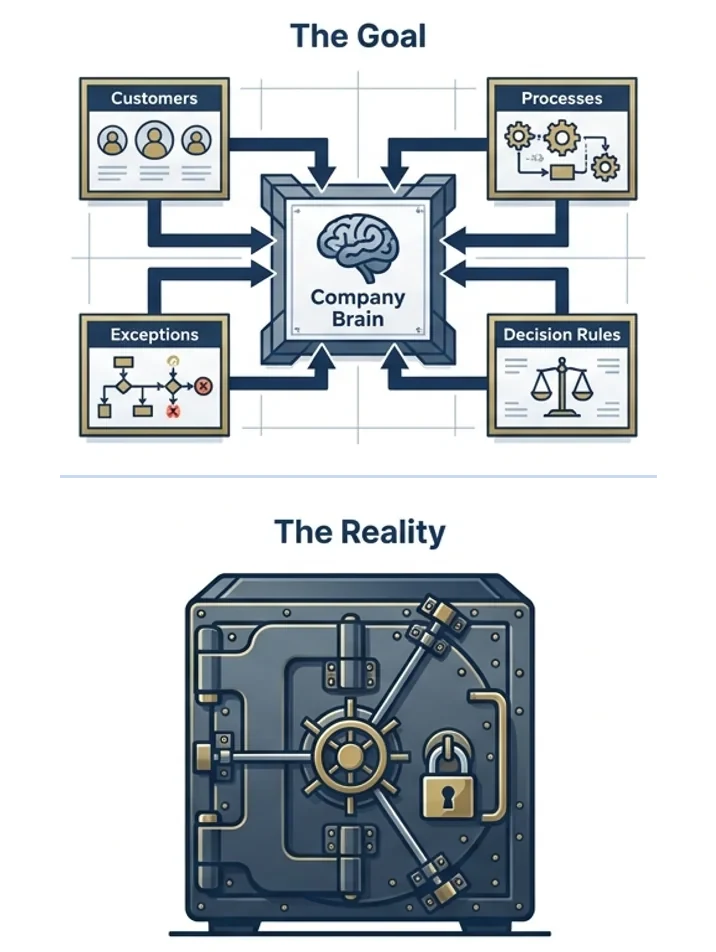
Your know-how sits in a few heads.
Your key people carry the exceptions, the customer history and the workarounds. Little of it is written down, and a buyer will ask what happens when they leave.
Why it stalls
Good people say yes and share little.
Asked to document what makes them hard to replace, good people say yes politely and share very little. Research shows that hesitation is rational.
What changes
Sharing becomes the safer choice.
The company captures the playbook. Your people keep visible credit as the named experts. The reward is tied to the sale, so quality counts more than volume.
Why people hold back
Three reasons good people keep what they know
They feel the knowledge is theirs
Ownership of what they know leads to hiding.
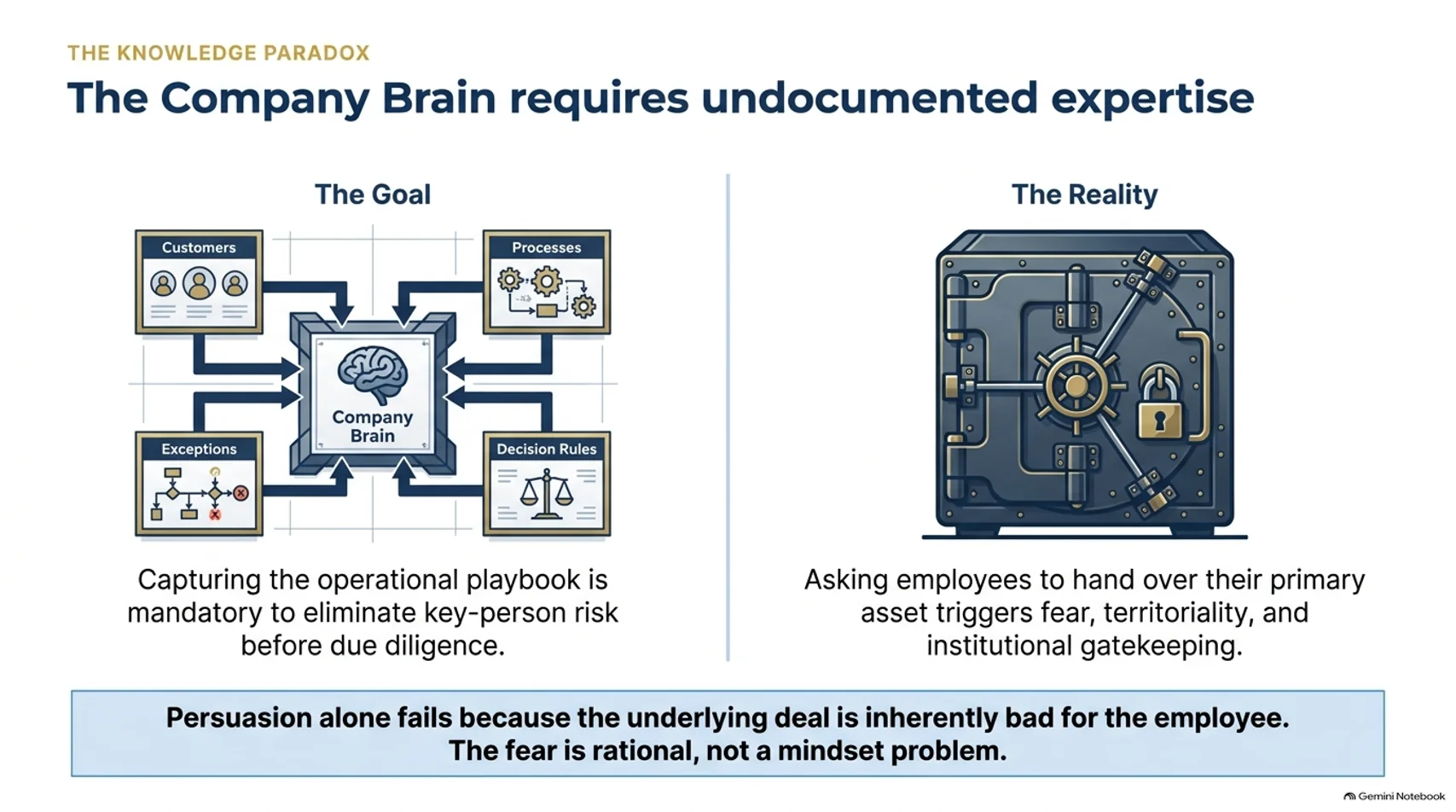
People who feel their knowledge belongs to them hide more of it. The effect disappears when they also feel ownership of the organization itself.
Source: Peng 2013, Journal of Knowledge Management
They worry about their jobs
Job insecurity lowers safety, and sharing with it.
In a study of 365 employees, job insecurity lowered psychological safety, and lower safety led to more knowledge hiding. Supportive, serving leadership softened the effect.
Source: Jeong, Kim and Lee 2023, Frontiers in Public Health
AI raises the stakes
More than a third gatekeep to protect their jobs (Adaptavist, 2025).
In a survey of 4,000 knowledge workers in four countries, 35% said they gatekeep knowledge to protect their jobs, and 38% were reluctant to train others in their strengths.
Source: Adaptavist survey, reported by Workplace Journal, 2025
What it means for you
The request itself has to change.
The fear makes sense, so a motivating speech leaves it in place. The request itself has to change, and that is what the Contributor Deal does.
What to leave out
Why a bonus per entry backfires
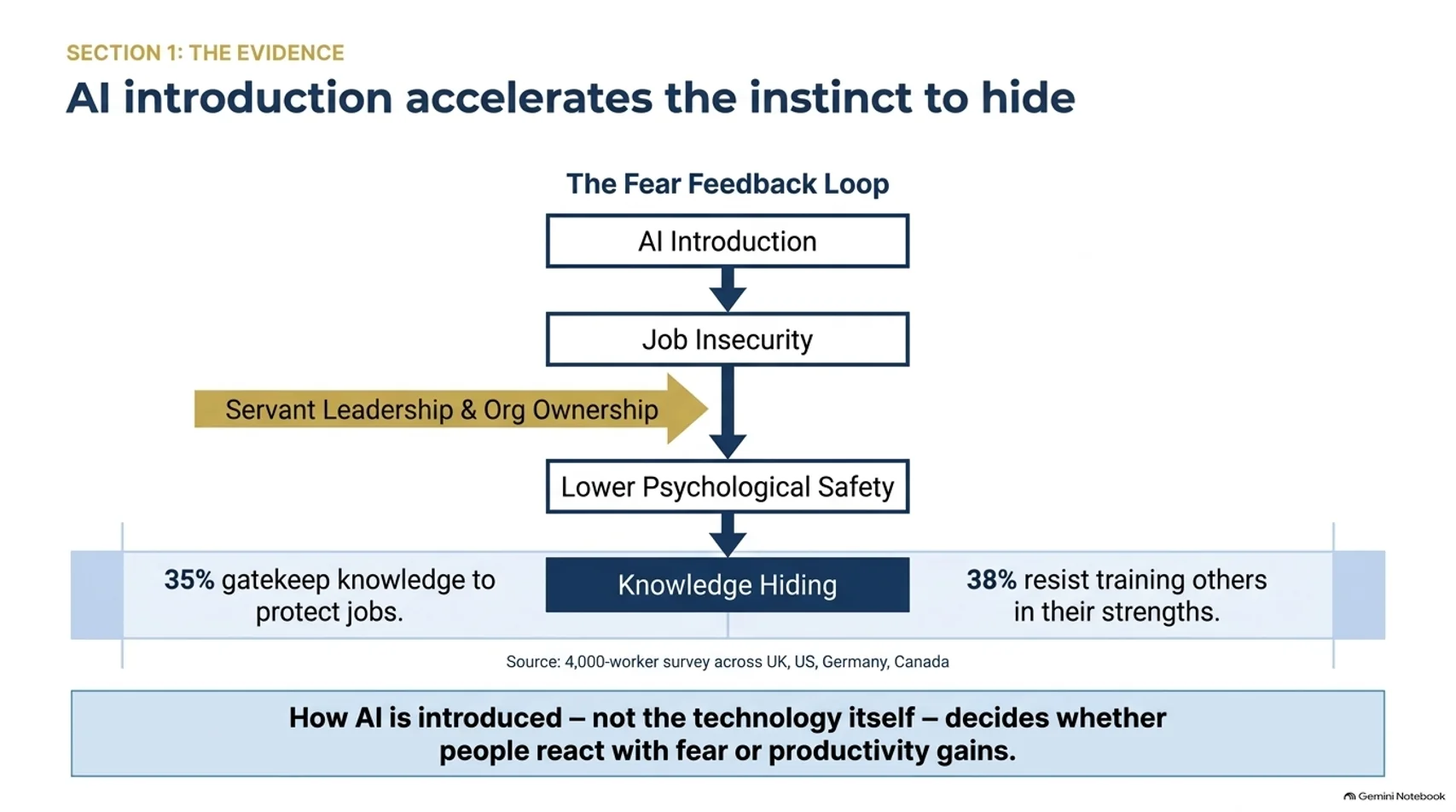
Rewards for every contribution feel fair, yet research shows they make people share less, and they reward volume over quality.
What the research shows
Most owners reach for a motivating kickoff or a reward for every contribution. In a field study of 154 managers across 27 organizations, expected rewards weakened people's attitude toward sharing knowledge, while expected help in return strengthened it. Later research found that rewards for sharing crowded out people's own motivation and harmed helpful behavior between colleagues.
Per-entry bonuses and leaderboards also reward volume. A Company Brain full of quick, shallow entries is exactly what a buyer's due diligence team will discount.
Sources: Bock, Zmud, Kim and Lee 2005, MIS Quarterly; Lombardi et al., What money cannot buy
The Contributor Deal
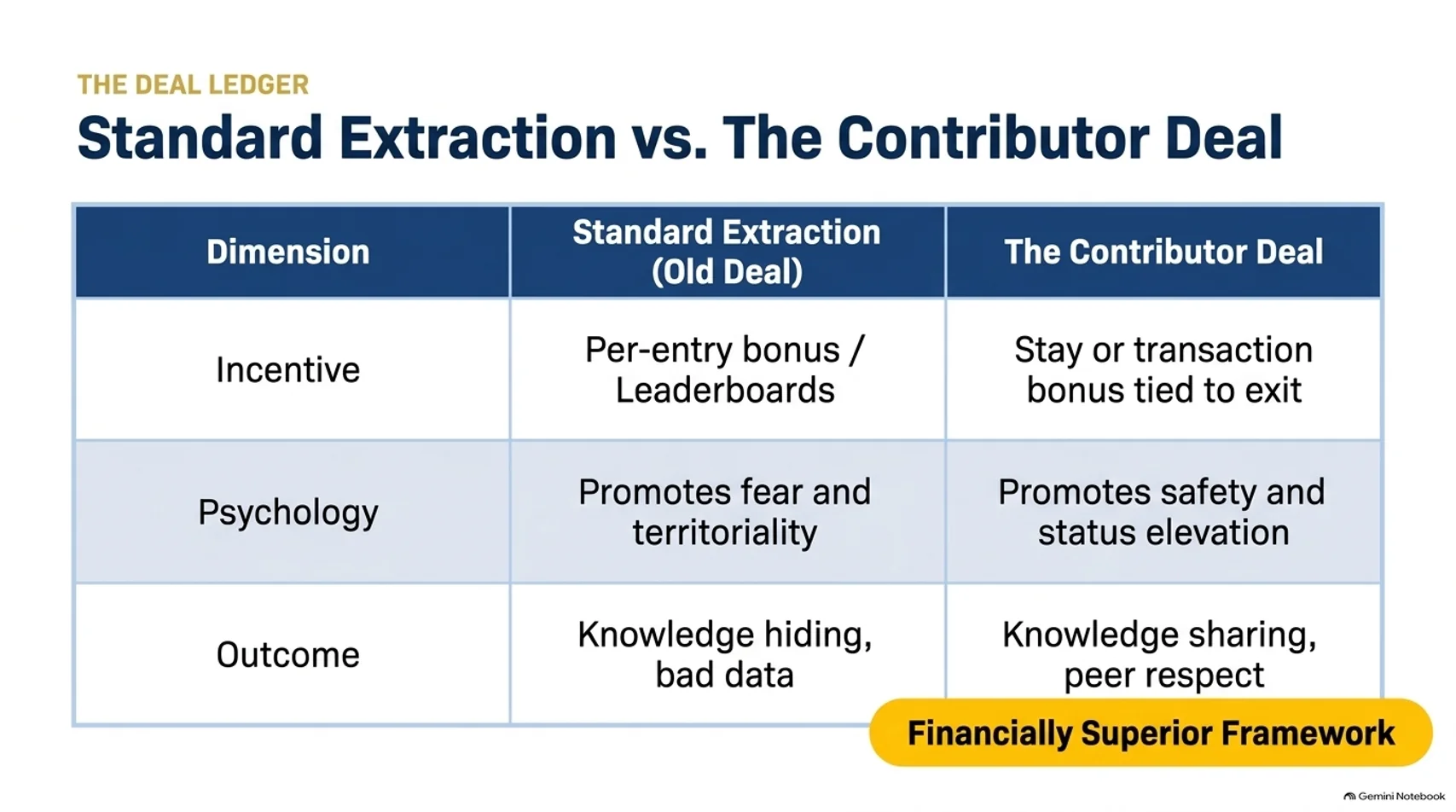
Three new terms for the request
The company captures the playbook
Customers, processes, exceptions and decision rules go into the Company Brain, so the business keeps what it knows.
Your people keep the credit
With their agreement, entries carry the expert's name. Routine questions go to the Company Brain, hard cases still go to the expert.
The reward comes from the exit
Recognition is tied to the sale and to a knowledge-transfer milestone, so quality matters more than volume.
Seven principles
How to put the Contributor Deal into practice
Each principle makes sharing the safer choice for your people. Open any one for the detail.
1. Capture the business, keep people out of scope
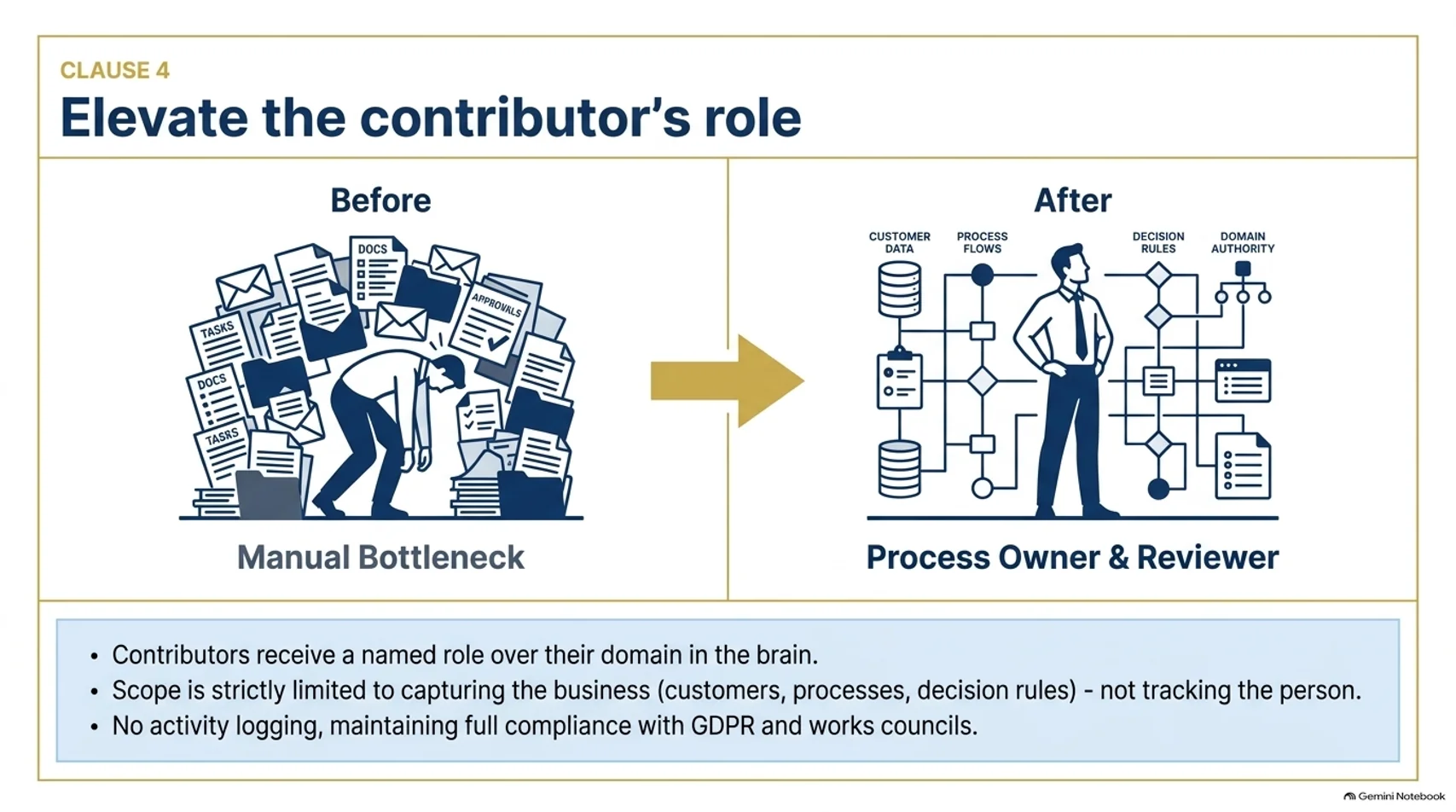
Put the scope in writing: customers, processes, exceptions and decision rules. Performance scoring and activity logging stay out. That keeps the Company Brain clear of purpose creep and, where a works council exists, of co-determination over systems that monitor behavior or performance.
2. Give before you take
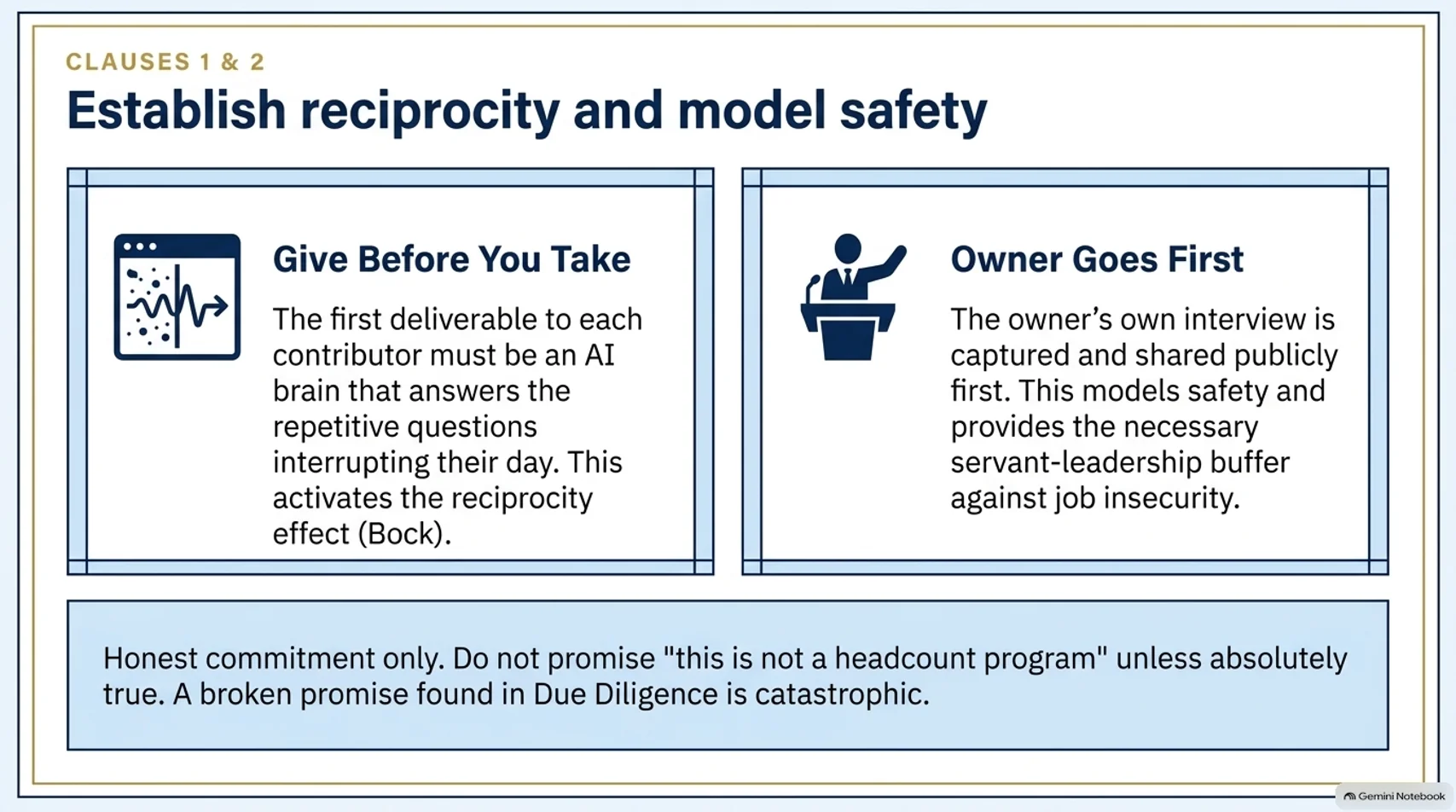
The first thing each contributor gets is relief. Ask which questions people bring to them over and over, capture those first, and let the Company Brain answer them. People share when they expect something back.
3. The owner goes first, publicly
Your own interview is captured and shared with the team before anyone else's begins. It shows the request is safe, and it is the serving leadership the job-insecurity research points to.
4. Give the expert visible credit
With the expert's agreement, every entry carries their name, for example "Expert: Anna, logistics exceptions." Name credit is optional and can be withdrawn. Routine questions go to the Company Brain and hard cases route back to Anna. Colleagues repay knowledge sharing with respect, especially when the contributor is competent, and attribution makes that respect visible.
Source: Tang, Lai and Chen 2024, The Learning Organization
5. Elevate the role
Contributors receive a named role over their area, such as Process Owner, including final review of every entry in it. They move from bottleneck to senior authority.
6. Reward at the deal level
Tie recognition to milestones that matter: a stay or transaction bonus for key contributors, linked to closing and to a knowledge-transfer milestone. Advisors report stay bonuses commonly range from 25% to 100% or more of annual pay for the people most critical to the business.
Source: Rehmann, M&A transactions: five tips for retaining key employees
7. Tell your people only what is true
Your first duty is to your own people: never tell them something that is not so. If you cannot honestly say that no jobs will change, leave that sentence out and tell them what you can honestly promise.
A broken promise, found by the team after the sale or by a buyer in due diligence, costs far more trust than an honest silence.
Three things to avoid
Mistakes that cost trust you cannot buy back
- Covert capture. Keystroke or screen logging to train AI agents destroys trust the moment it is discovered and carries significant legal risk.
- Skipping the works council. Where one exists, it has a say over systems able to record behavior or performance before rollout. Going ahead without agreement invites an injunction.
- Per-entry bonuses or leaderboards. They reward volume, crowd out the motivation you need, and fill the Company Brain with entries a buyer will discount.
What it does for the value of your business
What a buyer sees
Before the Contributor Deal
The know-how sits with a few long-serving people. A buyer has to price in the risk that they leave, and may ask for retention terms to protect what they are buying.
After the Contributor Deal
The playbook is captured, reviewed and credited to named experts who have a reason to stay through the sale. A buyer sees knowledge that transfers, and people motivated to help it transfer.
Why buyers also pay to keep your people
Buyers also pay to keep the people who carry the knowledge. Retention costs are usually small compared to losing the know-how a business may need to hit post-closing earnouts.
Source: Lowenstein Sandler, Sell your company, not your employees
Getting started
Your first four weeks with the Contributor Deal
- 1
Write the scopeWeek 1
Put on one page what is captured (customers, processes, exceptions, decision rules) and what is left out. Where a works council exists, involve it now.
- 2
Go firstWeek 2
Record your own interview and share it with the team, so everyone sees what the request looks like.
- 3
Start with the repeat questionsWeek 3
Ask each key person which questions they answer over and over. Capture those first, credited to them.
- 4
Name the roles and the rewardWeek 4
Give each contributor a named role over their area, with final review of its entries, and agree with your advisers how key people share in the sale milestone.
Prefer to start small?
The Company Brain can begin with you alone, then your key people, then the whole business.