
The Company Brain Checklist: 9 Things a Business Owner Can't Skip
A startup builds its brain for itself.
An owner with staff, customers and a future buyer needs a few more parts.
You have built a business where the most valuable answers still sit in a few heads. Yours, and those of two or three people you would hate to lose.
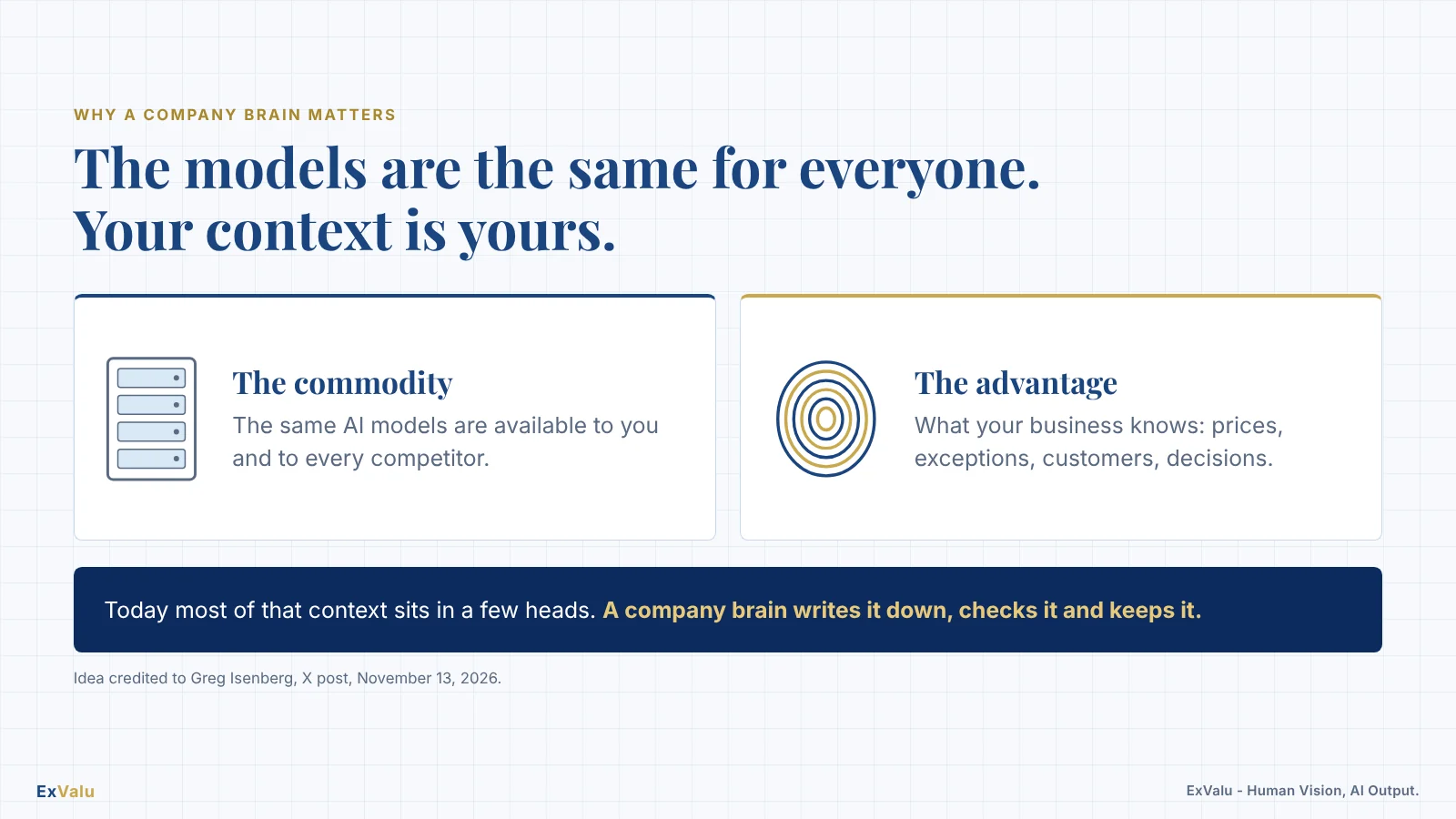
This week Greg Isenberg, host of The Startup Ideas Podcast, posted a 49-point list for running a company on AI. It's a great list, and his closing idea is the one I keep coming back to: the models are the same for everyone, and "your context is the only part that's yours."
I agree.
I read the list twice.
Once as a builder, and once the way corporate finance taught me to read a business: as the person who has to buy it.
Read by the owner of a company with 20 to 200 people, the list needs nine more parts. Here they are, followed by what you can do in the next 30 days.
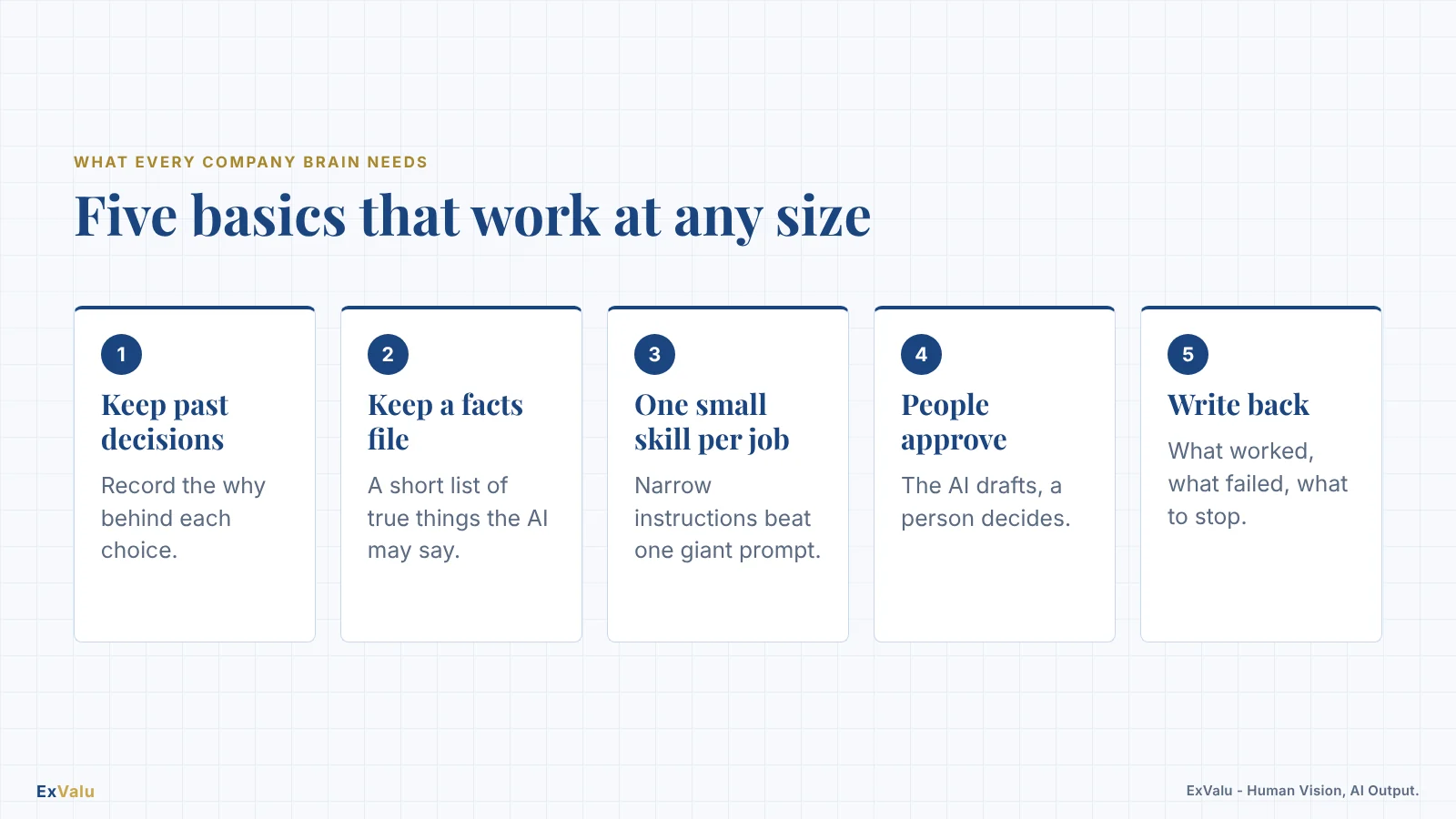
Five of his points matter to every owner, whatever the size of the business:
Keep past decisions and why you made them. The reason behind a price or an exception is the part that leaves first.
Keep a facts file. A short list of true things the AI is allowed to say stops made-up claims.
One small skill per job. A narrow, boring instruction beats one giant prompt.
People approve and own the outcome. The AI drafts, a person decides.
Every finished job writes back. What worked, what failed, what to stop doing.
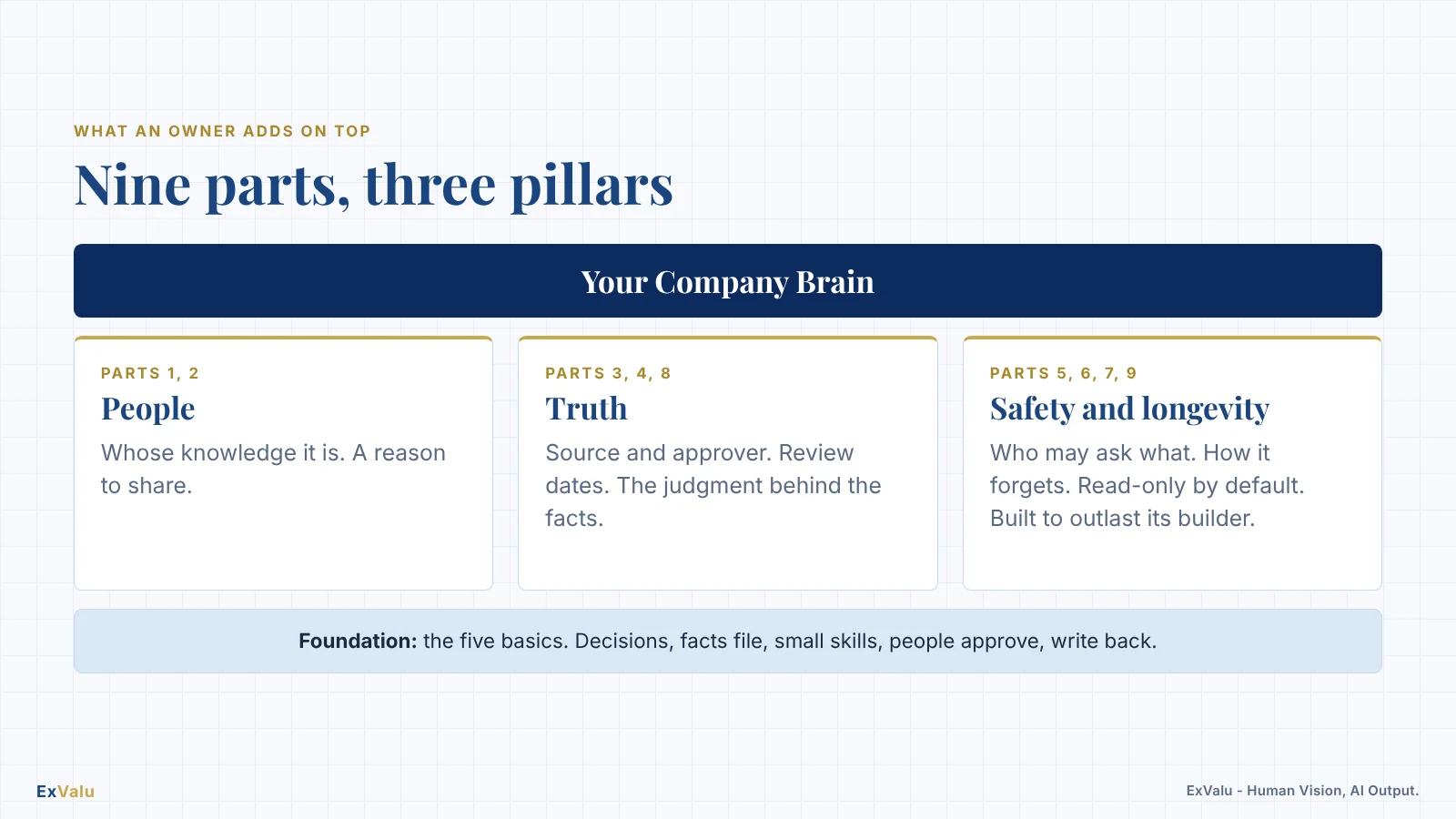
We build the Company Brain on the same ideas. The nine parts below are what we add when the brain belongs to a company with staff, customers and, one day, a buyer.
The 9 parts an owner's company brain needs on top
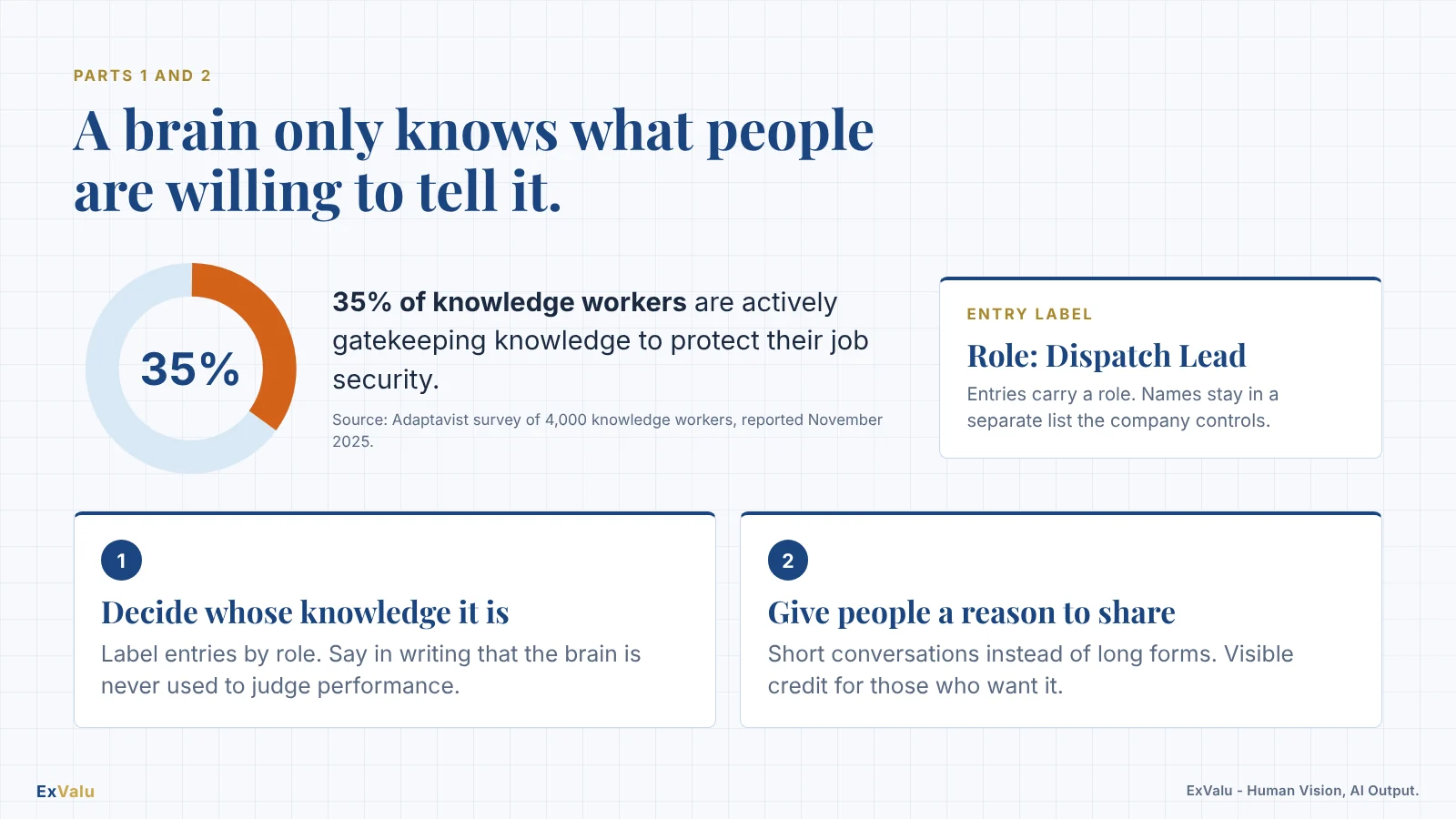
1. Decide whose knowledge it is
A solo builder's brain holds one person's thinking. Yours will hold what your staff know about customers, prices and exceptions, and records about named people count as personal data in most countries.
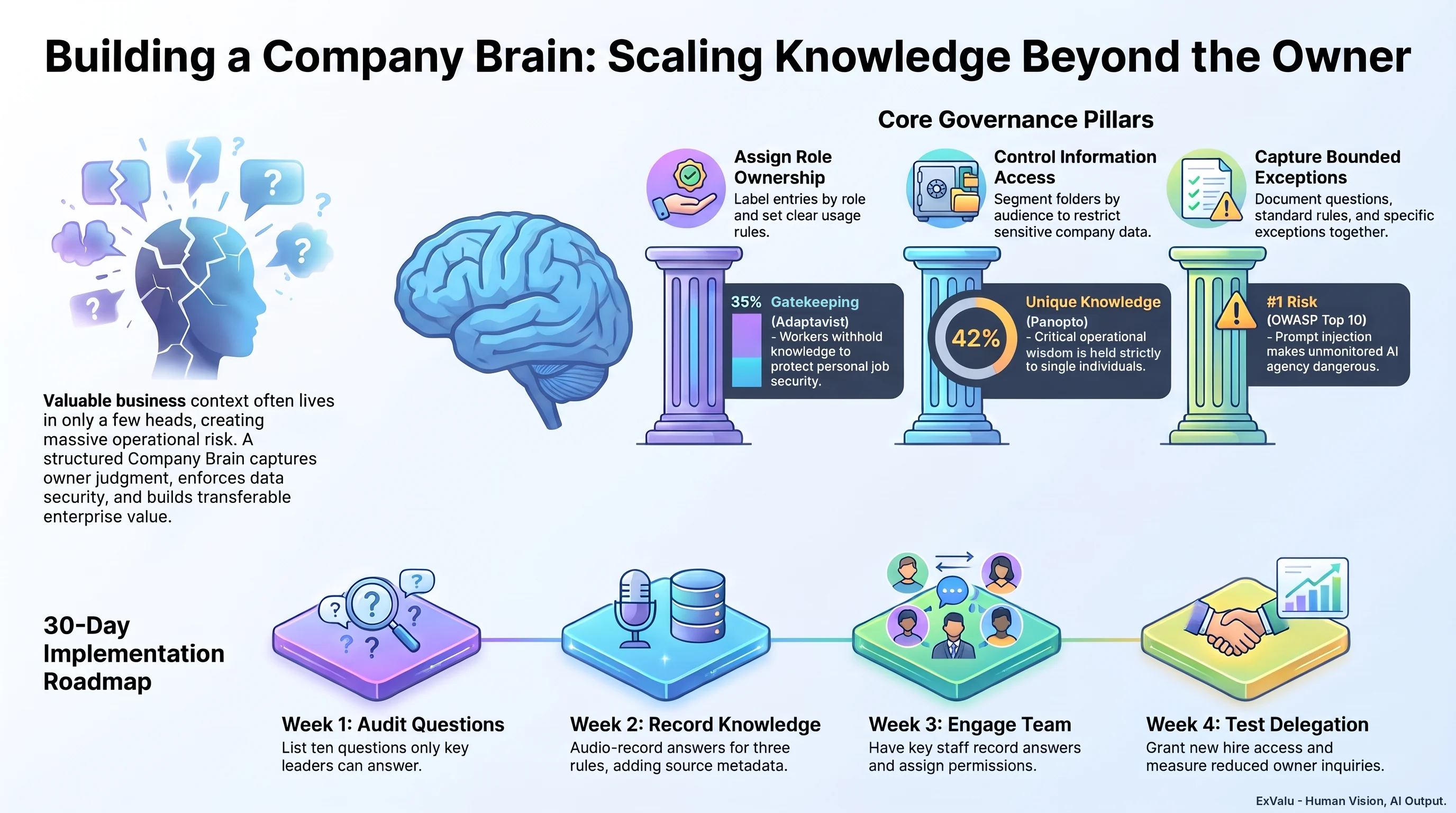
What to do: label entries by role, such as Dispatch Lead, and tell your team before you start what the brain is for and what it will never be used for, such as judging performance.
2. Give people a reason to share
A survey of 4,000 knowledge workers by Adaptavist found that 35% are actively gatekeeping knowledge to protect their job security. A brain only knows what people are willing to tell it.
What to do: put in writing what the brain is for, give contributors visible credit if they want it, and ask for their judgment in short conversations instead of long forms.
3. Give every fact a source and an approver
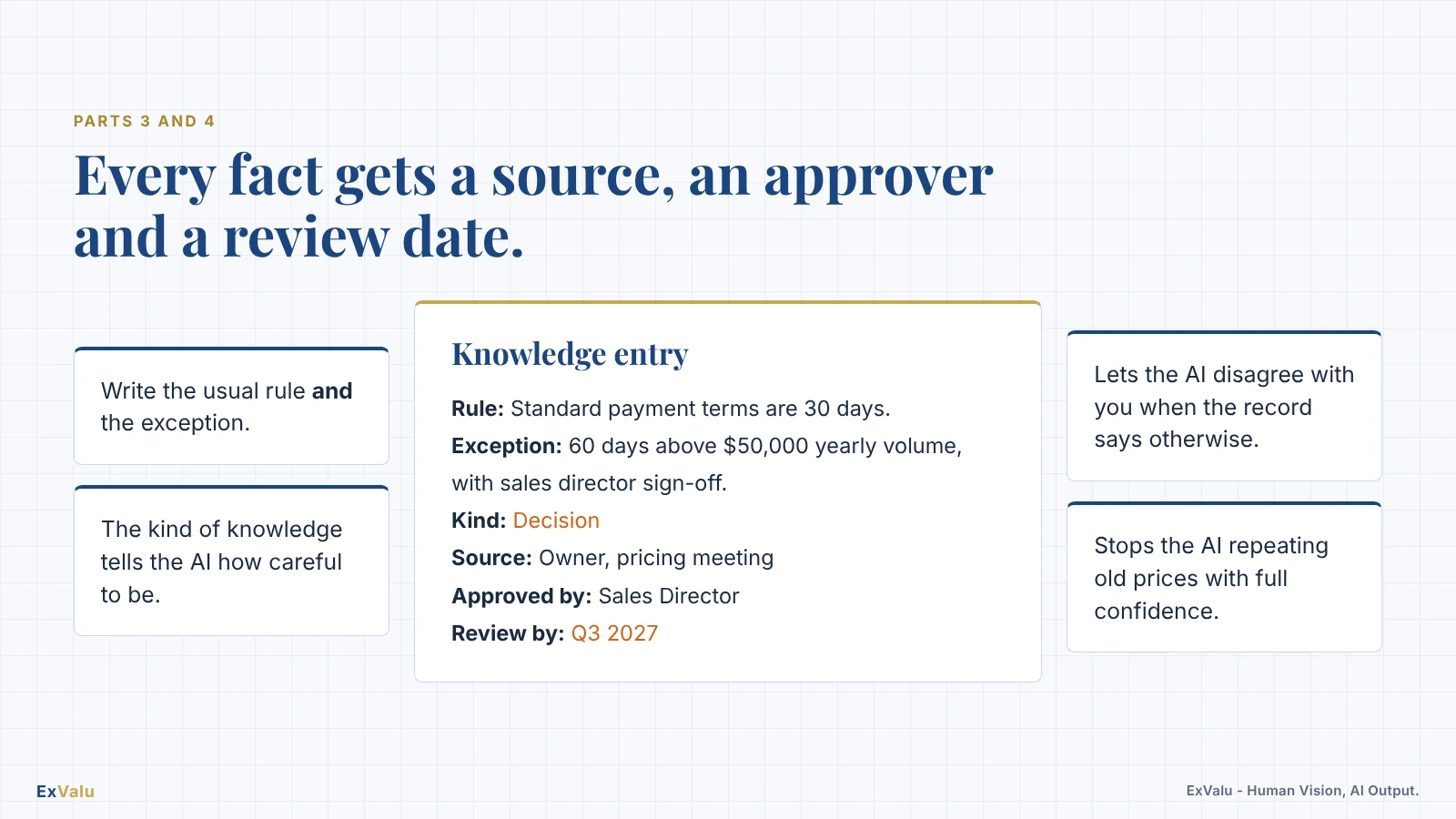
A facts file is a strong start. In a company, each entry also needs to say where it came from, who approved it, and what kind of knowledge it is: a document, an expert's view, an assumption, a decision or an open question.
What to do: add those three fields to every entry. It is also what lets the AI disagree with you when the record says otherwise, which we wrote about in The AI Yes-Man Problem.
4. Give every fact a review date
Prices change, terms change, people change roles. An entry without a review date ages quietly, and the AI keeps repeating it with full confidence.
What to do: name one reviewer per area and give each entry a review date. Once a quarter, the reviewer confirms, updates or retires what is due.
5. Decide who may ask what
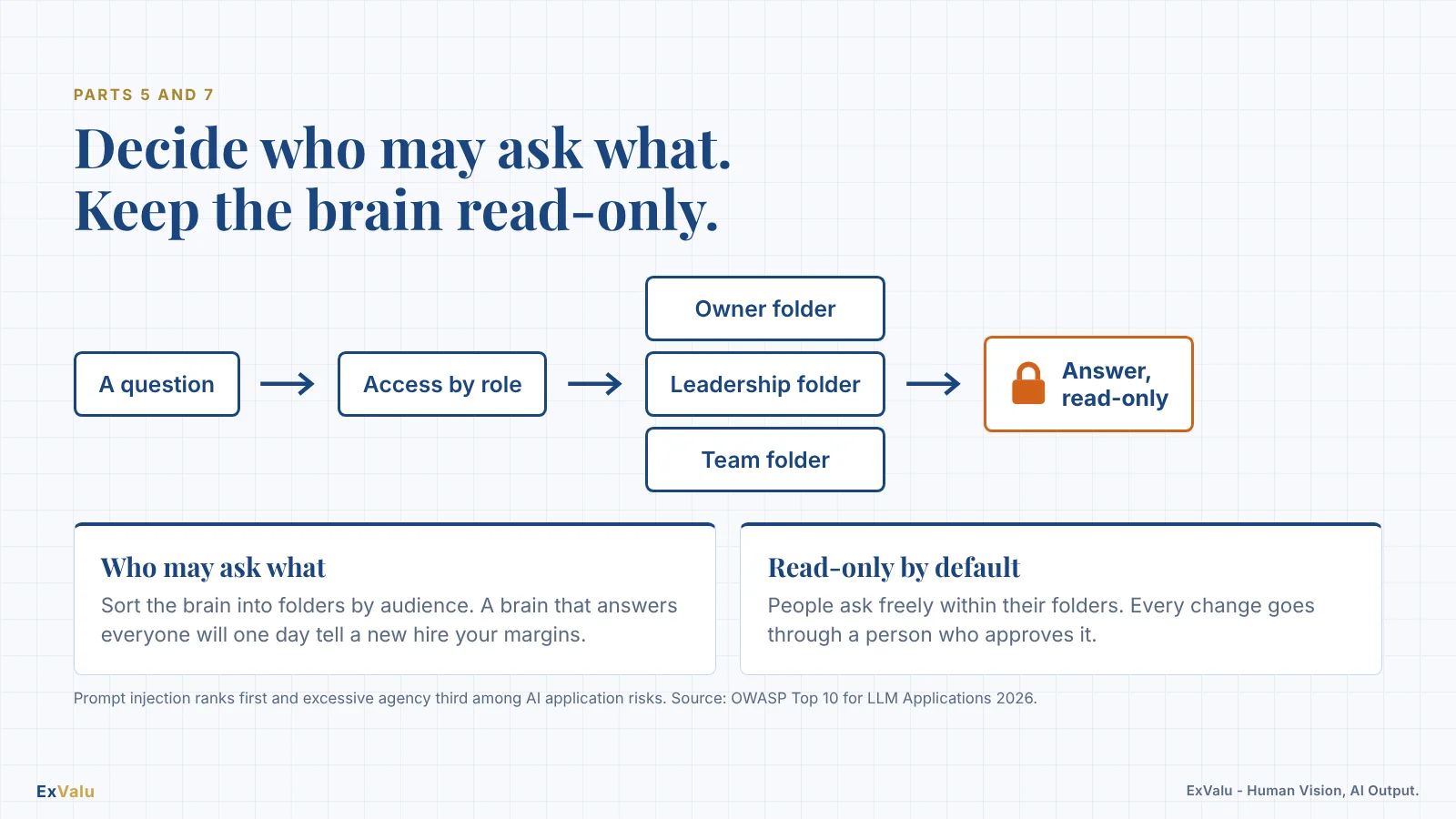
A brain that answers everyone will one day tell a new hire your margins, a colleague's salary or a customer's special terms.
What to do: sort the brain into folders by audience, for example owner, leadership and team, and give each person access only to their folders.
6. Plan how it forgets
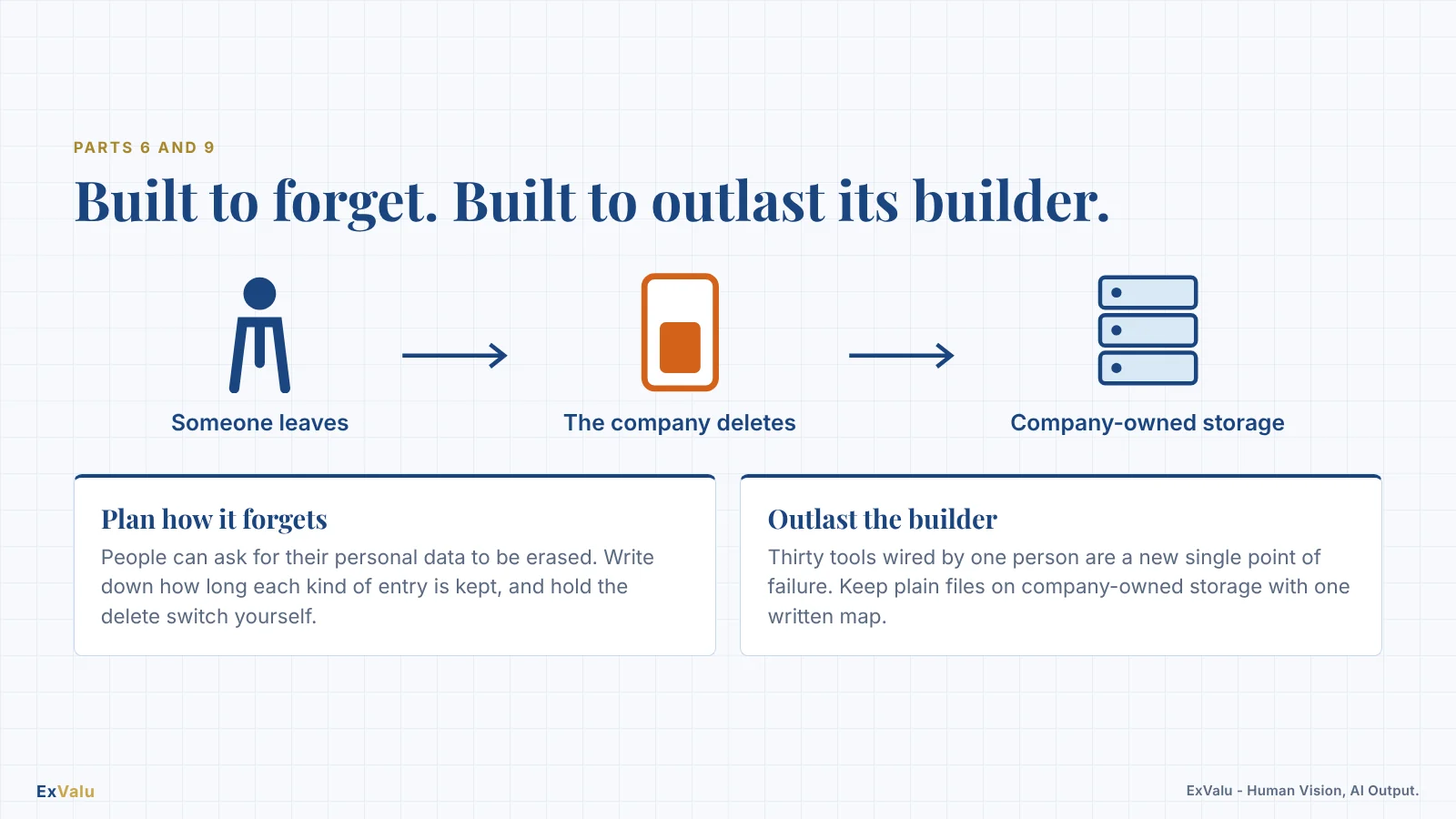
People leave, and in many countries they can ask for their personal data to be erased (for example GDPR Article 17). A brain that cannot forget becomes a liability.
What to do: write down how long each kind of entry is kept, and make sure your company holds the delete switch itself.
7. Keep the brain read-only by default
Greg's list gives agents the power to act in email, payments and code. The OWASP Top 10 for LLM Applications 2026 ranks prompt injection first and excessive agency third among the risks of AI applications.
What to do: let your people ask the brain anything they are allowed to see, and route every change through a person who approves it.
8. Capture the judgment behind the facts
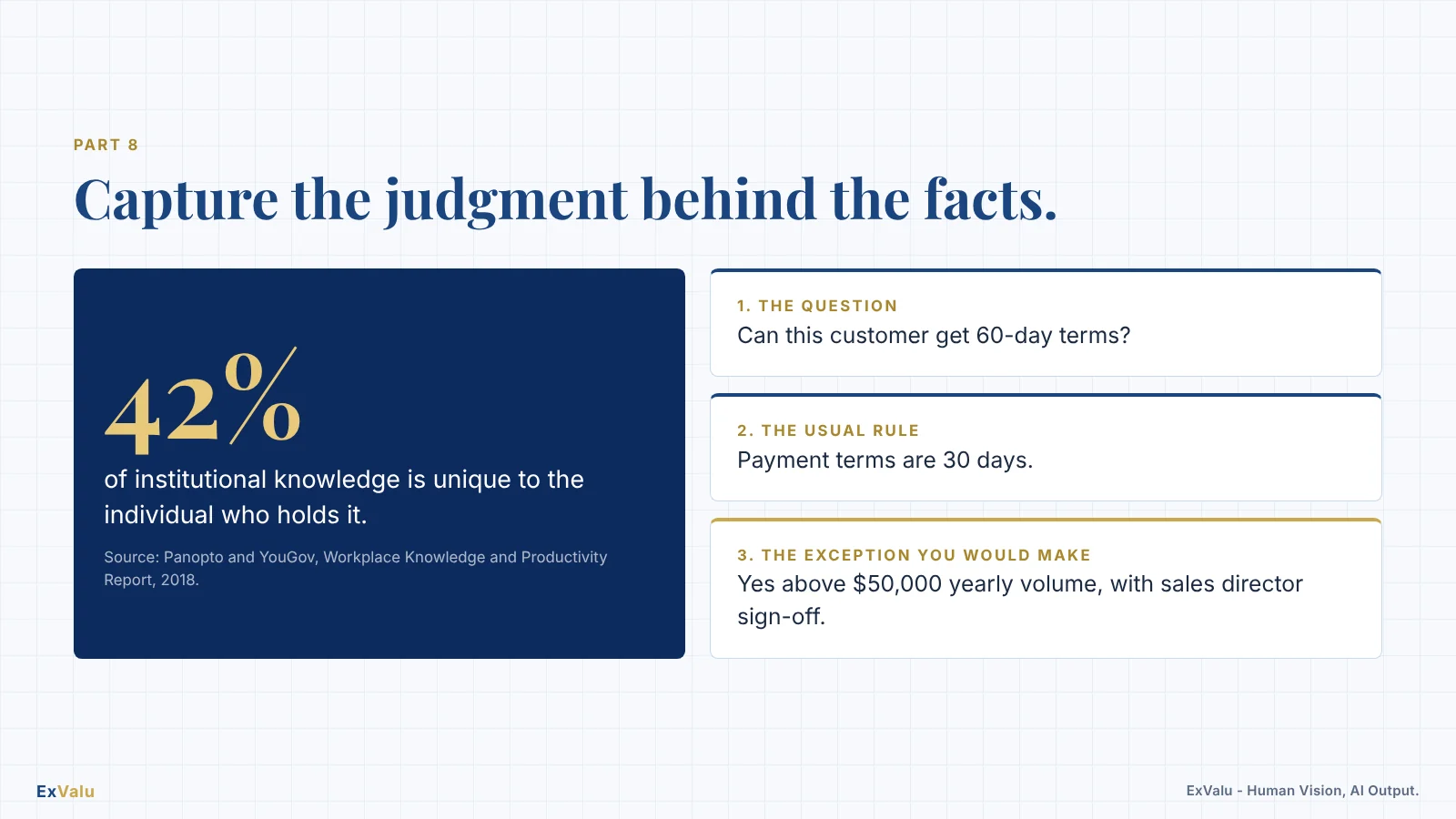
Panopto and YouGov found that 42% of institutional knowledge is unique to the individual who holds it. Most of it is judgment: when the rule bends, and why.
What to do: for each important question, write down three things. The question, your usual rule, and the exception you would make.
9. Build it to outlast the person who built it
A stack of 30 tools wired together by one person creates a new single point of failure. A buyer looks at that the same way they look at an owner who cannot step away.
What to do: keep the brain in storage your company owns, in plain files with one written map of how it is organized. Then measure what matters to you and to a buyer: how many questions still only you can answer, and how long a new hire takes to work on their own.
Your first 30 days building your Company Brain
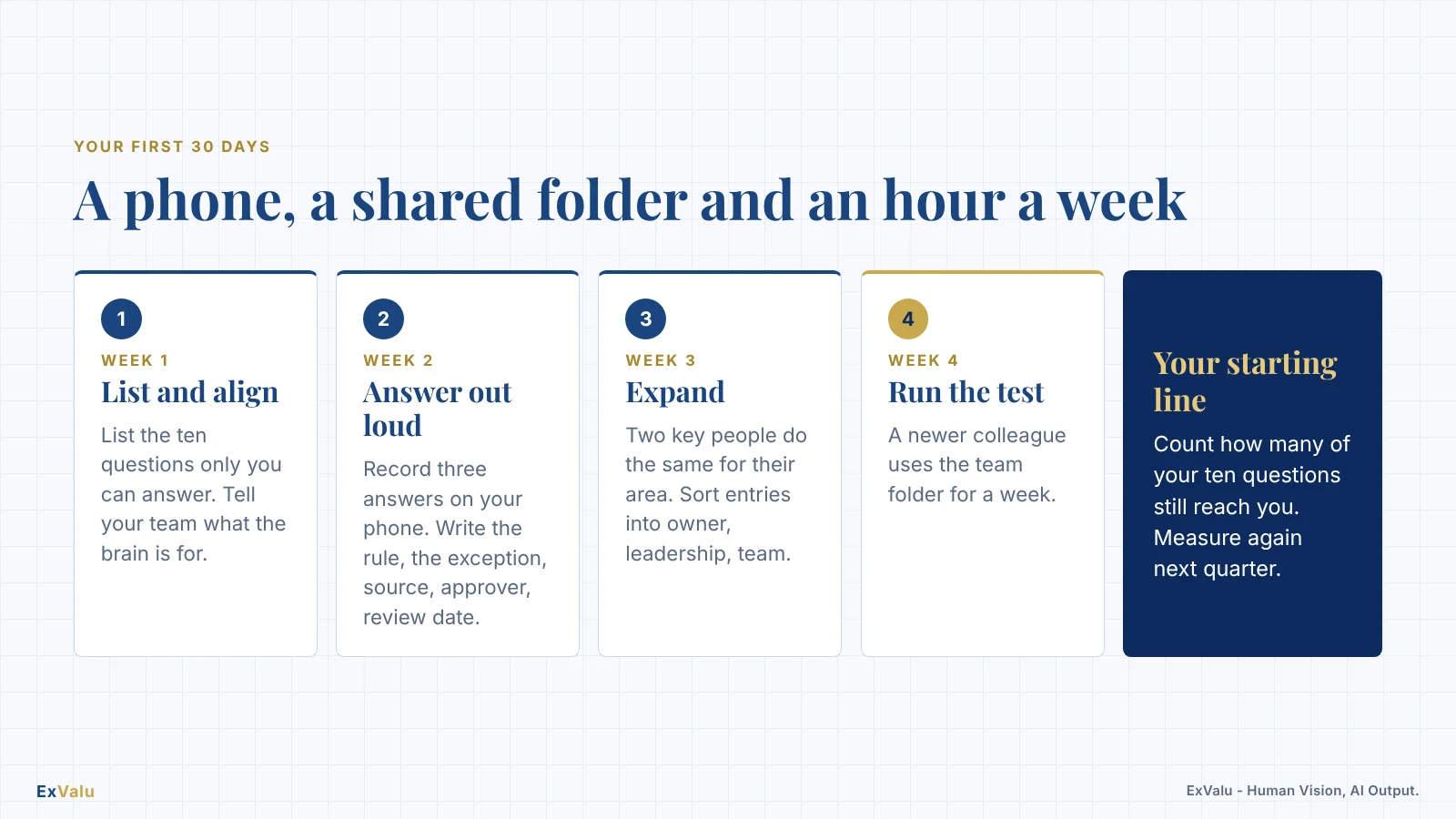
You can start this month with a phone, a shared folder and an hour a week.
Week 1: list the ten questions only you can answer. Pricing exceptions, the difficult customer, the supplier you call when something breaks. Then tell your team in one meeting what you are building, what it is for and what it will never be used for.
Week 2: answer three of them out loud. Record yourself on your phone. For each, write down the question, your usual rule and the exception. Add a source, an approver and a review date.
Week 3: ask two key people to do the same for their area. Credit them by name only if they want it. Sort every entry into folders: owner, leadership, team.
Week 4: run the test. Give a newer colleague access to the team folder for a week. Count how many of your ten questions still reach you. That number is your starting line.
After day 30: keep it where your company owns it. Plain files in your own shared drive, one page that explains how it is organized, and one person who reviews it every quarter.
Want a head start? The Owner's Facts File is a free three-page template for writing down the facts only you know, each with a source, an approver and a review date.
One question to take with you
Greg is right that your context is the only part nobody can download. For an owner, the next question is whether that context still works for the business on the day you are not in the room.
Which question do your people still bring only to you?
If you would like to see how we set this up for owners, see if the Company Brain fits your business.
Sources
Greg Isenberg, X post, November 13, 2026.
Adaptavist survey of 4,000 knowledge workers, reported by Workplace Journal, November 2025.
Panopto and YouGov, Workplace Knowledge and Productivity Report, reported by HR Dive, 2018.
OWASP Top 10 for LLM Applications 2026, summarized by the Cloud Security Alliance, October 2026.
GDPR Article 17, right to erasure.
ExValu - Human vision, AI output.