How the Company Brain turns what your business knows into an asset a buyer can take over
You have built a business that runs on what you and your people know. The Company Brain keeps that knowledge, connects it, and makes it ready to hand over.
What your business knows, ready when people need it
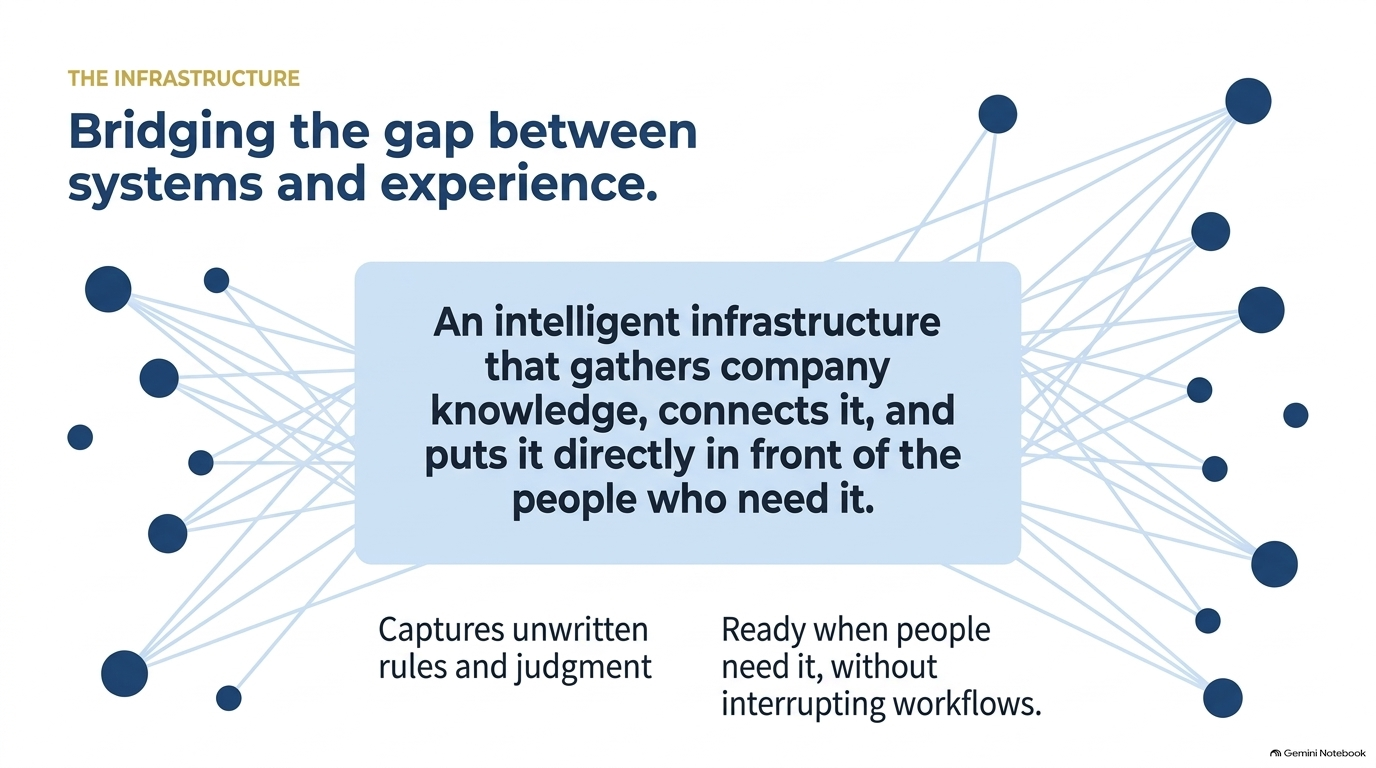
Much of what makes your business work sits in people's heads. The Company Brain gathers it, connects it, and puts it in front of the people who need it.
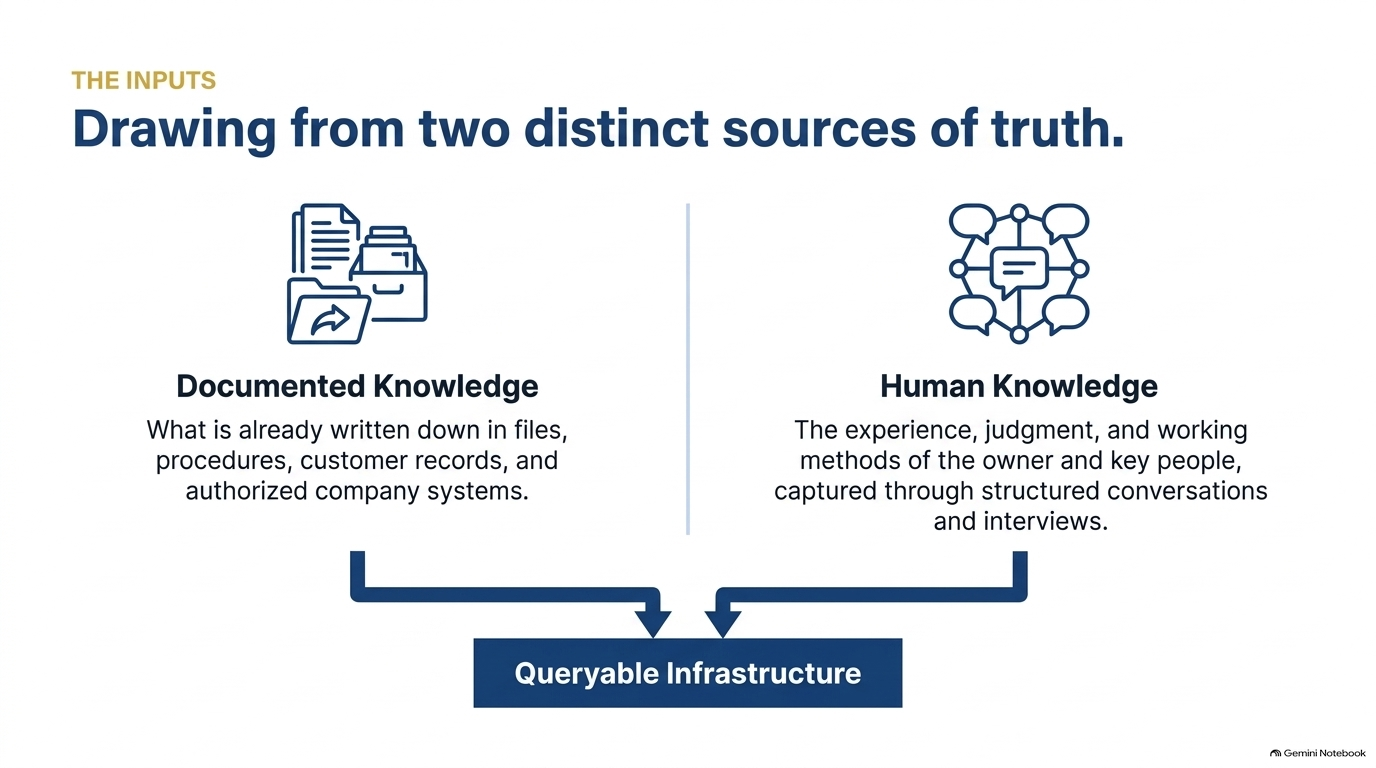
Documented knowledge
What is already written down in files, procedures, customer records and other company systems you authorize.
Human knowledge
The experience, judgment and working methods of the owner and key people, captured through structured conversations and interviews.
Where your business knowledge lives today
Every business that works builds up knowledge over the years. Some of it sits in documents, emails, procedures and systems like Microsoft SharePoint or Google Drive. Much of the most valuable part sits in people's heads: how the owner makes the big calls, how a senior employee handles the odd problem nobody else has seen, why certain customers get special treatment, what keeps a key supplier relationship working, and the unwritten rules that keep the place running.
Authorized employees and managers ask the Company Brain questions in everyday language. They get answers based on your company's own knowledge.
Ask anything, at any hour
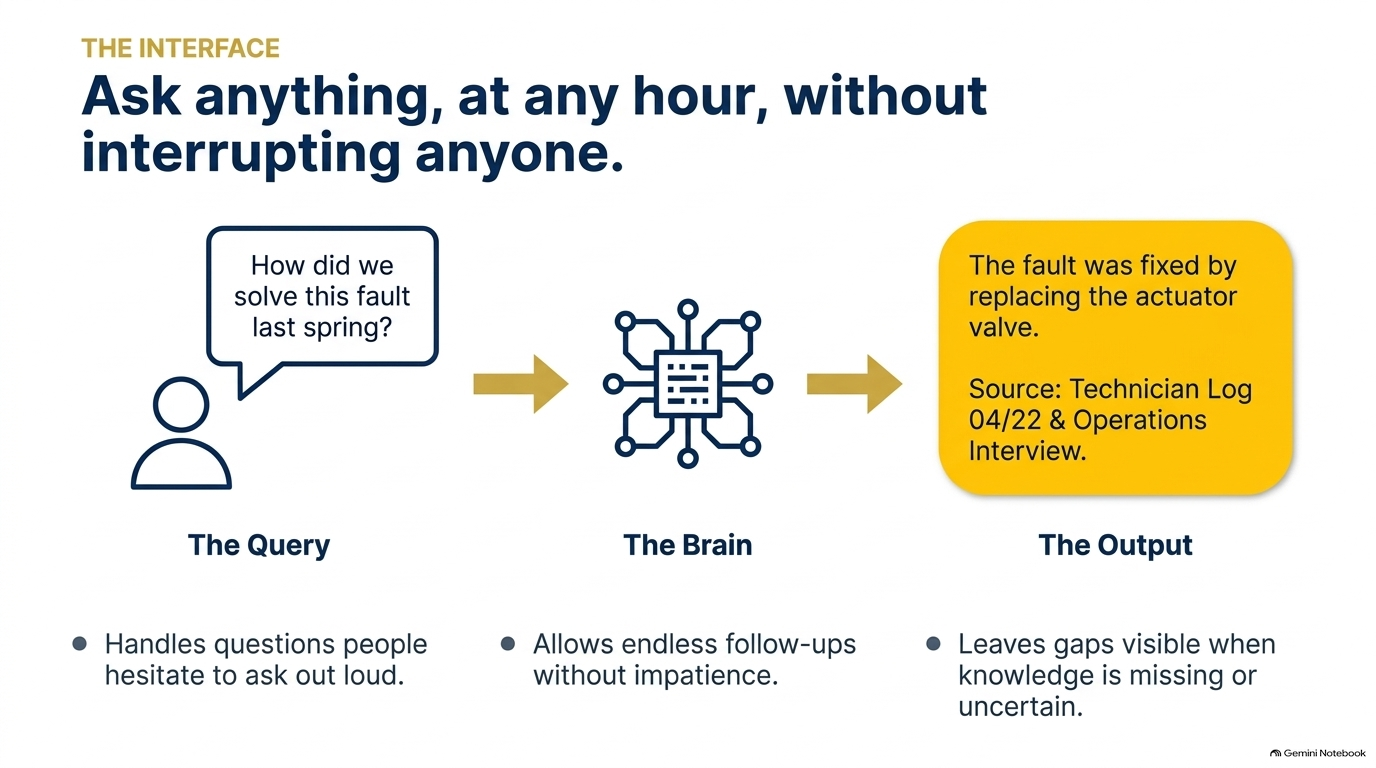
The Company Brain is there at any hour, and asking it interrupts no one. It answers and shows where the answer came from. When the knowledge is missing or uncertain, it says so.
What people ask it, and why it helps
A new employee asks how to handle a customer situation they have never seen. A manager finds out why a commercial decision was made years ago. A technician looks up how a colleague solved the same fault last spring. A new owner learns how the business runs, why things are done the way they are, and what its people have learned along the way.
People can still go to the owner or an experienced colleague, and their judgment still matters. The Company Brain gives them one more place to ask. That helps most with the questions people hesitate to ask out loud: the basic one, the one they asked last week, the one that feels awkward in front of a senior colleague. It also handles the hard questions that need knowledge from several parts of the business.
Nobody gets impatient with it. An employee can ask the same thing ten times, ask for a simpler explanation, or work through a problem one follow-up question at a time.
What the research shows about sharing experience
A 2025 study in The Quarterly Journal of Economics, "Generative AI at Work," gives a useful data point. Erik Brynjolfsson of Stanford and Danielle Li and Lindsey Raymond of MIT followed 5,172 customer-support agents as their company introduced an AI assistant.
With the assistant, agents resolved 15% more customer issues per hour on average. Newer and less experienced agents gained the most, improving both speed and quality. The most experienced agents gained a little speed and lost a little quality. The researchers also found signs that the AI spread the working habits of the best agents to everyone else.
The study looked at one AI assistant in one company's support team. It did not look at ExValu's Company Brain. What it shows is the principle: AI can give employees access to expertise they have not built up themselves.
Source: Brynjolfsson, E., Li, D., & Raymond, L. (2025). "Generative AI at Work." The Quarterly Journal of Economics, 140(2), 889-942. DOI 10.1093/qje/qjae044In an owner-led business, what your experienced people know can help everyone else do their jobs, once it is captured, organized and easy to reach.
When connected knowledge shows something new
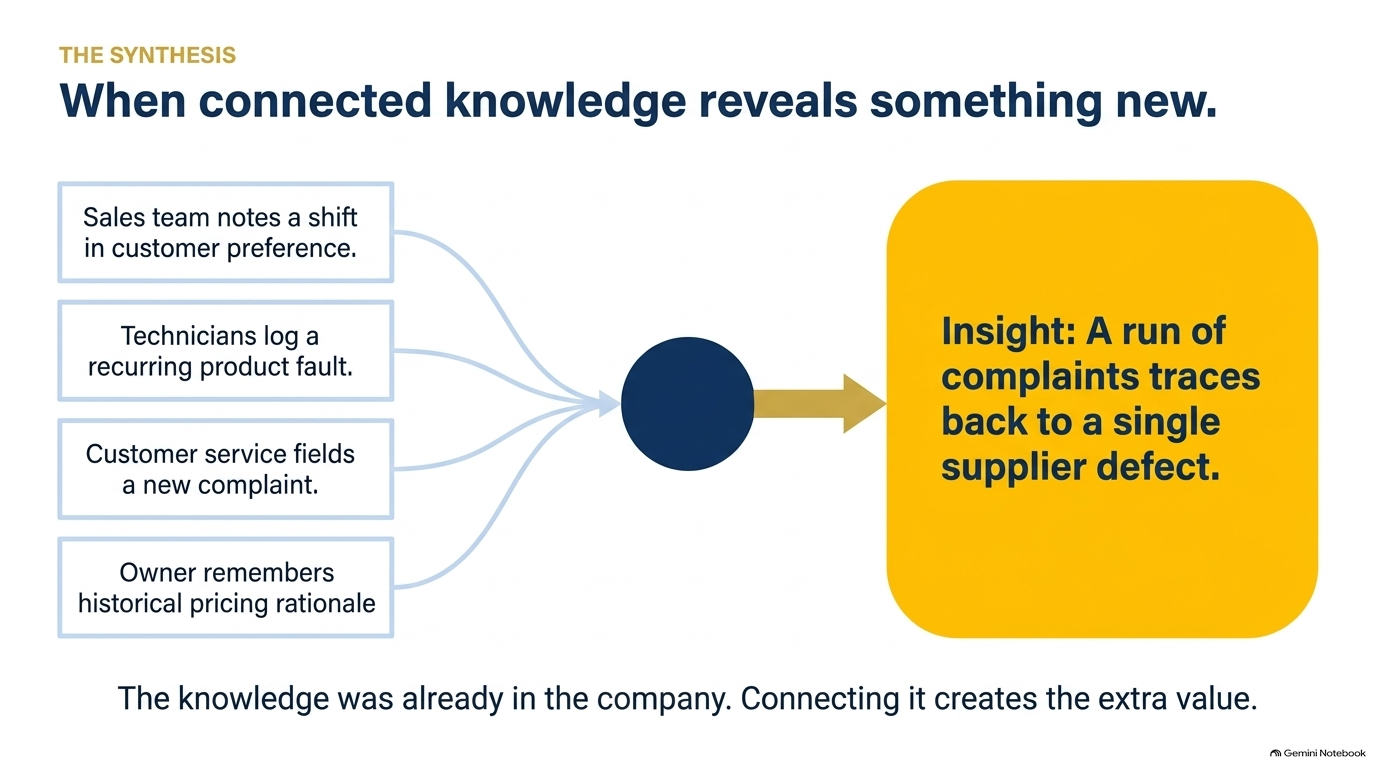
Keeping what people know is the first step. Connecting it is where things get interesting: the knowledge was already in the company, and connecting it creates the extra value.
How connected knowledge reveals patterns
Picture a company where the sales team hears customer preferences shifting, the technicians keep seeing the same product fault, customer service is fielding a new kind of complaint, and the owner remembers why the pricing was set the way it was. Each of them holds one piece.
Put those pieces together with what is already in the company's documents and systems, and patterns appear that no single person would spot. A run of complaints traces back to one supplier. A fix one technician found helps another department. A string of lost deals points to pricing, delivery or positioning.
Over time, the Company Brain can help managers look for patterns and dig into the causes of a problem. How far this goes depends on how complete and accurate the captured knowledge is, and on which analysis features are set up.
Questions you could ask it about your market
The Company Brain can also draw on selected outside sources, such as market research, competitor moves, regulatory changes, new technologies and economic indicators, and combine them with what your people know.
- Where does changing market demand meet expertise we already have?
- Which customers could use a new service because of what is happening in their industry?
- Which new regulations create needs our people already know how to meet?
- Do recurring customer problems, together with a new technology, point to a product or service we could offer?
- Which economic or market shifts could put key customers, revenue or margins at risk?
Each of these questions applies what the company already knows to a market that keeps moving.
What the research shows about AI and complex work
A second study shows both the upside and the limits. "Navigating the Jagged Technological Frontier," published in Organization Science in March 2026, tested AI with 758 Boston Consulting Group consultants on realistic consulting tasks covering analysis, creative work and business problem solving.
On tasks within the AI's capabilities, consultants using it completed 12.2% more tasks, finished 25.1% faster, and produced work rated more than 30% higher in quality.
On one complex business problem outside those capabilities, consultants using AI were 19 percentage points less likely to reach the right answer. Their answers also read as more convincing, including the wrong ones. That is why the Company Brain shows where every answer comes from and says so when the knowledge is not there.
Source: Dell'Acqua, F., et al. (2026). "Navigating the Jagged Technological Frontier: Field Experimental Evidence of the Effects of Artificial Intelligence on Knowledge Worker Productivity and Quality." Organization Science, 37(2). DOI 10.1287/orsc.2025.21838AI can make a real difference to analysis and creative work. How much depends on the task, and on whether people know where it stops being reliable. That shapes how ExValu builds the Company Brain: experienced managers keep the decisions, and whether it uncovers new commercial opportunities in a given business has to be shown in practice and measured.
For the people who share what they know
The Company Brain only works if your key people want to contribute. They are sharing what took them years to learn, so they deserve straight answers about what happens to it.
What contributors can count on
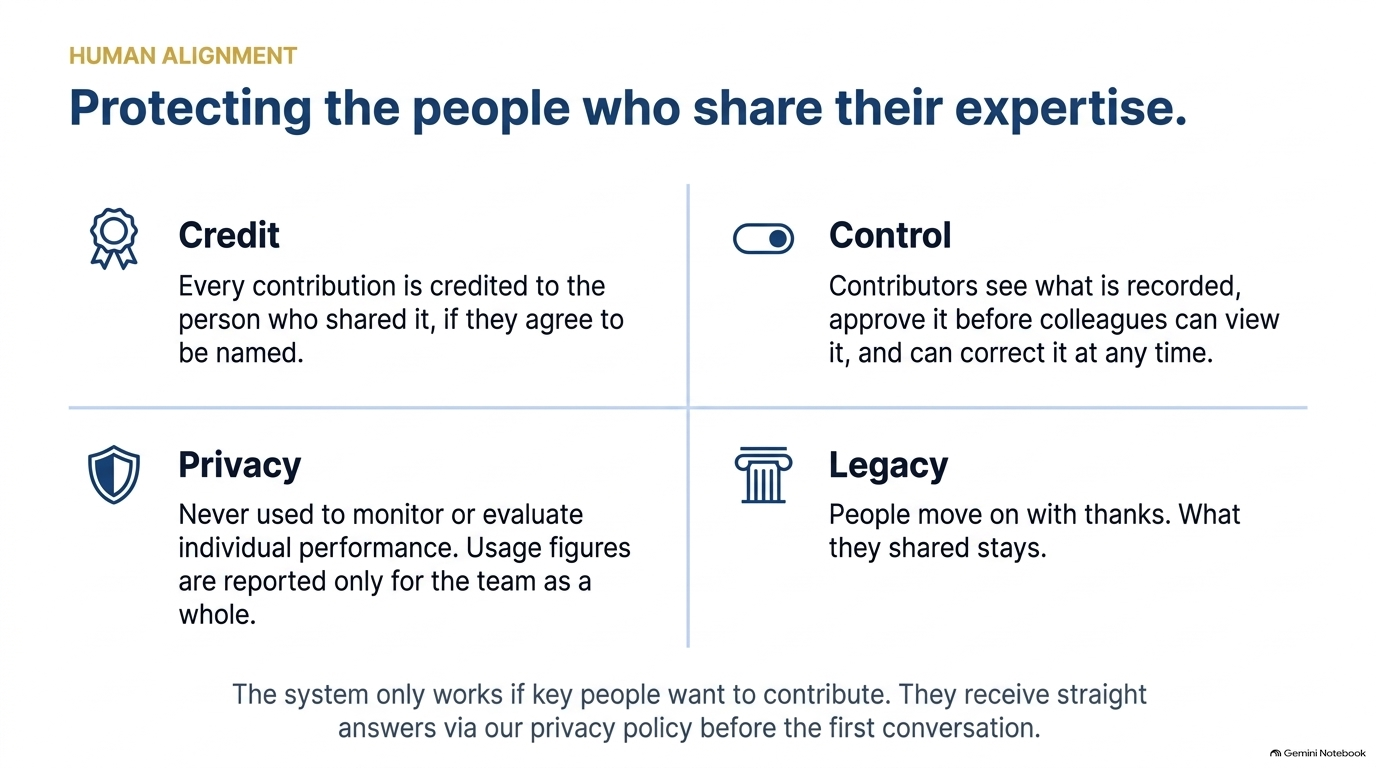
Every contribution is credited to the person who shared it, if they agree to be named. Contributors see what is recorded from their conversations and approve it before colleagues can ask about it, and they can correct it at any time. The Company Brain captures how the work is done and why. It is never used to monitor or evaluate anyone's performance, and usage figures are only reported for the team as a whole.
The Company Brain takes routine questions off experienced people's desks, so they spend more of their time on the work only they can do. Before the first conversation, every contributor learns what is captured, for what purpose, who can see it and how long it is kept. The details are in our privacy policy.
Keeping the knowledge up to date
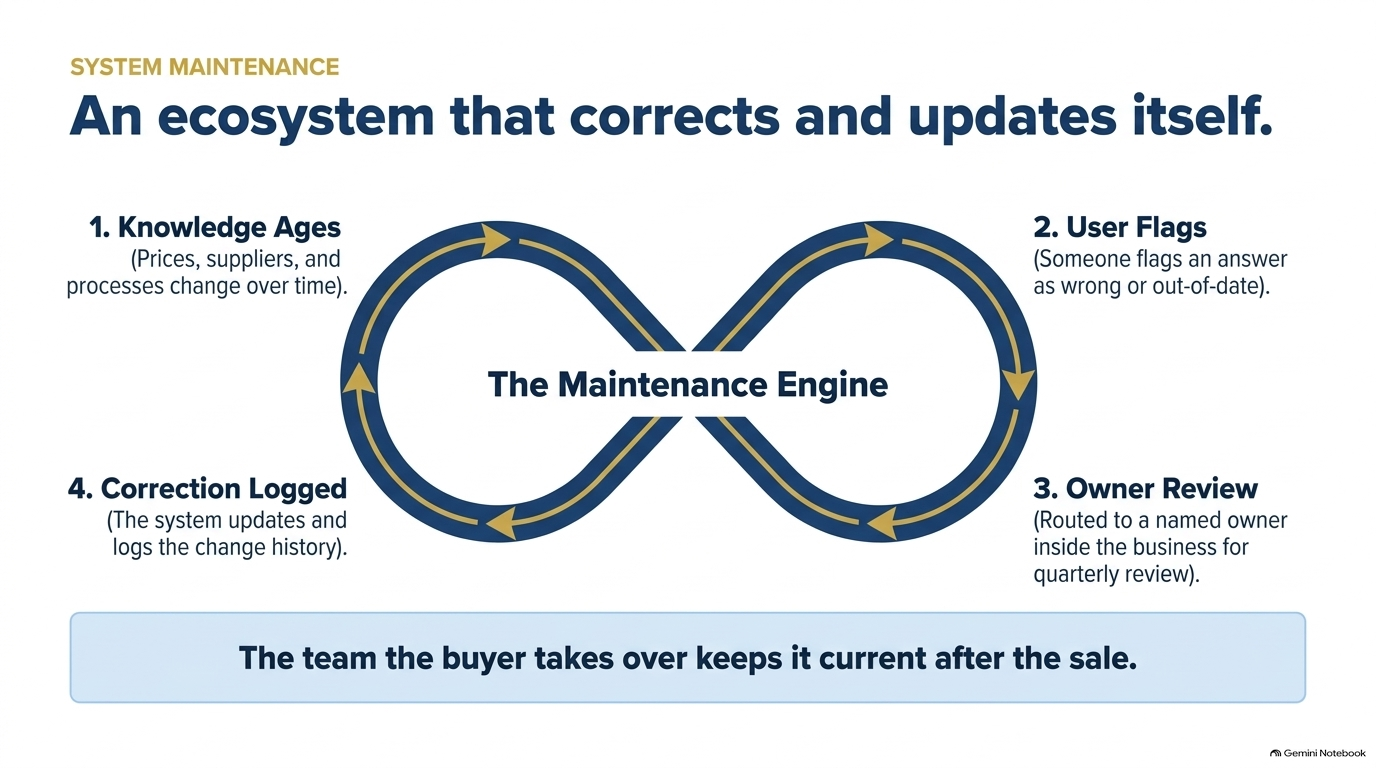
Each area of the Company Brain has a named owner inside the business who reviews its entries every quarter. The team the buyer takes over keeps it current after the sale.
How corrections work
Knowledge ages. Prices change, suppliers change, processes improve. When someone flags an answer as wrong or out of date, it goes back to the owner of that area, gets corrected, and the correction is logged.
What this means for a buyer
A buyer sees value in two places.
Lower risk
Knowledge that used to depend on the owner or a few key people becomes documented, accessible and transferable. That supports continuity, shortens onboarding and handover, and reduces uncertainty around the change of ownership.
Room to grow
A company that uses its collective knowledge to improve operations, solve problems and respond to market changes is in a stronger position to protect margins, grow revenue and scale.
That matters when the business is sold. Without it, buyers often price in the risk that essential know-how leaves with the owner and key staff, through a lower valuation, an earn-out, deferred payment, or a requirement that the seller stays on. With these capabilities proven in practice, the buyer takes over a company whose knowledge is captured, connected and ready to hand over.
What a buyer can check in due diligence
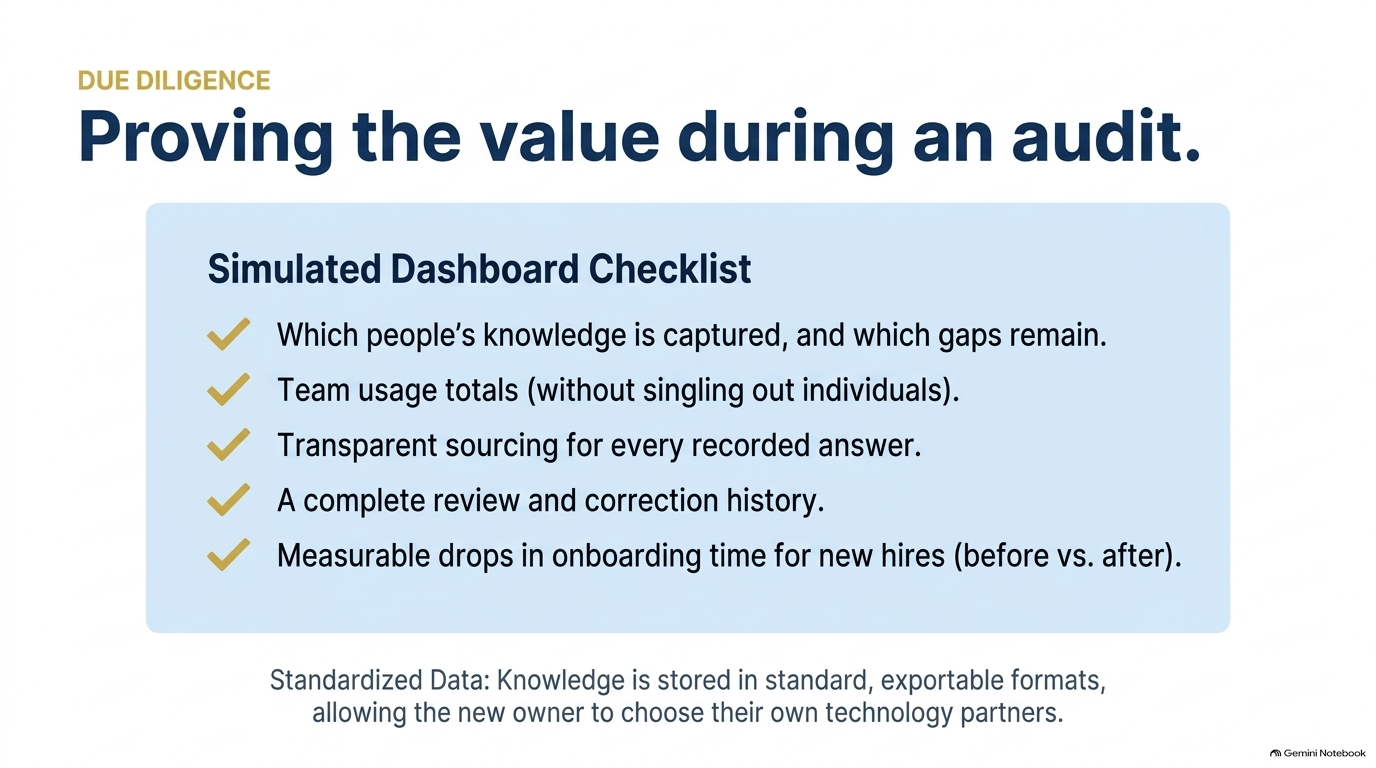
- which people's knowledge is captured, and which gaps remain
- how much the team uses the Company Brain, in totals that do not single out individuals
- where each answer comes from
- the review and correction history
- how long new hires took to become productive, before and after
The knowledge belongs to the company. It is stored in standard, exportable formats and moves with the business when it changes hands, so the new owner stays free to choose their own AI provider and technology partners.
The Company Brain works alongside the other building blocks of an independent business: documented processes, clear decision rights, a capable management team and proper access controls. Together they turn what the whole company knows into a lasting asset, available whether or not any one person is in the room.
Answers before you decide
What owners ask about their people, their privacy and the accuracy of the answers.
Will my people feel monitored?
No. The Company Brain captures how the work is done and why. It is never used to monitor or evaluate anyone's performance, and usage figures are only reported for the team as a whole.
Will my people be credited for what they share?
Yes. Every contribution is credited to the person who shared it, if they agree to be named. Contributors see what is recorded from their conversations and approve it before colleagues can ask about it, and they can correct it at any time. Before the first conversation, every contributor learns what is captured, for what purpose, who can see it and how long it is kept.
Can the Company Brain give a wrong answer?
Like any AI, it can be wrong, so every answer shows where it came from, and it says so when the knowledge is missing or uncertain. Your managers keep the decisions. People can still go to the owner or an experienced colleague, and their judgment still matters.
Who can ask it questions, and who owns what goes in?
Authorized employees and managers ask the Company Brain questions in everyday language and get answers based on your company's own knowledge. The knowledge belongs to your company. It is stored in standard, exportable formats, so you stay free to choose your AI provider and technology partners.
How do the answers stay up to date?
Each area of the Company Brain has a named owner inside the business who reviews its entries every quarter. When someone flags an answer as wrong or out of date, it goes back to the owner of that area, gets corrected, and the correction is logged.
You decide what comes next
For you as the owner, the biggest benefit goes beyond the price. Stay for a transition period, stay on as an advisor, or step away when the company is ready. Your personal knowledge is no longer the main reason a buyer needs you to stay.
Make staying after the sale your choice.
See if it fits your businessPrefer to see it in action first? Join the Company Brain Workshop, a live 30-minute session on Thursdays at 6:00 pm Central European time. Join the workshop