Your business might be worth significantly more than you think.
Most SME owners approaching exit discover too late that their business is valued far below its potential. Not because of weak financials, but because of how buyers read risk. There is a gap. It can be closed.
A short explanation of what exit readiness actually means, and why timing is everything.
Most exit planning conversations happen too late. By the time a buyer is at the table, the window to meaningfully improve your position has already closed. This video explains the gap, the timeline, and what well-prepared owners do differently.

You built something genuinely valuable. The question is whether buyers can see it.
Building a business over ten or fifteen years takes enormous skill, discipline, and sacrifice. What you have created is real. The financials prove it.
But there is a disconnect that surprises almost every owner at exit. Buyers do not just buy earnings. They buy future earnings they can count on. If too much of the business depends on the current owner being present, they price that uncertainty into the offer.
Why does this happen to well-run businesses?
The technical term is "key person risk." It is not a reflection of poor management. It is simply how buyers assess transfer risk. When revenue depends on personal relationships, when decisions require the owner's approval, when operational knowledge exists only in one person's head, a buyer sees fragility. They price that fragility into the multiple they offer. The practical effect is a multiple that sits at 4x instead of 7x. On the same business. With the same profitability. On a $2M EBITDA company, that gap is $6M.
What M&A advisors say about this
Avery Hastings, CPA and Founder of Acquidex
Can this be fixed before going to market?
Yes. And the good news is that it is a solvable problem. It requires preparation, documentation, and the right systems. It typically takes six months to do properly. The work is not glamorous, but the financial outcome at exit makes it one of the highest-return investments an SME owner can make. Most owners also recover the program cost through margin improvements and time savings before they sell.
The multiple is where the valuation gap lives, and the multiple is driven by how buyers perceive risk.
Owner independence is not a soft concept. It is the single factor that moves the multiple.
Every serious buyer asks the same underlying question: if the current owner leaves the day the deal closes, what happens to earnings? The answer to that question, more than any financial metric, determines the multiple they are willing to pay.
Why most owner-dependent businesses are undervalued
In most SMEs, a remarkable amount of value lives only in the owner's head. Client relationships built over years. The judgment calls that keep operations running. The institutional knowledge that no process document has ever captured. None of this is a flaw. It reflects how successful businesses are actually built. But at the point of sale, it becomes the primary source of buyer hesitation. Key person discounts in formal valuations typically range between 15% and 40% of enterprise value. The effect on the EBITDA multiple is even more pronounced: the difference between a business that can operate independently and one that cannot is often the difference between being acquired on your terms, or not at all.
What buyers and M&A advisors say about this risk
iMerge Advisors, M&A transaction analysis, founder-led companies
When earn-outs are structured into a deal, a meaningful portion of your purchase price becomes contingent on your continued involvement post-sale. This is the opposite of the clean exit most owners are planning for.
How the problem gets solved
The solution is not to make the owner less important. It is to make the owner's judgment, relationships, and knowledge transferable: captured in systems, documented in processes, and embedded in workflows that run whether the owner is present or not. AI-supported systems make this possible at a scale and speed that was not practical a few years ago. There are very few firms that do this work specifically for SME owners preparing for exit. We do.
What is your valuation gap worth?
Move the slider and select your owner dependence level. See your estimated exit value, and the gap that preparation can close.
20-30 minutes. A specific picture of where you stand.
Estimates based on typical EBITDA multiples for SME transactions. High dependence: 3.5x-4x. Medium dependence: 5x-5.5x. Low dependence: 6.5x-7x. Actual multiples vary by industry, market conditions, and individual circumstances. This tool is for orientation purposes only.
The Exit Readiness Program
A structured six-month program for SME owners 12-24 months from a planned sale. Not advisory. Not a report. An implementation program that builds the systems, documents the evidence, and produces a buyer-facing result.
What gets built over 6 months
The program works across three areas: owner independence (replacing personal judgment with documented systems), EBITDA quality (making margins defensible and predictable), and due diligence readiness (evidence packs, operational documentation, data room). The result is a company that buyers can inspect, trust, and acquire with confidence.
Explore the full programKnowledge Capture and Systematisation
Critical decisions, client relationships, and operational logic transferred from the owner's head into AI-supported systems that run without personal involvement.
EBITDA Defensibility
Real-time financial dashboards, documented margin drivers, and predictable revenue pipelines that hold up under buyer scrutiny and support the multiple you are targeting.
Exit Readiness Dossier
A structured evidence pack covering process documentation, ownership records, compliance groundwork, and the Exit Readiness Certificate that answers buyer questions before they are asked.
This is not a new insight. It is a well-documented valuation reality.
M&A advisors, corporate finance professionals, and PE practitioners consistently identify owner dependency as the primary source of SME valuation discount.
"If the revenue walks when the owner walks, it's not a business. It's a liability dressed as an opportunity."
"Buyers will often discount valuation or structure earn-outs to hedge against key person risk. In some cases, they may walk away entirely."
"The more a business depends on its founder, the more buyers attempt to shift risk back to that founder through earn-outs, holdbacks, and deferred payments."
"Key person discounts in formal valuations typically range from 15% to 40% of enterprise value, depending on company size and the degree of personal dependency."
"In nearly every deal we work on, one factor looms larger than expected: the business depends too much on the owner. When every decision flows through one person, buyers see fragility and price it in."
"Operational continuity is not optional. It is fundamental to valuation. If the company cannot demonstrate independence from the founder, perceived risk rises and the multiple follows."
The program is designed for a specific situation.
Not the right fit for everyone. Here is an honest picture of who benefits most, and who this is probably not for.
- Planning to sell in the next 12-36 months
- Business generates $500K or more in annual EBITDA
- Still heavily involved in day-to-day decisions
- Have received interest from buyers or advisors
- Want to understand your valuation gap before going to market
- Want your exit to reward the years of work you have put in
- Already in active sale negotiations
- Not planning to sell in the foreseeable future
- Business is pre-revenue or early stage
- Looking for generic AI consulting or technology implementation
- Not able to commit preparation time alongside the program
Three steps to a clear picture of your exit position.
No complex onboarding. No lengthy proposals before you have seen any value. A straightforward sequence, and we stop if the numbers do not make sense.
30-Minute Diagnostic Call
A focused conversation about your business, exit timeline, and where the primary valuation risks sit. No pitch. A clear picture of your current position.
What we cover on the call
We discuss your EBITDA, current owner dependence level, target exit timeline, and whether you have received any preliminary interest. By the end of the call you will have a clear sense of where your biggest valuation risks sit and whether the program makes sense for your situation.
Owner Independence Score
A scored assessment across five dimensions of owner dependency, with a specific dollar estimate of your valuation gap.
What the score covers
The Owner Independence Score assesses five dimensions: decision-making dependency, revenue transferability, operational knowledge capture, process documentation, and due diligence readiness. Each dimension is scored 0-2, with the total indicating how buyers are likely to perceive your business and which areas to address first.
Program Proposal
If the numbers make sense, a scoped proposal with milestone-based delivery and pricing tied to your EBITDA. If they do not make sense, we say so.
How pricing works
Program pricing is structured as a percentage of your EBITDA, typically 2-3% with a fixed cap and milestone-based payments. This aligns the cost with the scale of your business and the value at stake. If we do not see a clear path to at least 3x return on program cost, we say so before you commit to anything.
What owners typically ask before starting
How long does the program actually take?
The core Exit Readiness Program runs for six months. An annual review is available as an optional add-on, useful if your exit timeline shifts or if you want ongoing documentation of operational improvement over time.
We do not have documented processes. Is it too early to start?
It is actually the ideal time. Businesses with undocumented, owner-dependent processes see the largest multiple improvements, because the before-and-after contrast is exactly what buyers pay a premium for. We do not need existing documentation to begin. Building it is part of the work.
What does it cost, and how does the return work?
Program pricing is structured as a percentage of your EBITDA, typically 2-3% with a fixed cap and milestone-based payments. On a $1.5M EBITDA business, that is a fraction of the valuation uplift the program is designed to deliver. If your exit moves from a 4x to a 7x multiple, the difference on $1.5M EBITDA is $4.5M. We discuss specific numbers on the diagnostic call.
We are probably 2-3 years away from selling. Is it too early?
No. This is the optimal window. Buyers identify last-minute systematisation quickly. They call it window dressing, and they discount it accordingly. What commands a premium is 12-24 months of documented, consistent operational improvement. Most owners also find the program pays back its cost through margin improvements and time savings well before exit.
Find out what your business is actually worth
and what it could be worth.
A 30-minute diagnostic conversation. A specific assessment of your valuation position and whether the program would make financial sense for your business situation.
20-30 minutes. A specific picture of where you stand.
Get Your Free Exit Valuation Analysis
(15-minute diagnostic call — zero obligation)
What you'll discover:
✅ We'll score your founder dependency
✅ Identify your valuation bottlenecks
✅ Show you AI systems to get this fixed
✅ Calculate potential multiple improvement
No credit card required
Ready to See YOUR Company's Hidden Value?
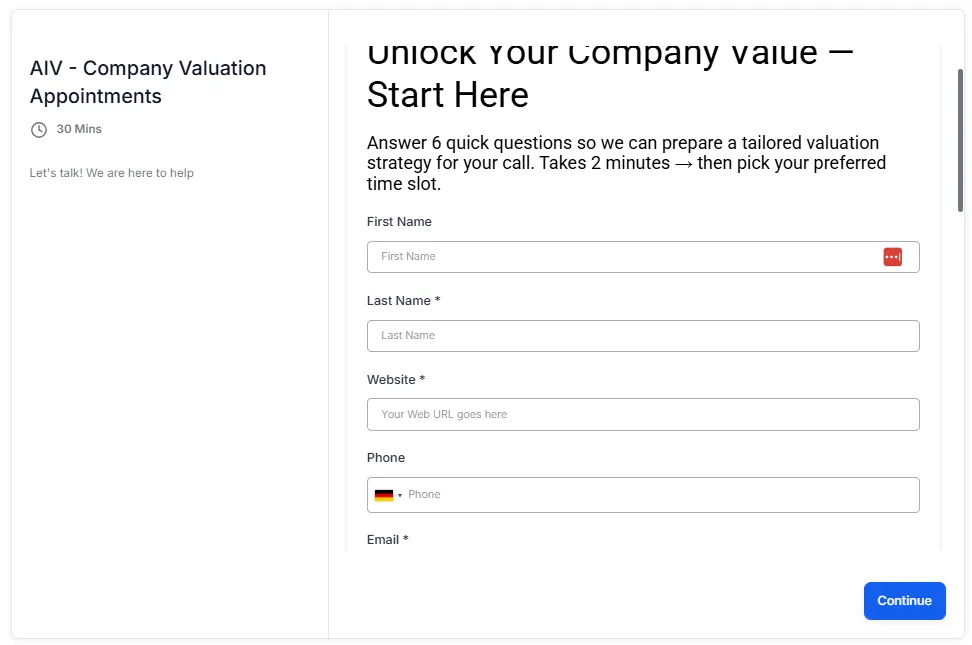
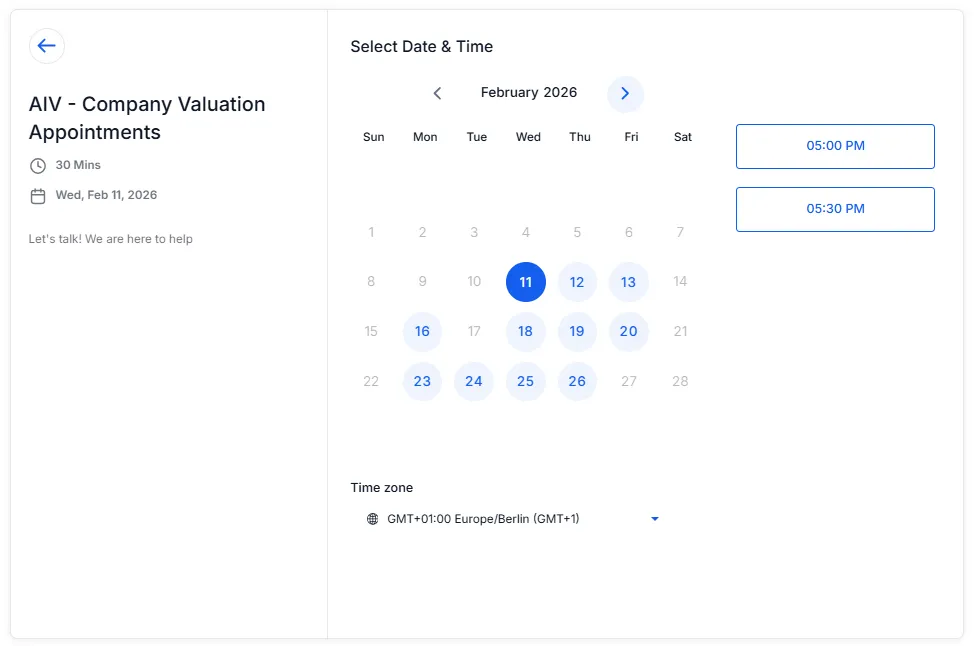
How it works: Quick questions (2 min) → Pick your time → We prep your custom analysis
Where to Start
If you are 12–18 months from exit and ready to begin, the right first step is to book a call below. A 15-minute session that identifies your specific founder dependency gaps, estimates the valuation impact, and produces a prioritised roadmap for your engagement. Not certain yet? The call gives you a clear picture of how to get your business ready for exit.
Book your free call below.

Innovation
Fresh, creative solutions.

Integrity
Honesty and transparency.

Excellence
Top-notch services.
FOLLOW US


COMPANY
CUSTOMER CARE
LEGAL
© 2026 ExValu All rights reserved. AI-Driven Exit Readiness for SMEs. Increase valuation, reduce founder dependency, exit successfully.