
Your Facts File: What Your AI Is Allowed to Say About Your Business
This article is for: owners who let an AI or a chatbot answer customers or staff.
You will recognize: the chatbot that promised a policy your business never had.
You will take away:
✔ A clear line between what your AI may say and what it must check first
✔ A one-page file you can start filling in today
✔ How to spot an answer that sounds right but has no source
Reading time: 7 minutes · Time to act: 30 minutes
You have spent years earning your reputation. Clients trust your quotes, your delivery dates and your word on the phone. Every claim your business makes was, at some point, checked by you: the years in business, the certifications, the response times, the guarantee you do or do not give.
Now more of those claims are written by someone else. A new hire answers the website chat. A sales manager asks an AI assistant to draft a proposal. A chatbot answers questions at night while you sleep. Each of them sounds sure of itself, and none of them has your memory of what is actually true.
This post is for owners and managers of a 10 to 80 person firm. It explains what a facts file is, why it belongs at the heart of a Company Brain, how ExValu builds one, and what you can start this week.
What a facts file is.
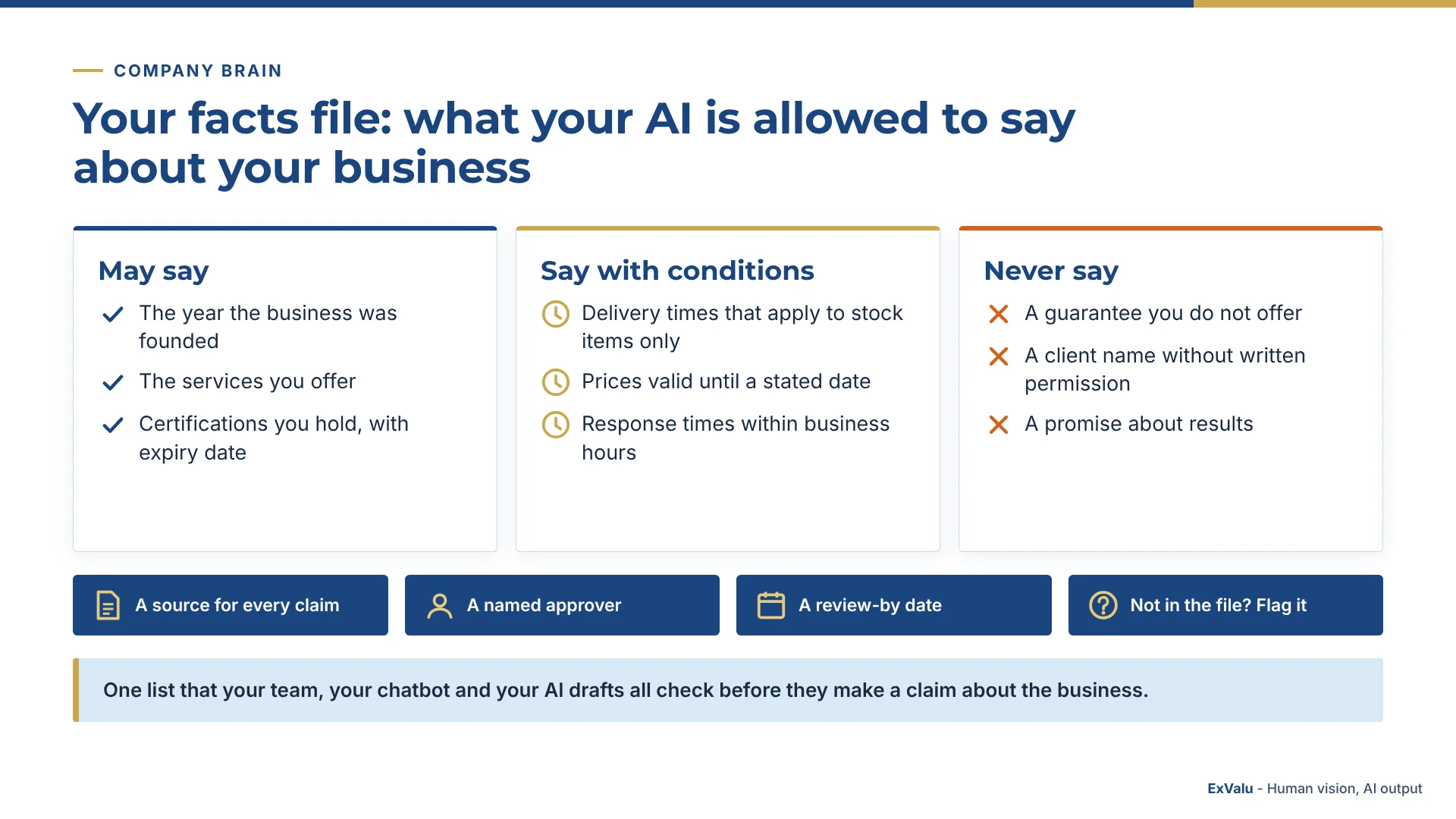
A facts file is a short list of true statements about your business that your team and your AI tools are allowed to say. Each statement carries a source, a named approver and a date when it must be checked again.
If a claim is not in the file, nobody repeats it to a client until it has been checked and added.
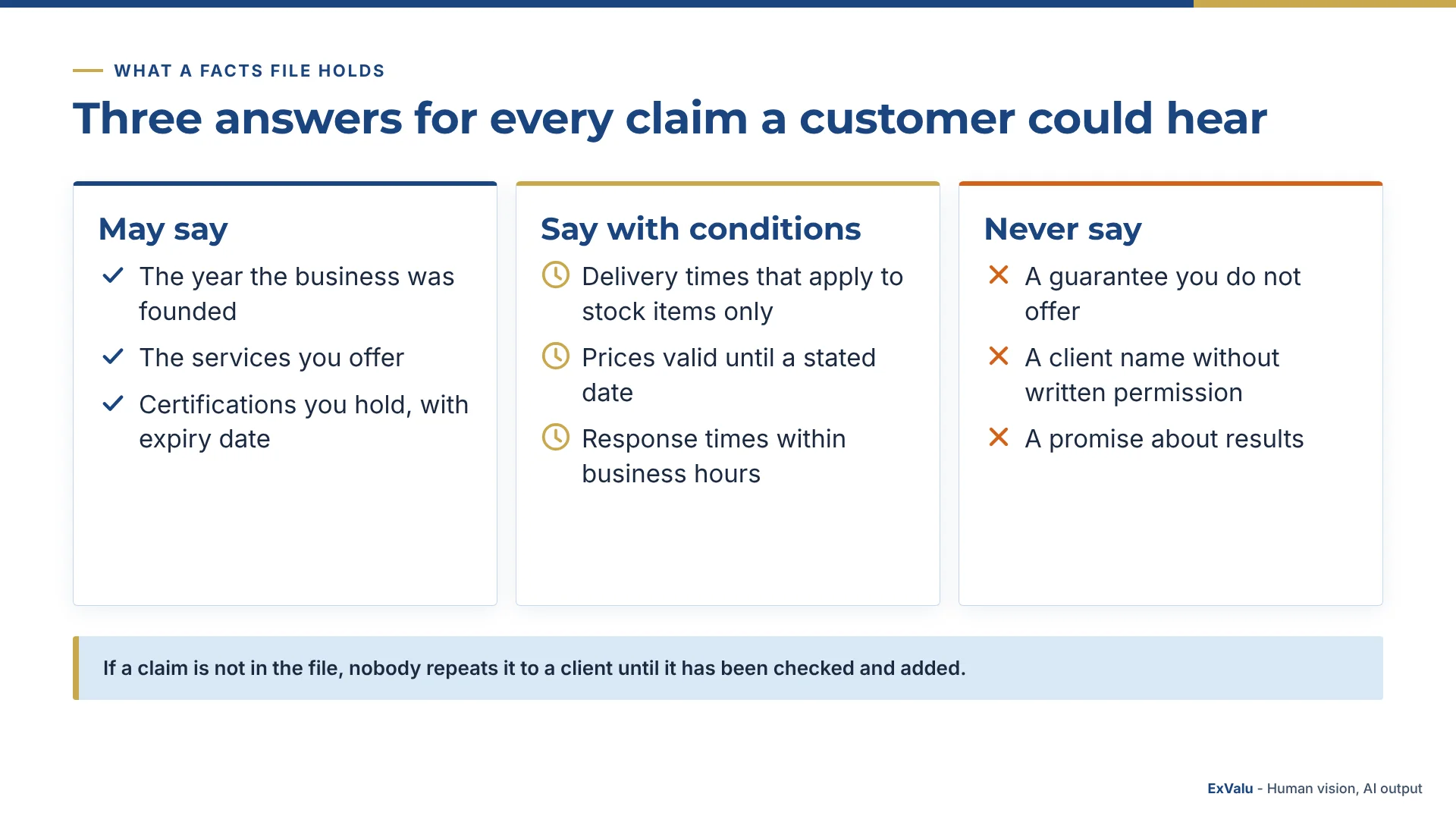
The file answers three questions for every claim a customer could hear:
What may we say? For example, the year the business was founded, the services you offer, the certifications you hold.
What may we say only with conditions? For example, a delivery time that applies to stock items only, or a price that is valid until a stated date.
What do we never say? For example, a guarantee you do not offer, a client name you have no permission to use, or a promise about results.
We have published a free template that shows how one fact is written down and gives you a ready table to fill in. This post explains why the file matters and how it works inside a Company Brain.
Click the link to: Get the Owner's Facts File
Why it matters for value: A business whose claims are written down, sourced and approved knows exactly what it promises customers. That removes hidden commitments, the kind that come back later as refunds, disputes or a call to you.
AI tools answer with confidence, and the business is liable.
AI assistants are built to produce a helpful answer. When they do not know a fact, they can fill the gap with something that sounds right. In a draft email, that might be a delivery time you never offered. On a website chat, it might be a refund rule that does not exist.
The business is responsible for what its tools tell customers.
In February 2024, the British Columbia Civil Resolution Tribunal decided Moffatt v. Air Canada. The airline's website chatbot had told a grieving customer that he could apply for a bereavement discount within 90 days after his flight. The actual policy required the request before travel. Air Canada argued that the chatbot was responsible for its own actions and that the correct policy was on its website. The tribunal rejected that argument and ordered the airline to pay the customer damages and fees.
Your business is far smaller than an airline, so a single wrong promise weighs more.
A facts file gives every person and every tool one place to check before they speak.
Why it matters for value: Fewer invented promises means fewer refunds, credits and disputes, which protects margin and supports EBITDA quality. It also lowers the legal and reputational risk that would otherwise land on your desk.
How the Company Brain uses the facts file.
In a Company Brain, the facts file sits above everything else the AI reads. A standing rule tells the AI: when a client-facing answer includes a claim about the business, check it against the facts file first. If the claim is there, use the approved wording. If the claim is not there, say so plainly and route the question to the person who owns that area.
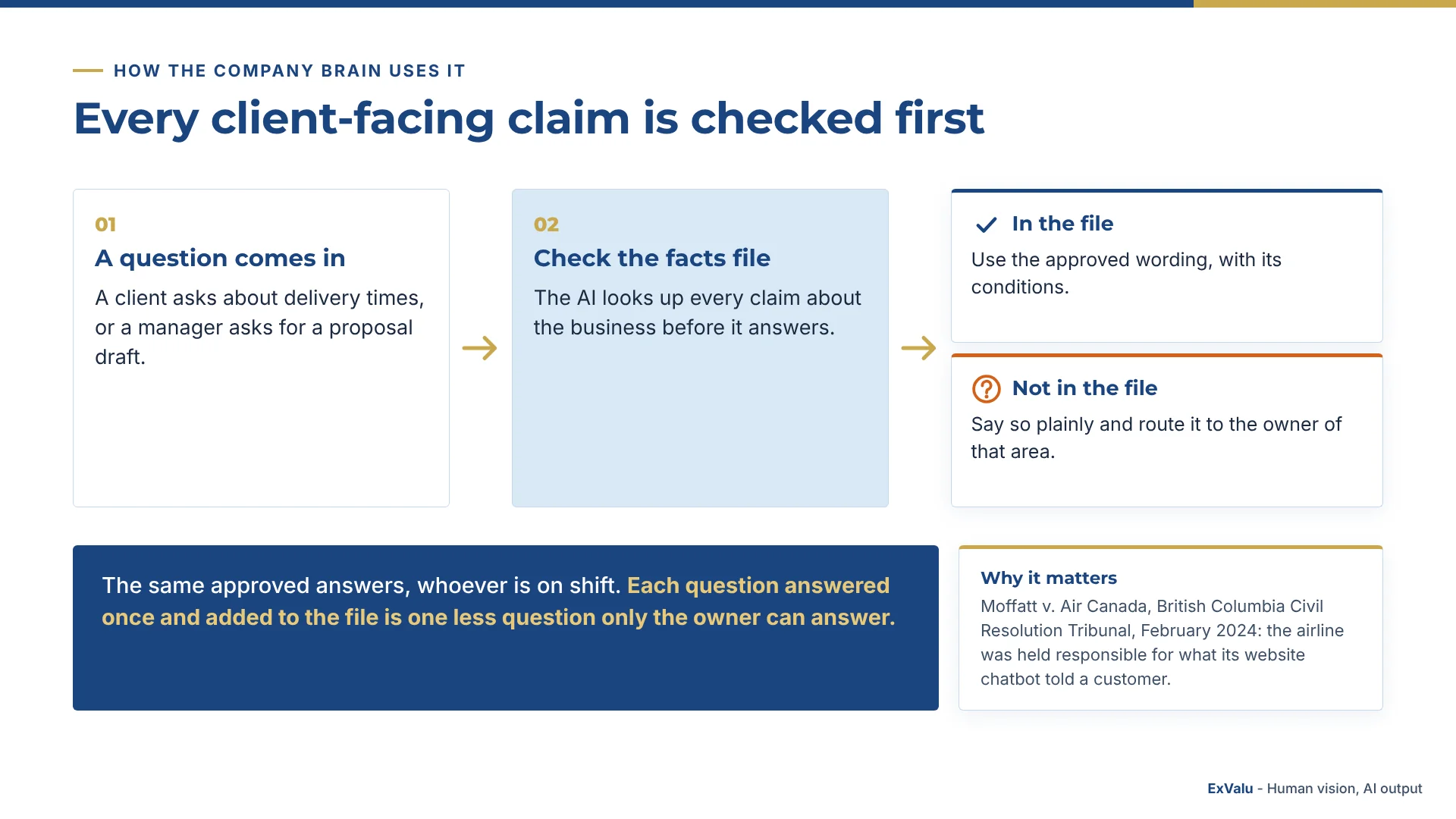
This changes how your team works with AI. A sales manager asking for a proposal draft gets your approved terms. A new hire on the chat sees the same answers your longest-serving person would give.
When a claim is missing, the gap shows up once, as a question for you, and the answer then serves everyone.
Why it matters for value: The same approved answers, whoever is on shift, make sales and service more predictable, which supports revenue predictability. Each question you answer once and add to the file is one less question only you can answer, which reduces owner dependence.
How ExValu builds a facts file, and why.
We build the facts file as part of every Company Brain, in plain files stored in the client's own storage. Our design, which we are testing with our first pilot, works like this:
We start from what customers hear. We collect claims from the website, proposals, contracts, email templates and the questions staff answer most often.
Every entry gets a source and an approver. The source is the document or record that proves the claim. The approver is a named role, often the owner at first.
Every entry gets a review-by date. Certifications expire, prices change, team sizes grow. A claim past its date is treated as unconfirmed until someone checks it.
Conditions are written into the entry. "Delivery within five working days" becomes "within five working days for stock items, confirmed at order".
A short never-say list sits next to the file. Guarantees you do not give, results you cannot promise, names you have no permission to use.
The AI is instructed to look for evidence before it agrees. When a team member states a claim that the file does not support, the brain points out the gap and asks for the source.
For the wider set of rules every entry in a Company Brain should follow, such as a source, an approver and a knowledge type, see The Company Brain Checklist: 9 Things a Business Owner Can't Skip.
Why it matters for value: A facts file that the business maintains without the owner is a small, visible piece of transferability. It shows that the business itself knows what it promises, so the answers stay right when you step back.
What an outside review sees.
Anyone who reviews your business from the outside, such as an auditor, a bank or a new partner, will compare what you say about the business with what the records show. A maintained facts file helps them, and you, in four ways:
Every client-facing claim has a source document they can check.
Every claim has an approver and a review date, so they can see that someone owns accuracy.
Expired or replaced claims are marked with the date they changed, so the history is readable.
The never-say list shows that the business manages its promises on purpose.
The same file shortens the questions reviewers ask about warranties, guarantees and customer commitments, because the answers are already written down.
A note on GDPR and permissions.
Keep personal data out of the facts file wherever you can. A claim such as "we supply three national retail chains" needs no names. If you want to name a client or quote a testimonial, record the client's written permission as the source, and set a review date so the permission is checked again. Staff names belong in the file only when the person has agreed, for example a named contact on your website. Please check the details with your data protection advisor.
What you can start this week.
Collect 20 claims your business makes. Use your website, your last three proposals and your standard email replies.
For each claim, write down the source that proves it. If you cannot find one, move the claim to a list of open questions.
Add a review-by date to each claim. Twelve months is a sensible default, shorter for prices and team facts.
Write five lines for your never-say list.
Paste the file into the instructions of any AI assistant your team uses, with one rule: claims about the business come from this file only, and anything else is flagged.
If a client screenshotted the last answer your team or your chatbot gave about your business, would you be comfortable standing behind every word?
To find out whether a Company Brain fits your business, take the fit check. It takes a few minutes.
Sources
Moffatt v. Air Canada, British Columbia Civil Resolution Tribunal, decision of February 2024, as reported by CBS News, 19 February 2024.