The Contributor Deal
The question nobody asks out loud
You have built a business that works. Part of the reason is a handful of people who have been with you for years. They know which customer needs a call before the invoice goes out, which supplier delivers faster when asked the right way, and which workaround saved a deadline more than once.
None of that is written down. Buyers know it, and the question every buyer asks first is simple: what happens to this business when those people, or you, are no longer in the room?
The obvious answer is to capture that knowledge in a Company Brain. The moment you ask, though, your best people hear a different question: "Will you hand over the one thing that makes you hard to replace?" Most of them will say yes politely and share very little. This article explains why, and how to structure the request so that sharing becomes the safer choice for everyone involved.
Why good people hold back
The hesitation is rational. Research on knowledge hiding points to three drivers, and all three are active in most businesses preparing for a sale.
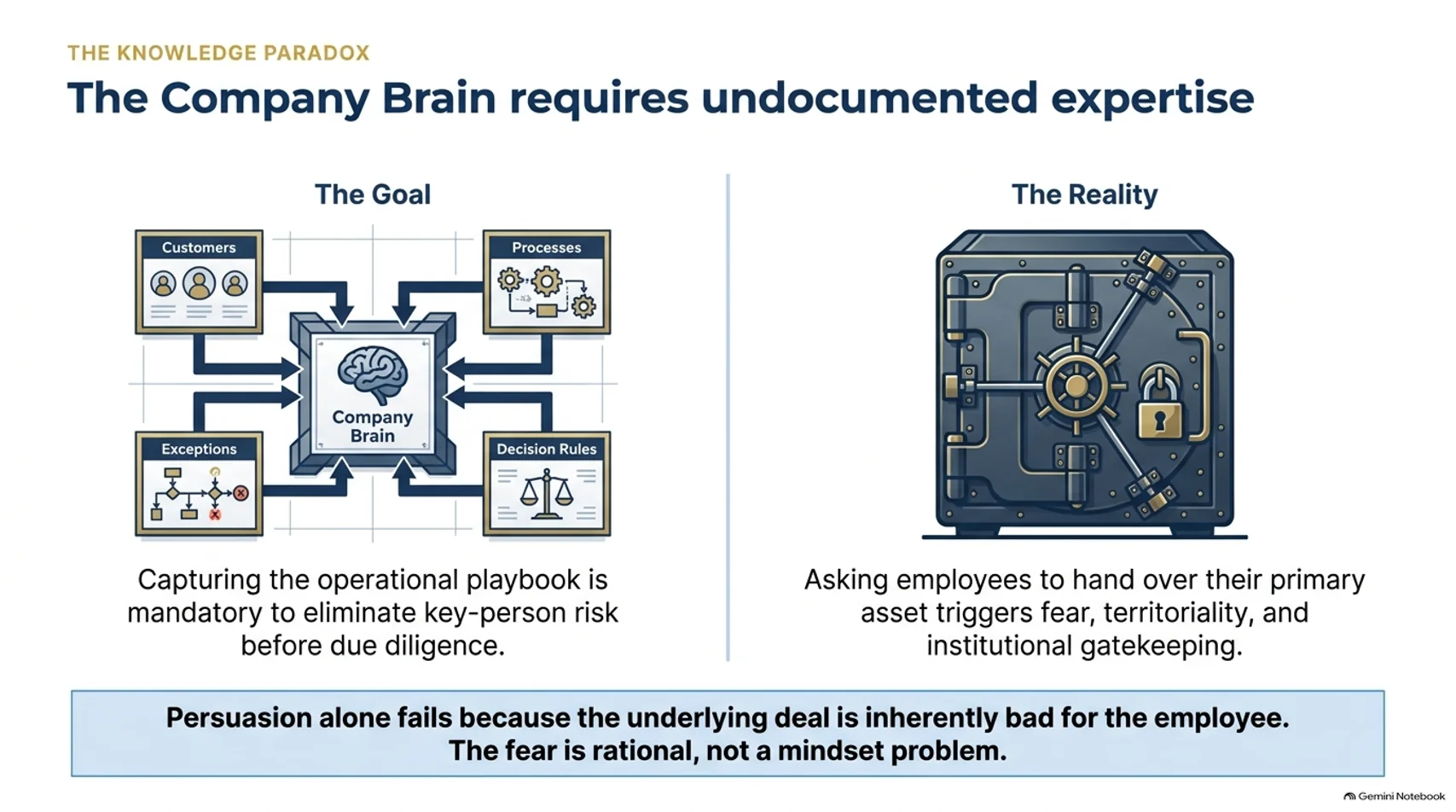
They feel the knowledge is theirs. A three-wave study of knowledge workers found that people who feel psychological ownership of their knowledge hide more of it, and territoriality fully explains that link. The same study found the effect disappears when people also feel ownership for the organization itself (Peng 2013, Journal of Knowledge Management).
They worry about their jobs. A time-lagged study of 365 employees showed that job insecurity lowers psychological safety, which in turn increases knowledge hiding. Servant leadership softened that damage (Jeong, Kim and Lee 2023, Frontiers in Public Health).
AI raises the stakes. In a survey of 4,000 knowledge workers across four countries, 35% said they actively gatekeep knowledge to protect their job security, and 38% said they are reluctant to train others in areas they consider personal strengths. The same research concluded that the way AI is introduced, more than the technology, decides whether people respond with fear or with productivity gains (Adaptavist, via Workplace Journal 2025).
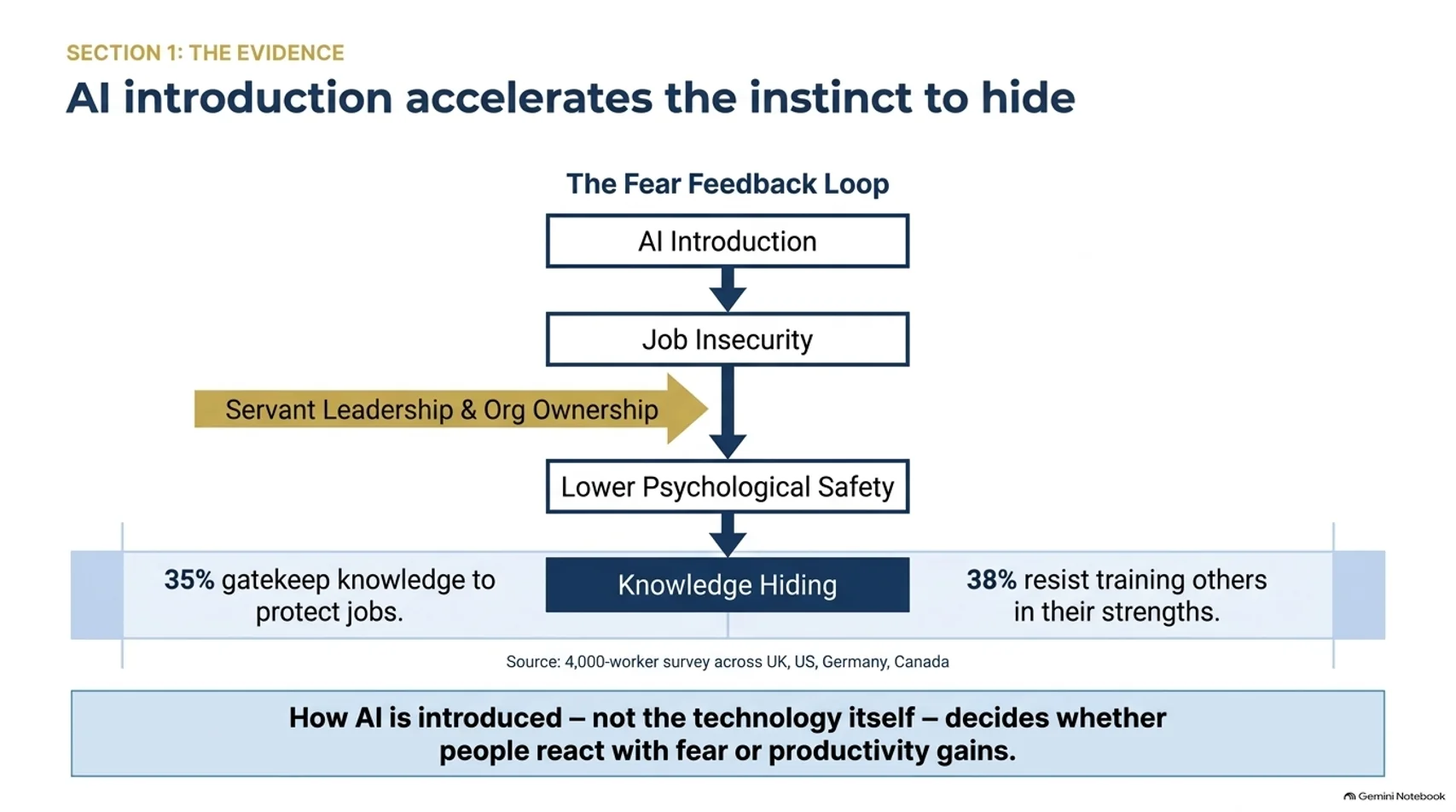
The takeaway for an owner is direct. A better speech will not fix this, because the fear makes sense. The structure of the request has to change.
Why the usual fixes backfire
Most owners reach for one of two tools: a motivational kickoff, or a reward for every contribution. The first does nothing about the underlying fear. The second can make things worse.
In a field study of 154 managers across 27 organizations, anticipated extrinsic rewards had a negative effect on attitudes toward knowledge sharing. Expected reciprocal relationships, people helping each other in return, had a positive one (Bock, Zmud, Kim and Lee 2005, MIS Quarterly). Later research found that rewards for sharing weakened the effect of intrinsic motivation and harmed helpful behavior between colleagues (Lombardi et al., What money cannot buy).
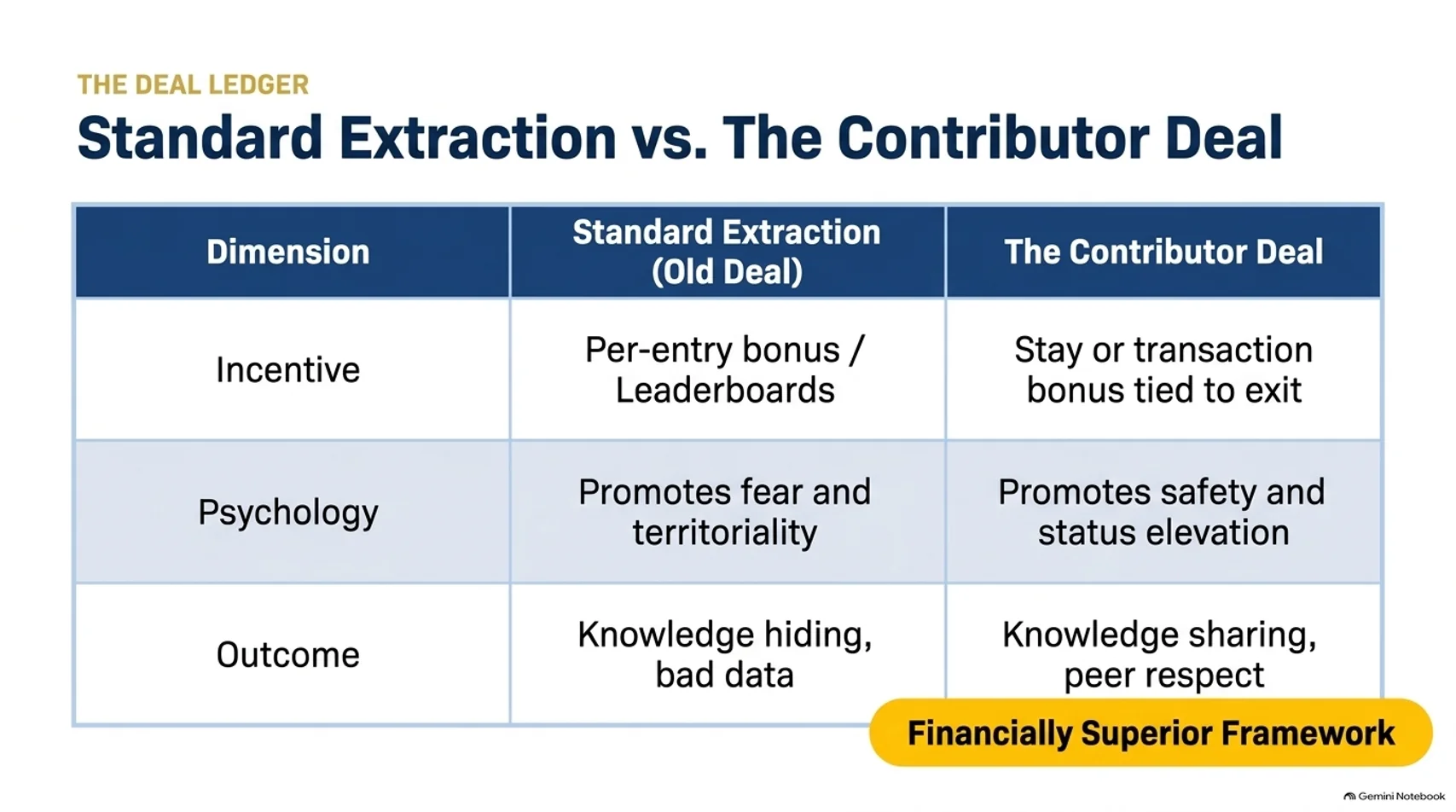
Per-entry bonuses and contribution leaderboards also reward volume. A Company Brain full of quick, shallow entries is exactly what a buyer's due diligence team will discount.
The same fear also shows up as legal and compliance risk when capture is done the wrong way
The Contributor Deal
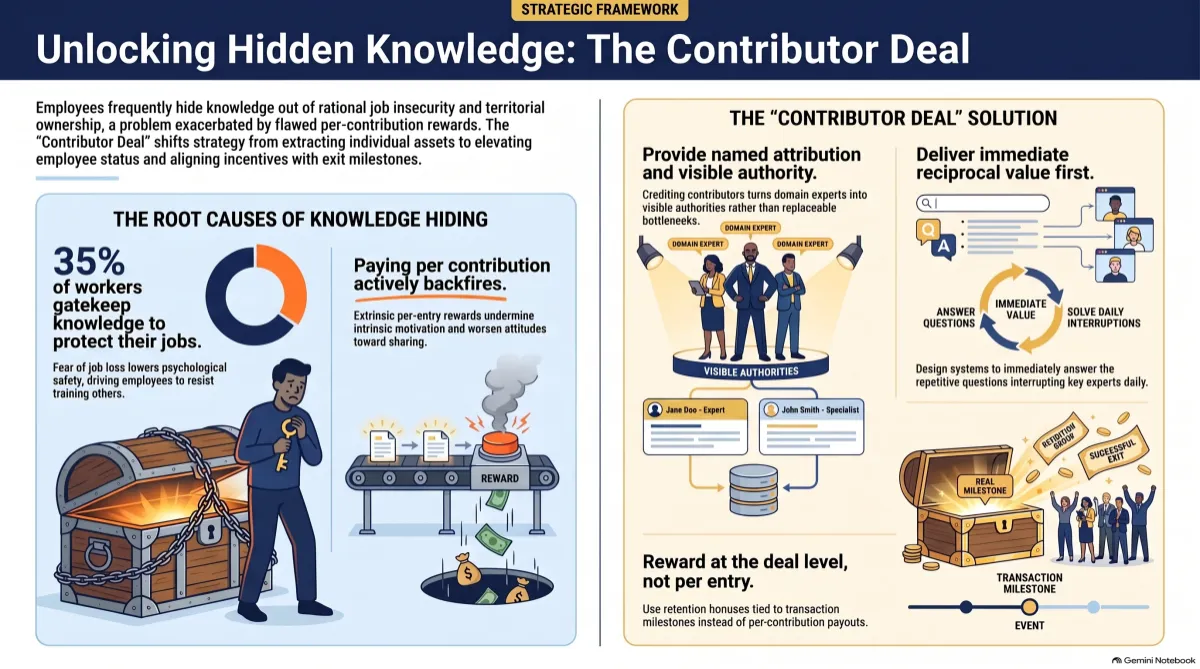
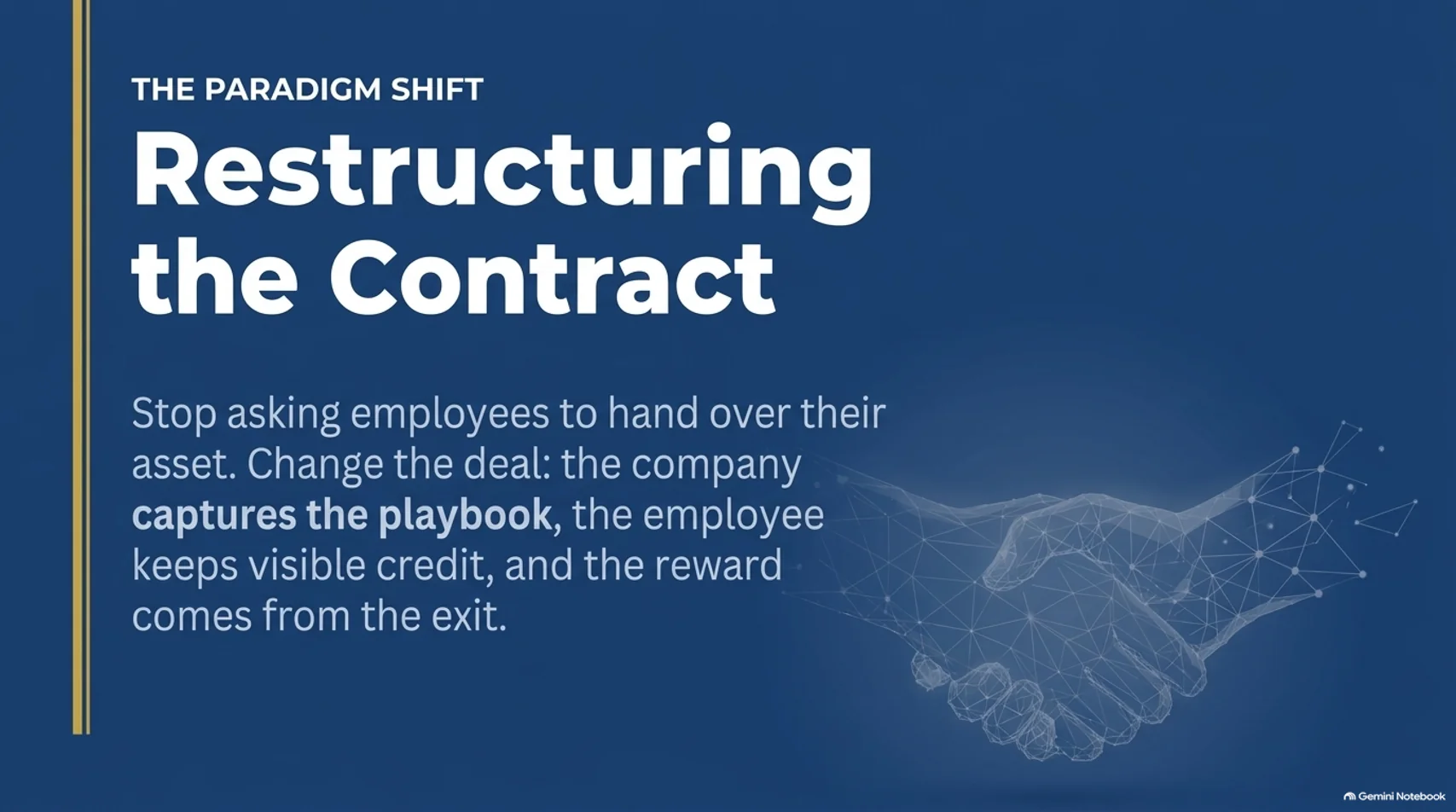
The Contributor Deal changes the terms of the request. The company captures the playbook. The employee keeps visible credit and becomes the named expert. The reward comes from the exit.
Seven principles put this into practice.
1. Capture the business, never the person
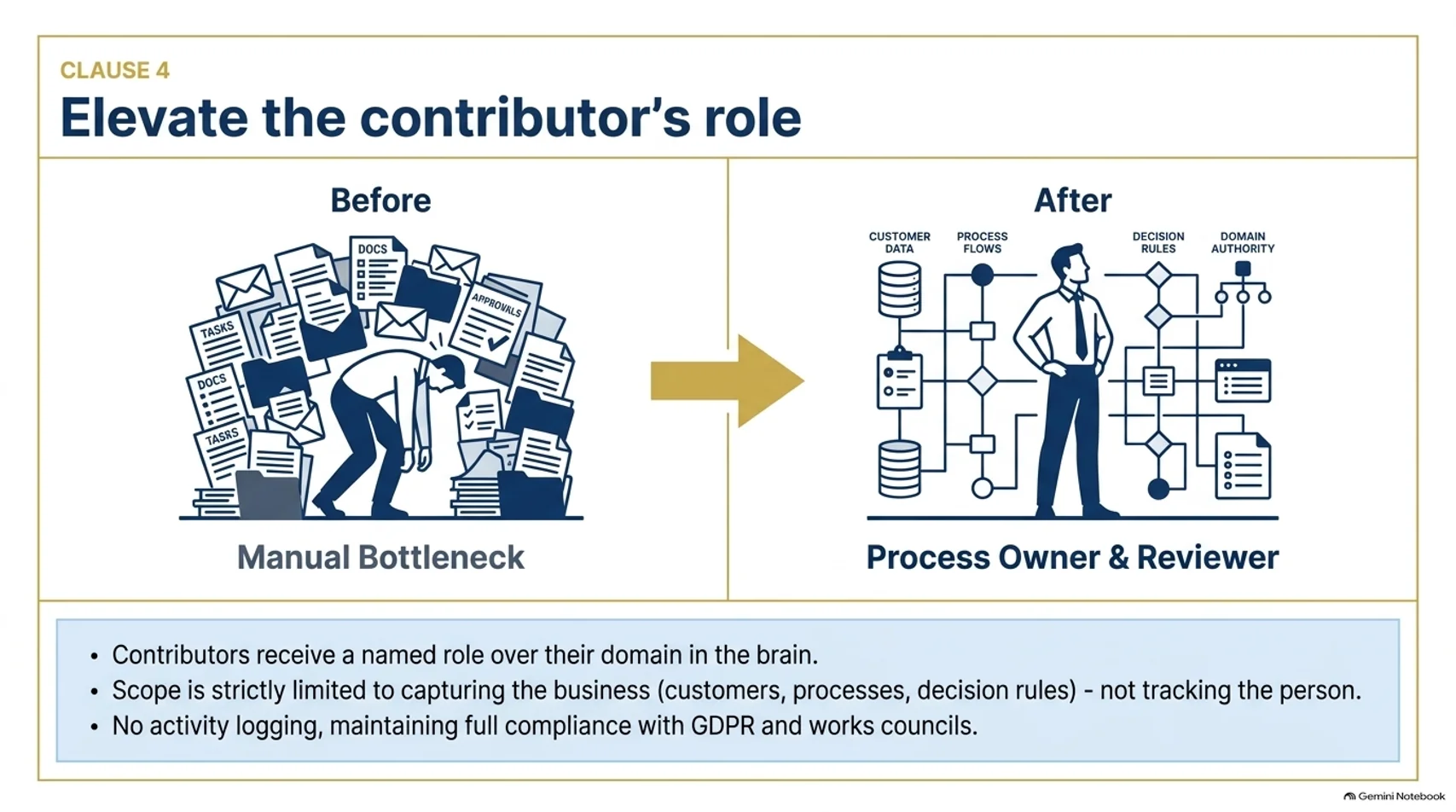
Put the scope in writing: customers, processes, exceptions and decision rules. Rule out performance scoring and activity logging. This keeps the Company Brain clear of GDPR purpose creep and, where a works council exists, of co-determination over systems that monitor behavior or performance (KI-Syndikat on §87 BetrVG).
2. Give before you take
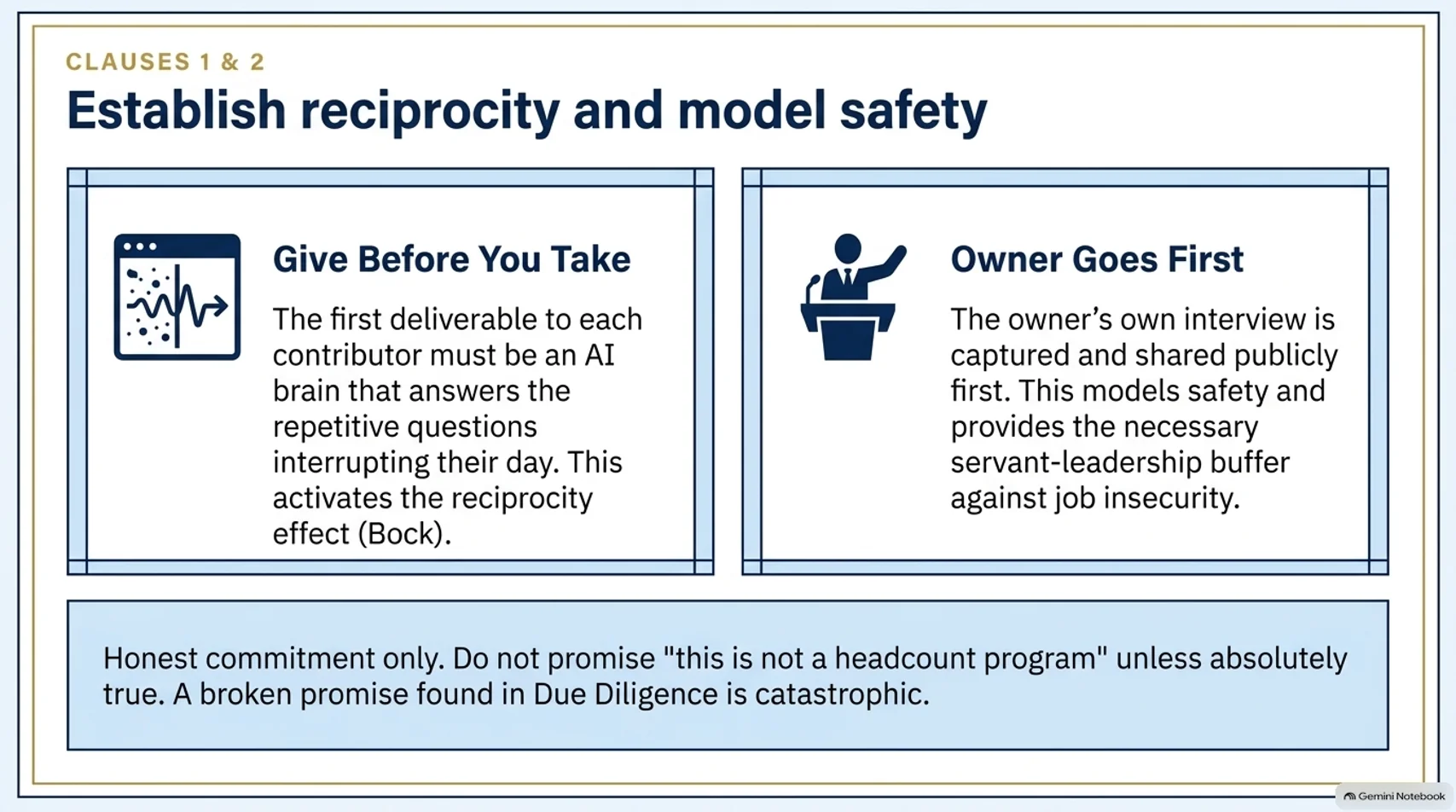
The first deliverable to each contributor is relief. Ask which questions people bring to them over and over, capture those first, and let the Company Brain answer them. This is the reciprocity effect Bock and colleagues found: people share when they expect something back.
3. The owner goes first, publicly
The owner's own interview is captured and shared with the team before anyone else's begins. It shows the request is safe, and it is the practical form of the servant-leadership buffer from the job-insecurity research.
4. Put the expert's name on every entry
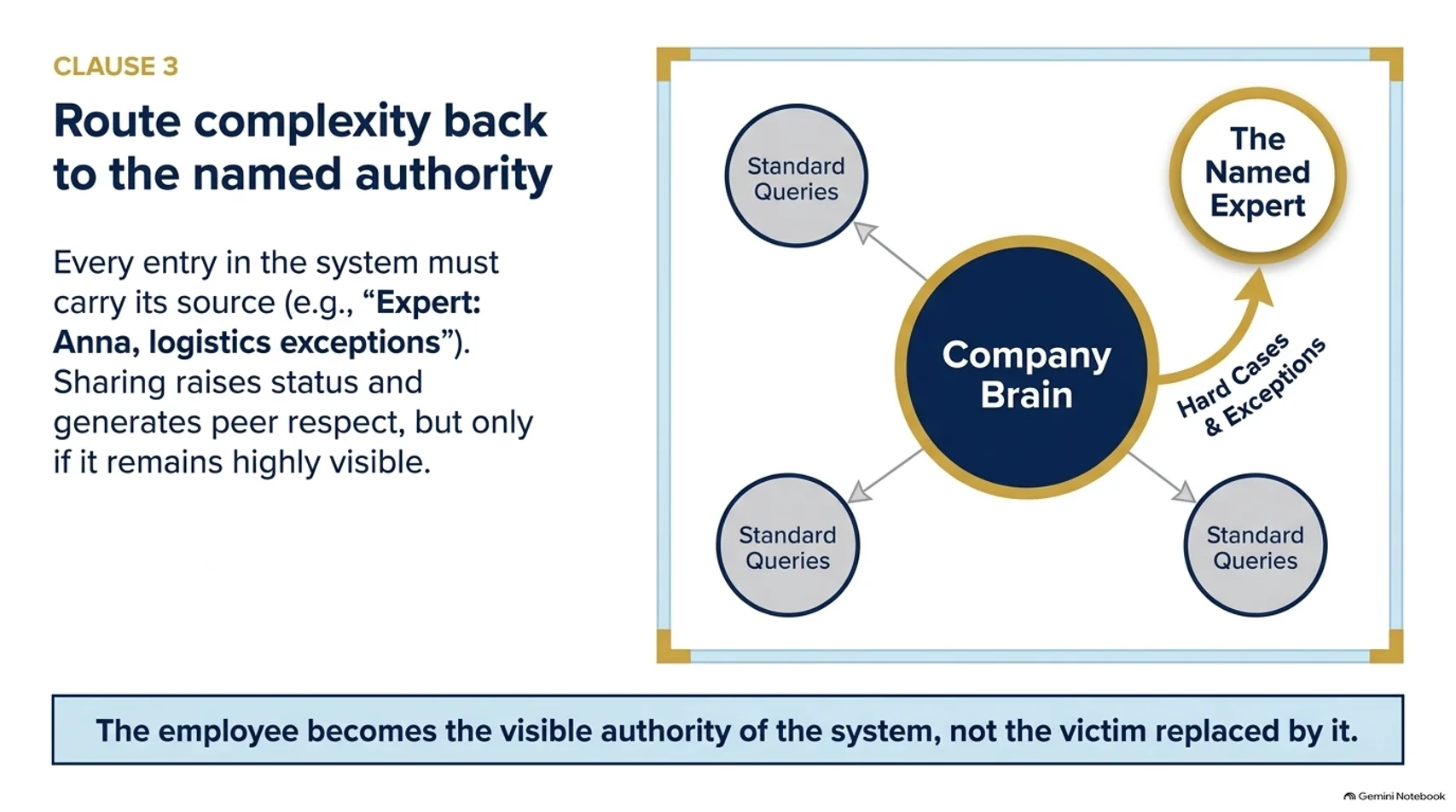
Every entry carries its source, for example "Expert: Anna, logistics exceptions." Routine questions go to the Company Brain. Hard cases route back to Anna. Research on team dynamics shows colleagues repay knowledge sharing with peer respect, especially when the contributor is competent (Tang, Lai and Chen 2024, The Learning Organization). Attribution makes that respect visible.
5. Elevate the role
Contributors receive a named role over their area, such as Process Owner, including final review of every entry in it. The message to the employee: you move from bottleneck to senior authority.
6. Reward at the deal level
Tie recognition to milestones that matter: a stay or transaction bonus for key contributors, linked to closing and to a knowledge-transfer milestone. Advisors report stay bonuses commonly range from 25% to 100% or more of annual compensation for the people most critical to the business (Rehmann). This keeps the focus on quality and avoids the crowding-out trap.
7. Promise only what is true
If the owner cannot honestly say "this is no headcount program," the sentence stays out. A broken promise discovered during due diligence, or by the team after closing, costs far more trust than an honest silence.
What buyers see
A documented Company Brain lowers key-person risk and makes the business more predictable, two things a due diligence team examines closely. That is the part most owners expect.
The part they often miss: buyers also pay to keep the people who carry the knowledge. Retention costs are usually small compared to the cost of losing institutional knowledge that may be needed to hit post-closing earnouts (Lowenstein Sandler).
So buyers want the Company Brain and the experts who built it. That is also the most honest message an owner can give the team: a documented expert is worth more to a buyer than an undocumented one.
Three things to avoid
Covert capture. Keystroke or screen logging to train AI agents destroys trust the moment it is discovered and carries significant legal risk.
Skipping the works council. Where one exists, co-determination over systems able to record behavior or performance is enforceable before rollout. Going ahead without agreement invites an injunction.
Per-entry bonuses or contribution leaderboards. They reward volume, crowd out the motivation you need, and fill the Company Brain with entries a buyer will discount.
A question for you
Think of the one person in your business whose absence would hurt most next Monday. If you asked them today to write down everything they know, what would they hear you asking?
The Contributor Deal gives you a way to ask that they can say yes to.
Sources
Peng 2013, Why and when do people hide knowledge? Journal of Knowledge Management
Adaptavist survey via Workplace Journal 2025, AI job fears driving knowledge hoarding
Bock, Zmud, Kim and Lee 2005, Behavioral intention formation in knowledge sharing, MIS Quarterly
Lombardi et al., What money cannot buy: the detrimental effect of rewards on knowledge sharing
Tang, Lai and Chen 2024, Coworkers' responses to knowledge sharing, The Learning Organization
Rehmann, M&A transactions: five tips for retaining key employees
ExValu - Human vision, AI output