Built for Control: The Four Pillars Behind the ExValu Company Brain
You have spent years building what your company knows: your processes, your client history, your pricing logic and the know-how your people carry. So when an AI knowledge system comes up, the first question most owners ask is the right one: what happens to my data?
When a buyer runs due diligence, they ask the same question, only harder.
So we built the ExValu Company Brain on safeguards you can check, one structure at a time.
Security comes first
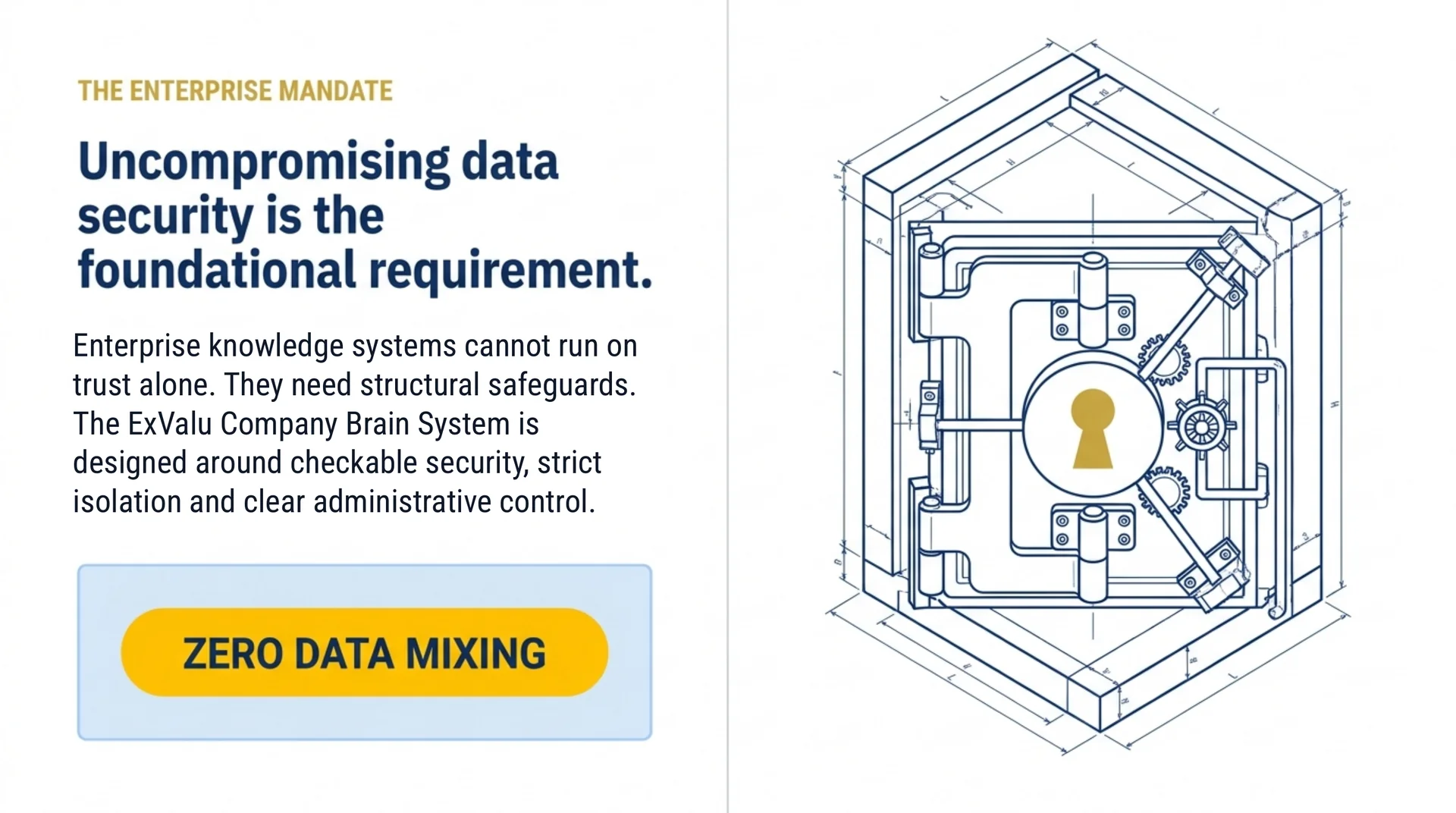
A knowledge system cannot run on good intentions. It needs structural safeguards: clear isolation, clear access rules and clear administrative control.
Our starting rule is zero data mixing. Your company's knowledge stays yours. It is kept apart from every other client's data.
The four pillars of the trust architecture
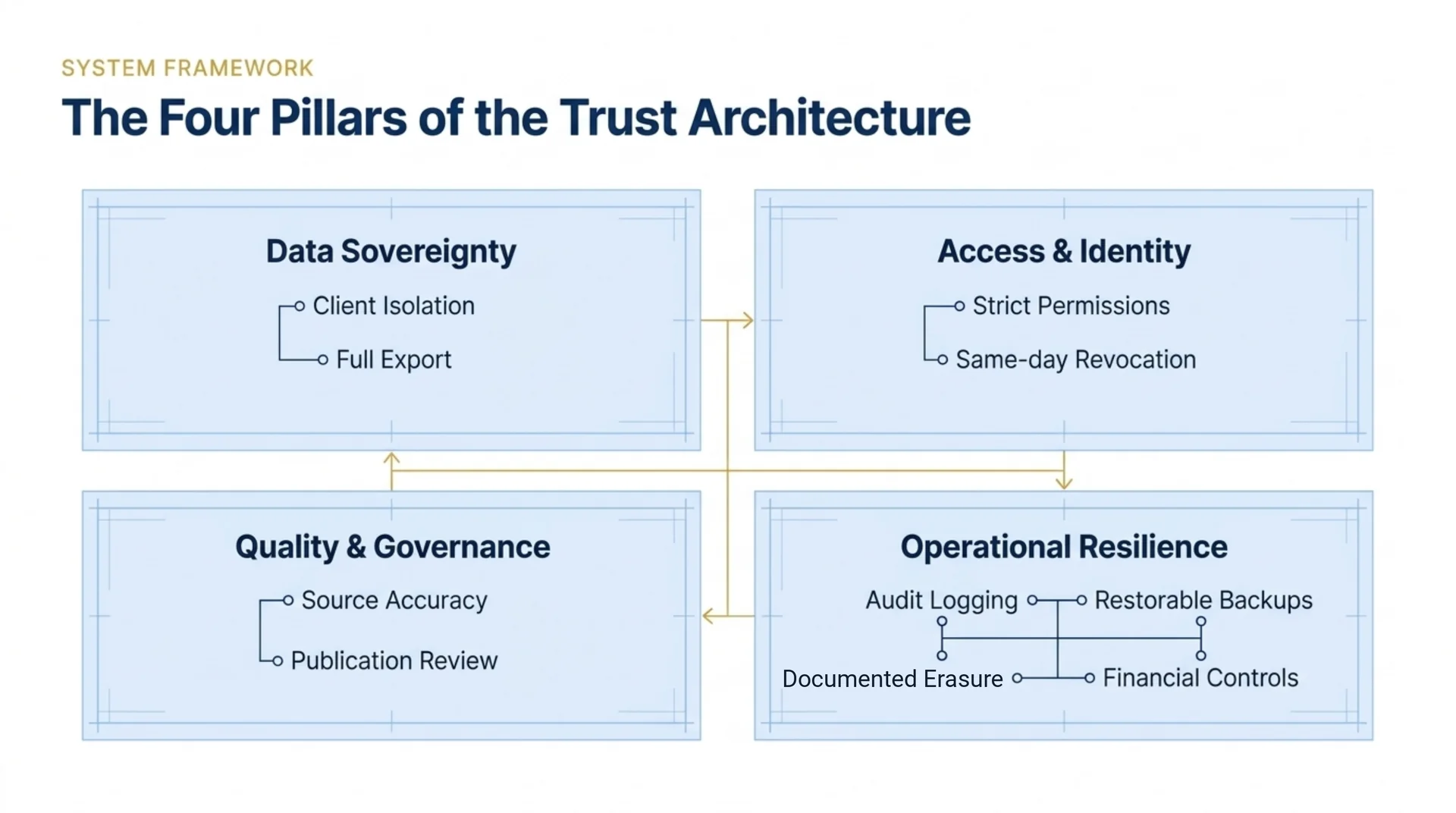
The Company Brain rests on four connected pillars:
Data Sovereignty: client isolation and full export
Access and Identity: strict permissions and same-day revocation
Quality and Governance: source accuracy and publication review
Operational Resilience: audit logging, restorable backups, erasure and financial controls
Each pillar answers a question that owners, employees and buyers will eventually ask. Before a client goes live, we test every pillar and keep the written results. Let's walk through them.
Pillar 1: Data Sovereignty
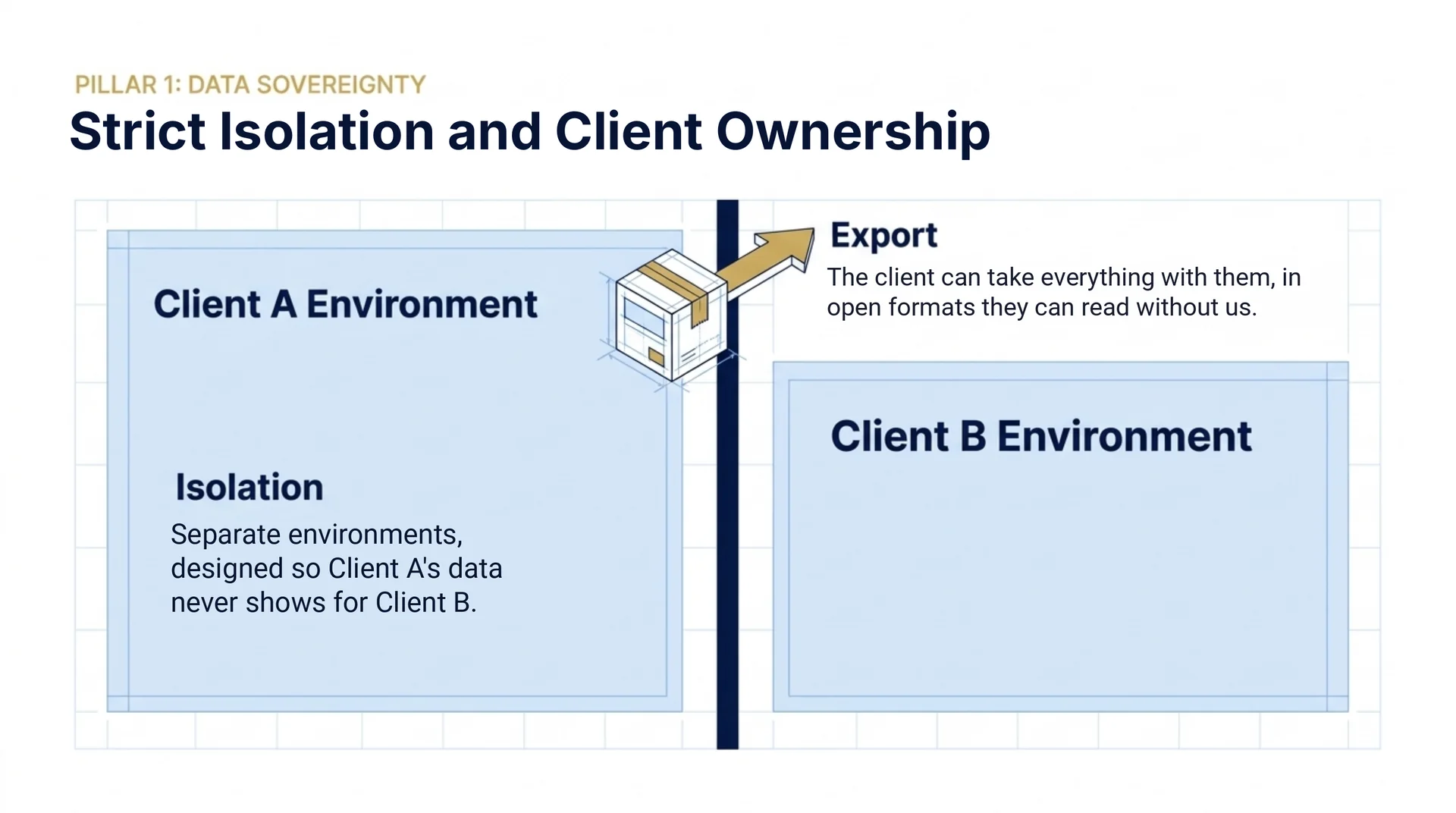
Isolation. Each client works in its own separate environment, so Client A's data is designed never to appear for Client B.
Export. You can take everything with you, in open formats you can read without us.
Why it matters for value: A buyer discounts any business that depends on a tool it cannot leave. Portable, owned knowledge is a transferable asset. Locked-in knowledge is a risk line in the diligence report.
Pillar 2: Access and Identity
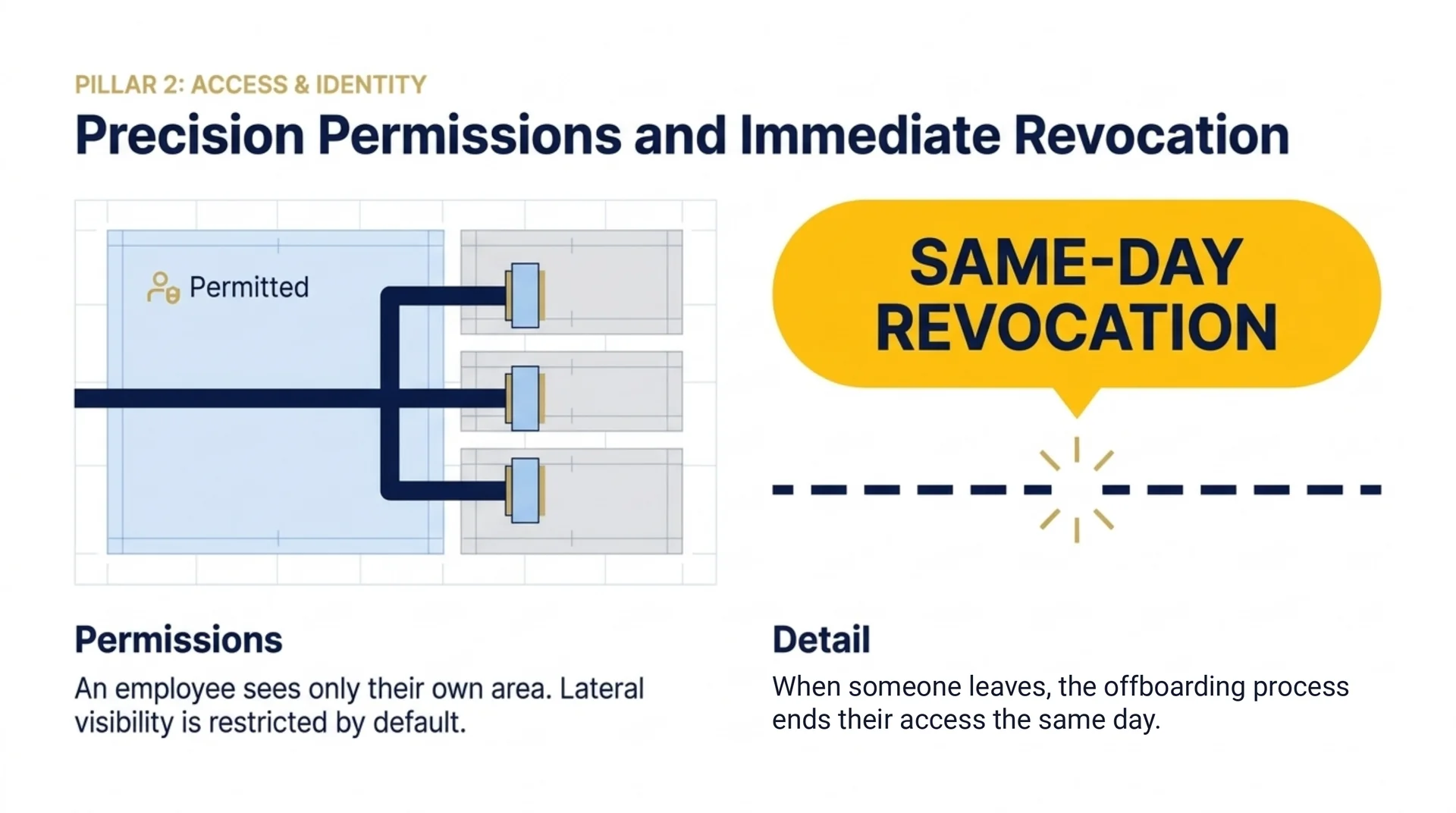
Permissions. An employee sees only their own area. Access to other departments is restricted by default.
Same-day revocation. When someone leaves, the process ends their access that same day.
Why it matters for value: When people leave, knowledge and access can leave with them. Tight access control protects the asset and shows a buyer that you run a disciplined operation.
Pillar 3: Quality and Governance
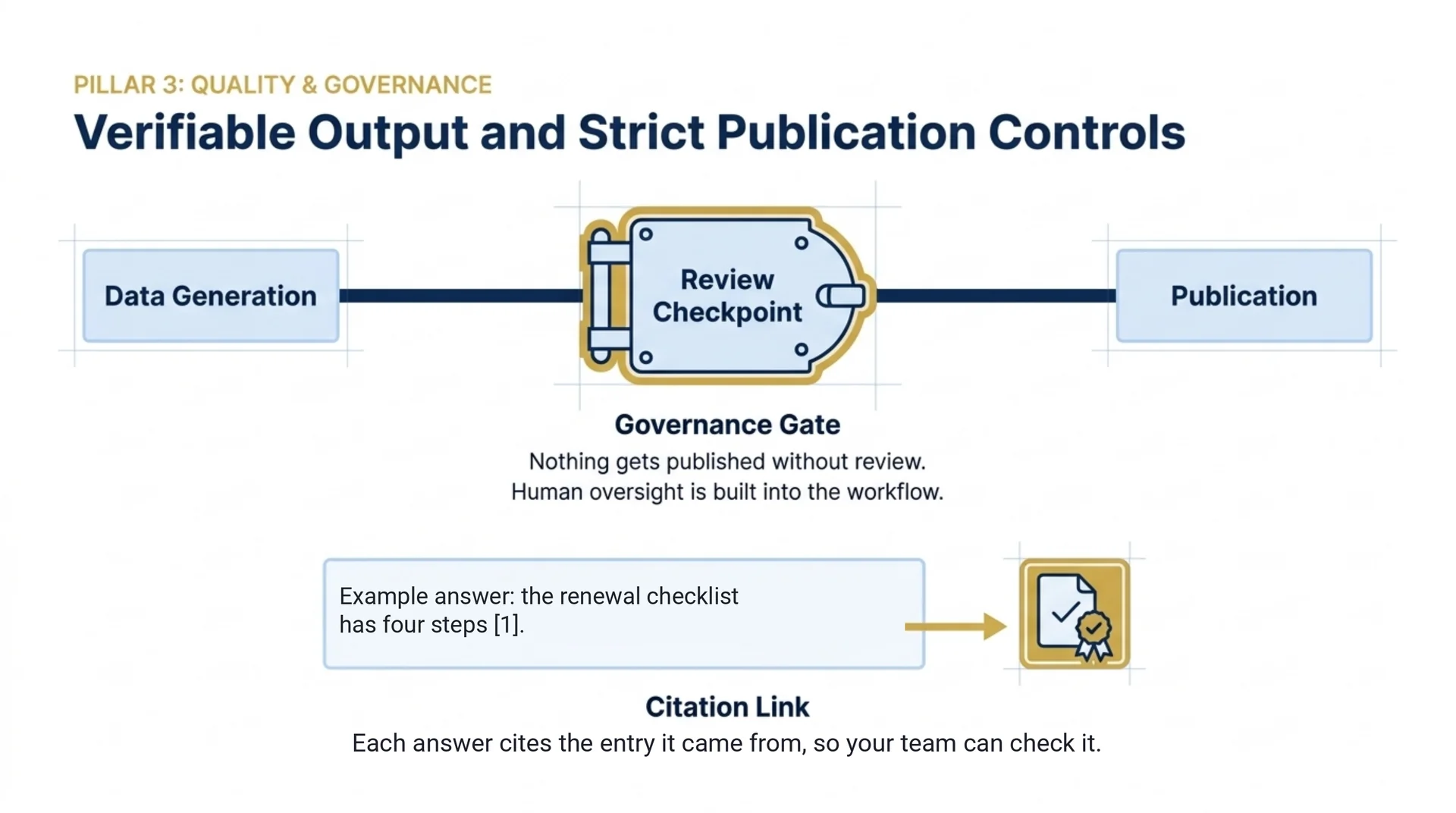
Governance gate. Nothing gets published without review. Human oversight is built into the workflow, between generation and publication.
Citation link. Answers point to the exact source entry they came from. Your team can check every claim.
Why it matters for value: AI that invents answers creates liability. AI that cites its sources creates confidence. For a buyer, documented and checkable knowledge reduces owner dependence, because the answers no longer live only in your head.
Why review stays mandatory. Answering from sources helps a great deal, and it still does not make errors impossible. In a Stanford study, general-purpose chatbots answered legal questions wrongly 58% to 82% of the time. Specialist legal research tools that answer from source documents did much better, yet still gave incorrect or misleading answers to 17% to 33% of test questions (Magesh et al., Journal of Empirical Legal Studies, 2025). That is why every Company Brain answer shows its source, and why nothing is published without a person checking it first.
Pillar 4: Operational Resilience
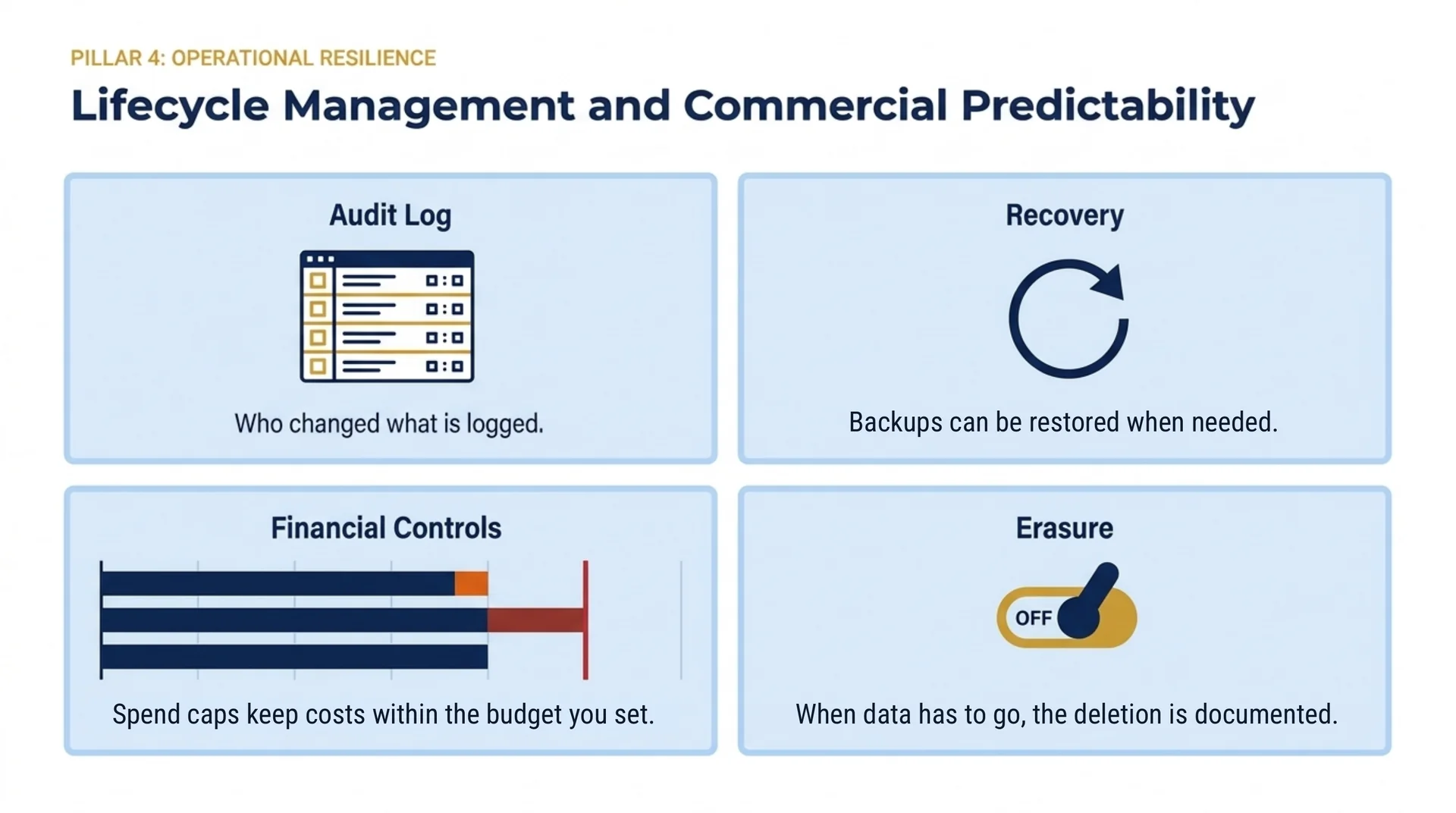
Audit log: who changed what is recorded.
Recovery: a backup can be restored when something goes wrong.
Financial controls: spend caps keep AI costs within the budget you set.
Erasure: when data has to go, it is deleted and the deletion is documented.
What erasure means in practice. There are two everyday cases. First, a person asks for their personal data to be deleted. Under the GDPR (Article 17, the "right to erasure"), you must be able to find that person's data and remove it without undue delay. Second, a client relationship ends. A service provider that processes data for you must then delete or return it (GDPR Article 28). In both cases, "we think it's gone" is not good enough. You need to be able to show that it is gone.
Why it matters for value: Predictable costs protect EBITDA. Audit trails and backups lower operational risk. Documented deletion lowers legal risk. All three are exactly what a careful buyer wants to see.
Standard solutions vs. the ExValu architecture
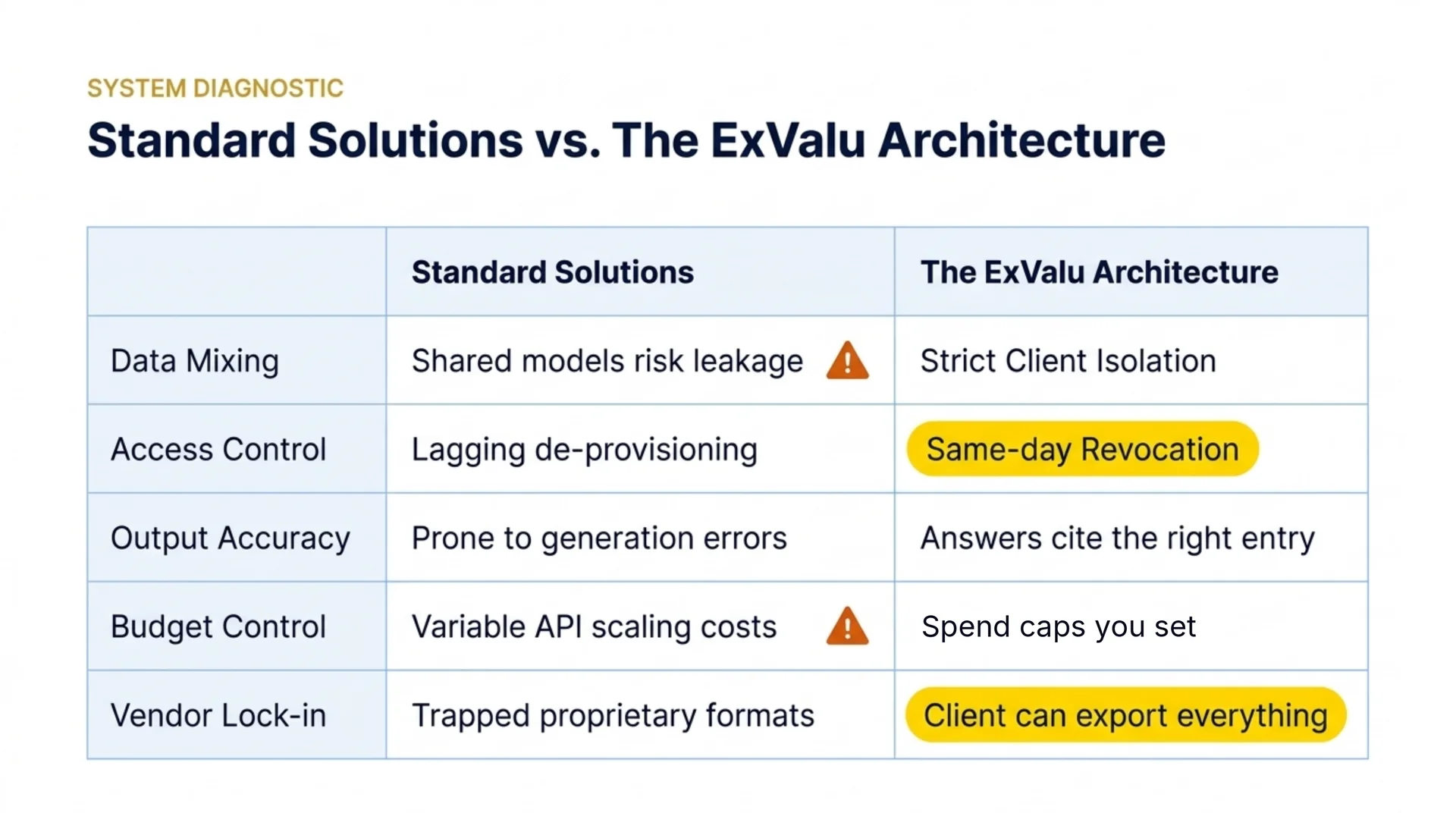
Many AI tools were built for speed first and control later. Here is how the difference shows up in practice:
Data mixing: shared models risk leakage, versus strict client isolation
Access control: slow de-provisioning, versus same-day revocation
Output accuracy: prone to generation errors, versus answers that cite the right entry
Budget control: variable API costs, versus spend caps you set
Vendor lock-in: trapped in proprietary formats, versus a client who can export everything
The full picture
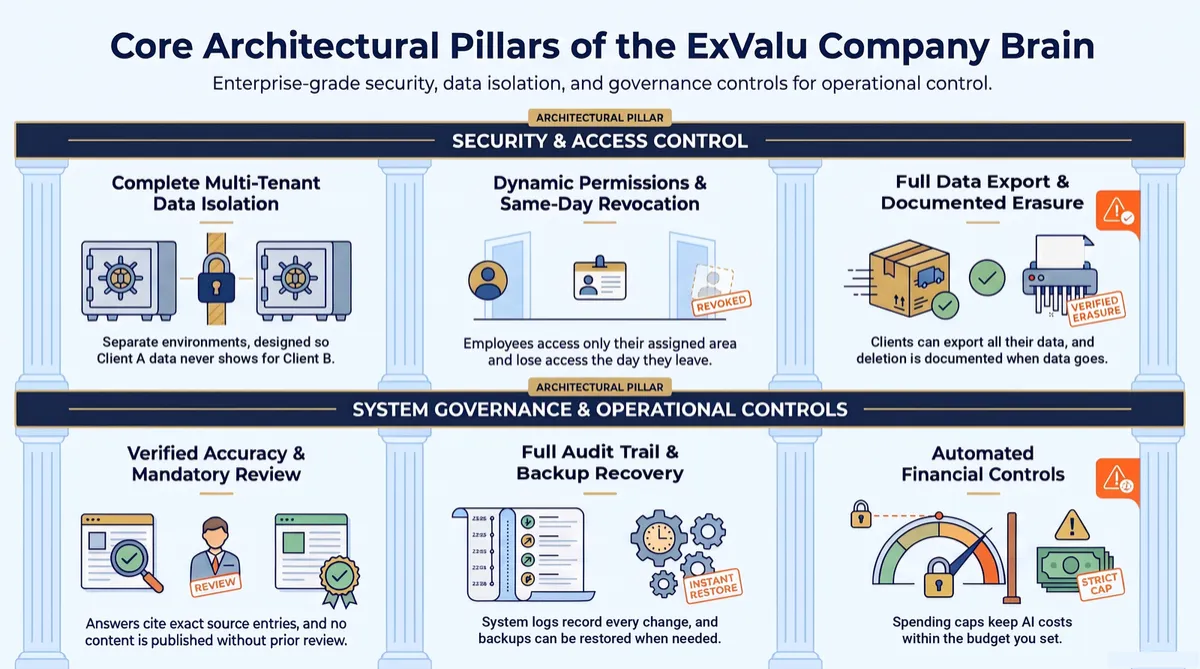
Put together, the six controls in the header infographic fall into two groups. Security and access control protects what you know. Governance and operational controls keep the system accurate, recoverable and on budget.
Total structural control
From data isolation to spend caps, the ExValu Company Brain works as a secure extension of your own company, one you can inspect, export and own.
For an owner preparing for exit, that is the point. Captured knowledge only adds value when it is owned, protected, verifiable and transferable. That is what a buyer pays for.
How much of your company's know-how could you prove is protected, owned and transferable today?
Want a head start? The Owner's Facts File is a free three-page template for writing down the facts only you know, each with a source, an approver and a review date. Get the Owner's Facts File
To find out whether a Company Brain fits your business, take the fit check. It takes a few minutes.
ExValu - Human vision, AI output.