
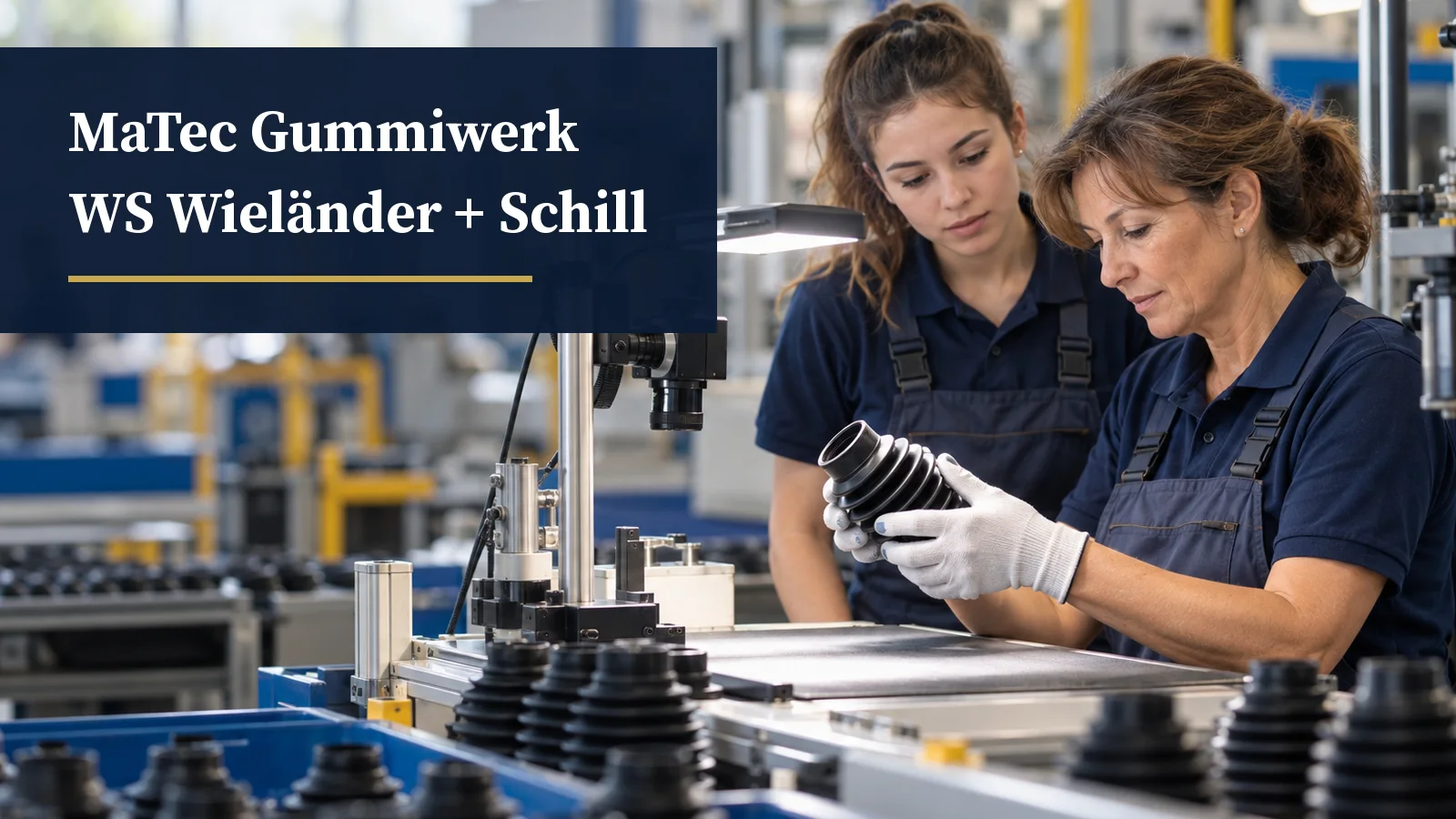
Some knowledge never makes it into words. An experienced worker feels when a part is right and can show it, but cannot write it down.
Two German manufacturers, MaTec Gummiwerk GmbH and WS Wieländer + Schill, joined a publicly funded research project to capture exactly that.
What the two manufacturers did
The WisPE project, coordinated by Pumacy Technologies with Fraunhofer and funded by the German federal research ministry and the European Social Fund Plus, ran from July 2024 to June 2026. It used cameras and sensor work clothing with machine learning to capture informal, experience-based knowledge and to give trainees individual feedback.
The pilots were assembly stations for special tools at WS Wieländer + Schill and final inspection in rubber part production at MaTec. Employees at both firms took part in the needs analysis. The project site reports a successful test at WS Wieländer + Schill and a successful close in June 2026. No figures are published yet, and a final report is due.
What it already gives the business
Katrin Bomball of Pumacy describes the aim: "With WisPE we want to make sure knowledge transfer in production happens more efficiently, to improve the quality of onboarding and to counter the loss of experience-based knowledge."
The two firms now have first-hand experience of what it takes to capture skills that live in people's hands, and of involving employees from the start.
The ExValu perspective, a hypothesis
Where a Company Brain could take it next
Sensors capture movements. The reasons behind them, why an expert rejects a part or adjusts a step, still need words.
A Company Brain could pair the recorded sequences with short explanations from the experts, so trainees learn both the motion and the judgment. Any monitoring of workers needs clear consent, an agreement with employee representatives and strict limits on the data. That is our hypothesis.
What an owner and a buyer would look for
Track training time for difficult tasks, quality rates for new staff and how many expert skills are documented.
A buyer of a manufacturer asks what happens when key skilled workers retire. Documented skills reduce that risk, and so does proof that data about workers was collected lawfully and with their agreement.
The problem behind this case
Facing the same problem?
About this analysis
* The image is AI-generated and does not show MaTec Gummiwerk or WS Wieländer + Schill staff. The facts and figures on this page come from the published source named below.
This is an independent ExValu analysis of a published case. Facts, figures and names are as reported in the source below, which our team checked on October 12, 2026. The ideas for next steps are our own perspective and make no claim about conditions inside MaTec Gummiwerk and WS Wieländer + Schill. To request a correction or removal, write to [email protected]. Quotes from the German-language source are translated by our team.
Primary source: Funded research project, Zukunft der Wertschöpfung and the WisPE project, 2024 to 2026. Available at www.zukunft-der-wertschoepfung.de/projekte/kmu-innovativ-wissensbasierte-produktionshilfe-beruhend-auf-bild-und-sensorbasierter-externalisierung-von-erfahrungswissen-wispe.