
The Old Internet vs. the New Internet
The Old Internet vs. the New Internet: What It Actually Means If You Plan to Sell
Alex runs an accounting and advisory firm. Eighteen years in, forty clients, a reputation built one referral at a time. When a private equity scout called last spring to ask about a sale, Alex assumed the conversation would be about the numbers: retention, margins, growth.
It wasn't. The first real question was: "If you took a two-month sabbatical tomorrow, what would break?"
Alex didn't have a clean answer.
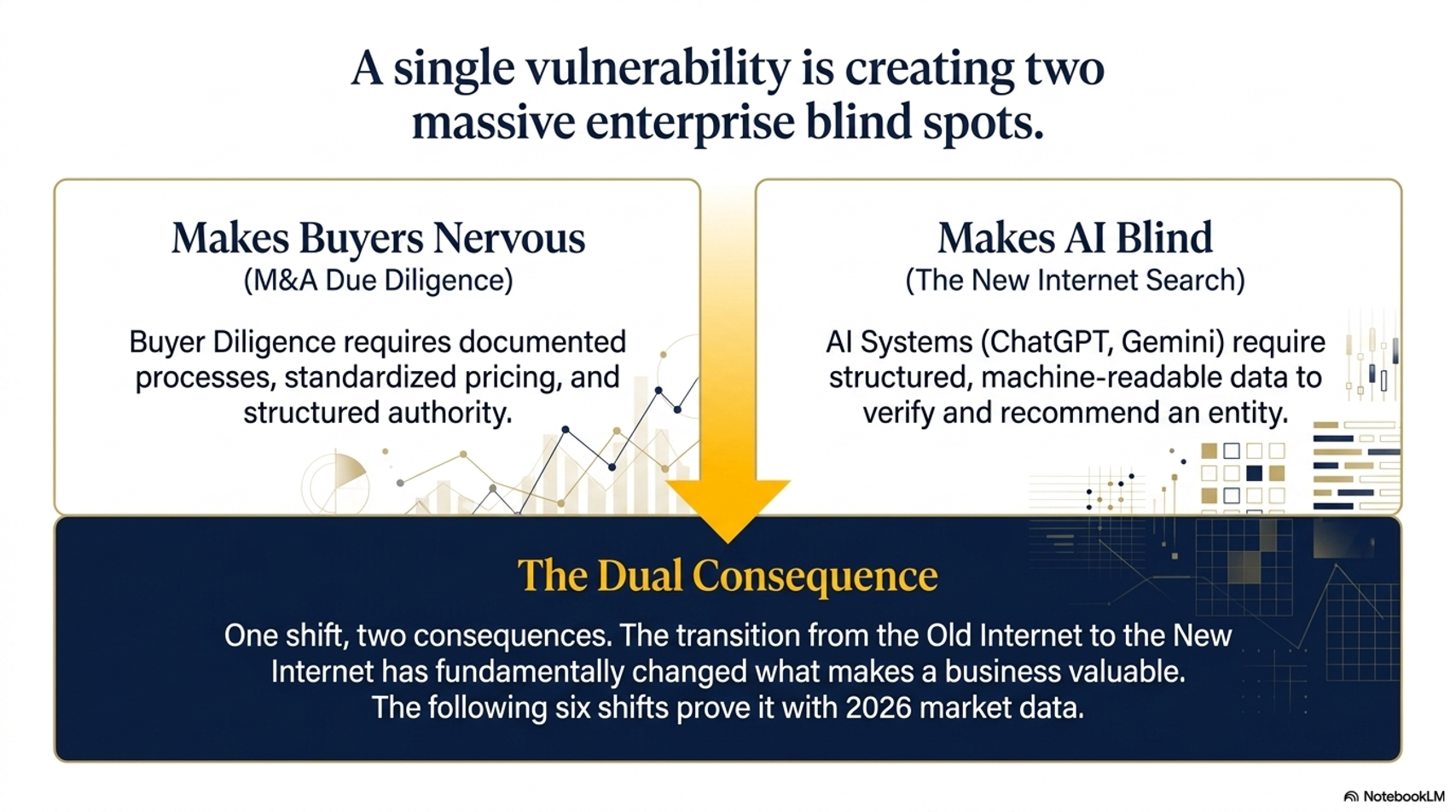
Most owners in this position don't, and there's a second, less obvious problem sitting right next to it. The same knowledge gap that makes a buyer nervous is the exact thing that makes AI systems unable to find, trust, or recommend the business at all. One shift, two consequences.
Six things that just changed
There's a comparison worth sitting with, because it's not marketing theory, it's already showing up in real 2026 data across service businesses.
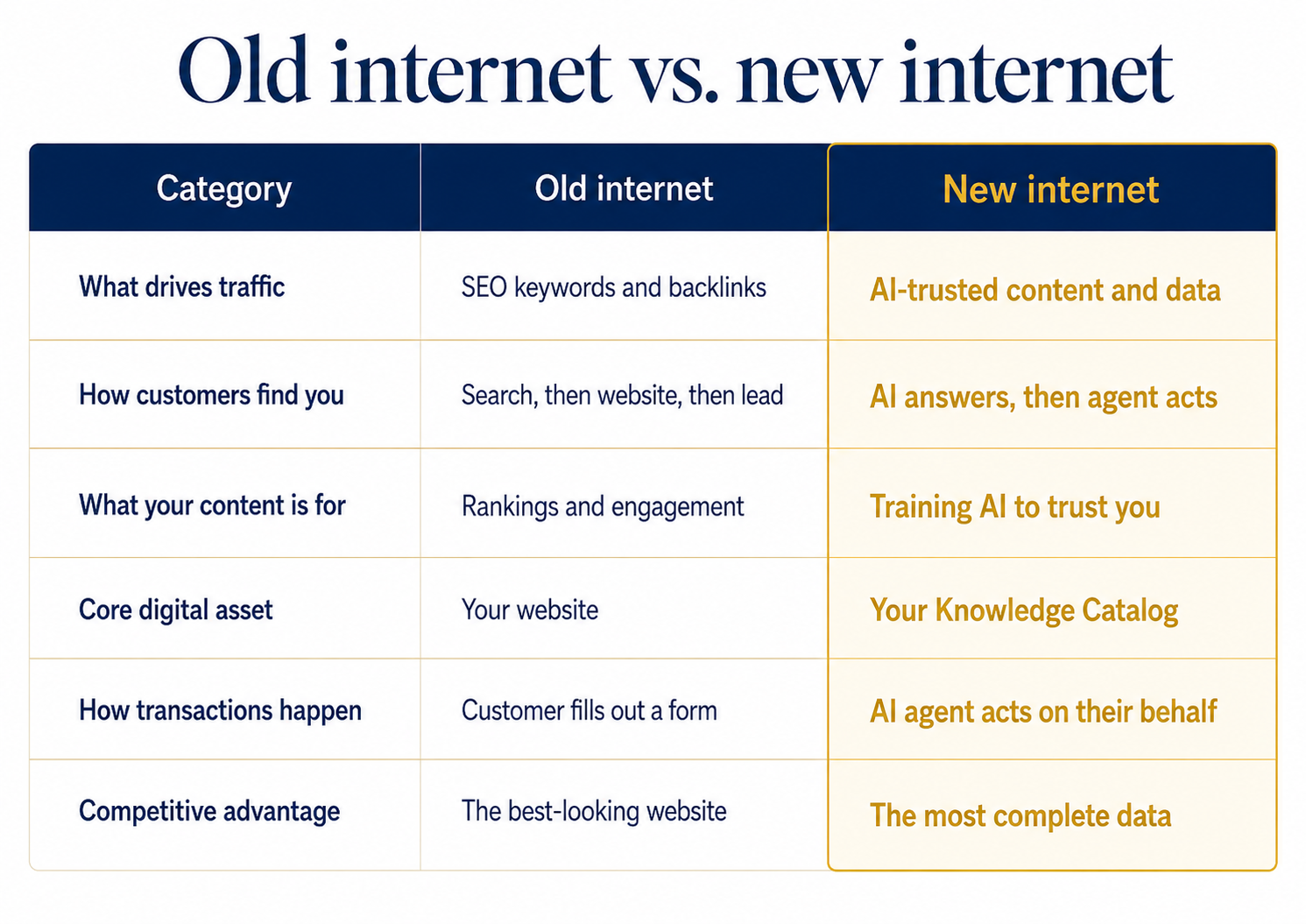
Each row is a real shift with real evidence behind it, and each one lands differently depending on whether you're marketing the business or preparing to sell it. That second lens is the one most articles on this topic skip entirely.
Row 1: What drives traffic
Jobber's 2026 Home Service Trends Report, based on a survey of home service business owners published in March 2026, found referrals still account for 59% of lead volume. What separates the businesses clearing $500K or more isn't better referrals. It's a four-channel stack layered on top: Facebook driving 32% of digital leads, Google organic and AI Overviews at 20%, Local Services Ads at 19%, YouTube and Instagram filling the rest. The same report found 88% of high-confidence business owners already use AI in daily operations, against 27% of the owners who describe themselves as struggling, a 3.3x gap that's currently the single biggest performance divider in that data set.
Practical step: audit where your last twenty leads actually came from, not where you assume they came from. If referrals are your only channel, you're not competing on quality, you're just not competing.
Row 2: How customers find you
An analysis by Hook Agency, cited alongside the Jobber data, put it plainly: ads don't introduce a business anymore, they confirm one. By the time someone clicks a Local Services Ad, they've already read the AI-generated answer, skimmed the reviews, and glanced at the service page. Roughly 60% of Google searches are now estimated to end without a click at all, because the AI Overview already answered the question and named three businesses.
Practical step: pull up your own top three service categories and ask ChatGPT, Gemini, or Google directly which local providers it would recommend. If your business doesn't appear, you've just seen the new front door, and it's currently locked from your side.
Row 3: What your content is for
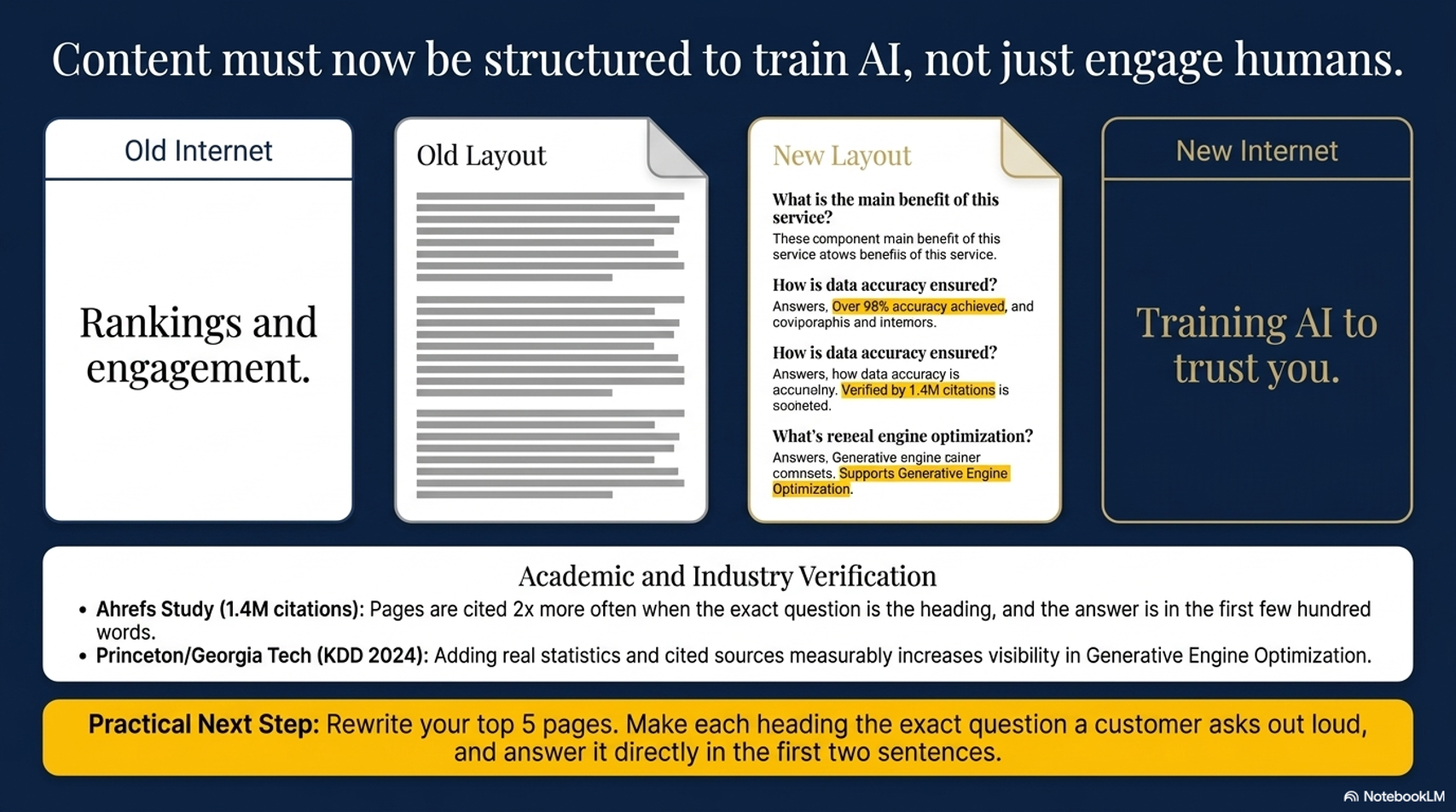
Ahrefs studied 1.4 million ChatGPT citations and found pages get cited roughly twice as often when they answer a direct question in the heading itself, and that over half of what gets quoted comes from a page's first few hundred words. A separate, peer-reviewed Princeton and Georgia Tech study found that adding real statistics and cited sources to a page measurably increases how often generative engines surface it. Old-internet content was written to rank. New-internet content is written to be extracted and trusted.
Practical step: rewrite your five most important pages so each heading is the exact question a customer says out loud, then answer it in the first two sentences, not the fifth paragraph.
Row 4: Your core digital asset
This is the one that should actually worry an owner thinking about an exit, and the evidence is stark. Plumbing & Mechanical magazine reported in May 2026 that roughly 87% of independent HVAC and plumbing contractors in the US have effectively zero AI citation share in their own metro and category, even businesses with 800-plus five-star reviews and thirty years of relationships. The citation surface is instead dominated by a small set of national brands (Roto-Rooter, Mr. Rooter, ARS/Rescue Rooter) and contractor software platforms (ServiceTitan, Housecall Pro, Jobber), based on the 5W HVAC & Plumbing AI Visibility Index 2026, which tested over 65 prompts across ChatGPT, Claude, Perplexity, and Google AI Overviews. The gap in what that research calls "entity strength," consistent business data, structured markup, trade-press coverage, is roughly 8x between the biggest and smallest players, the largest gap measured in any consumer category studied.
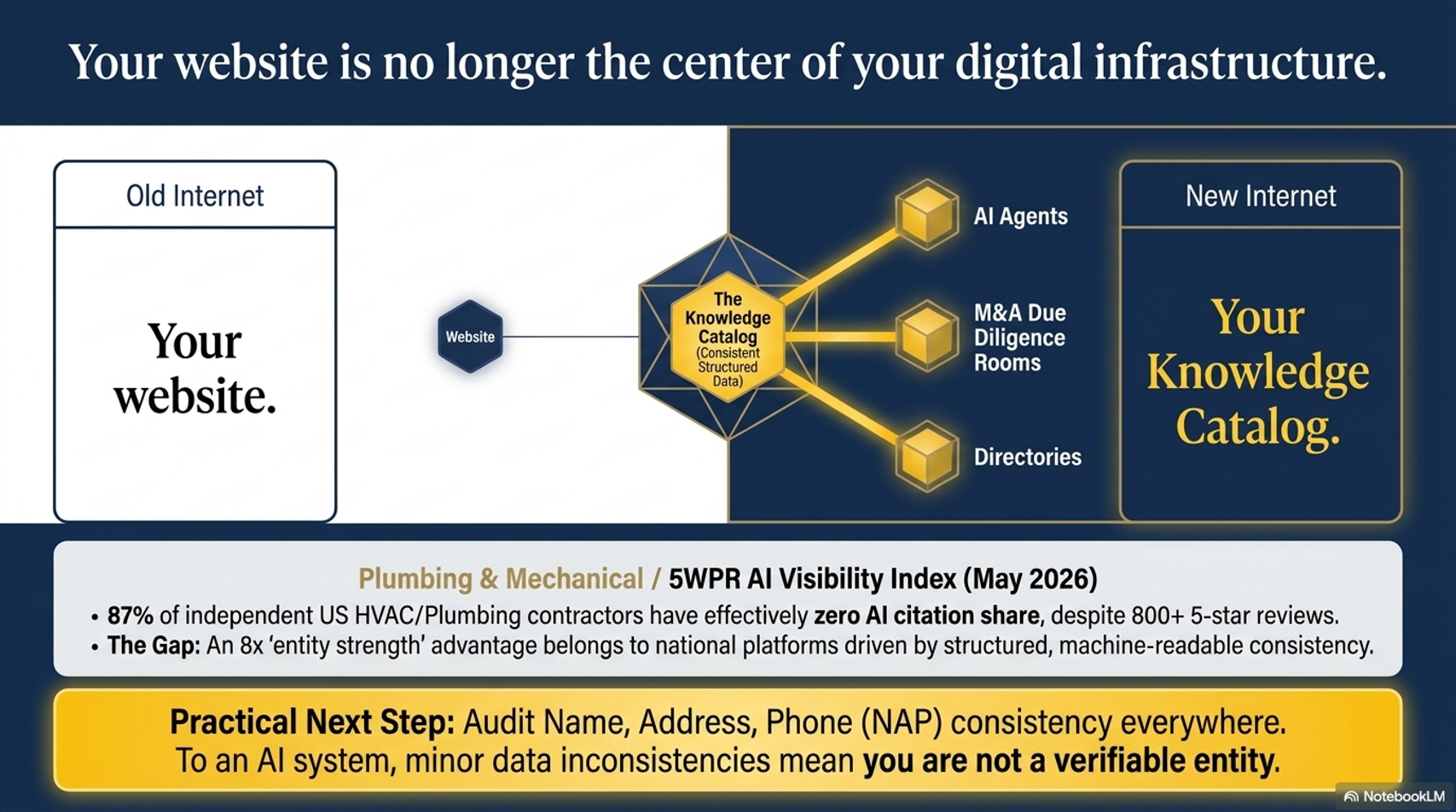
Your website used to be the asset. Now it's one input into something bigger: a structured, consistently published, machine-readable record of what you do, what you charge, and why you're credible. Call it a Knowledge Catalog. Nobody owns that term yet as an industry standard (Google Cloud uses it for enterprise data governance, which is a different thing entirely), so treat it here as a specific, buildable asset rather than a buzzword.
Practical step: check whether your business name, address, and phone number are identical across your website, Google Business Profile, and every directory you're listed on. Inconsistency here is invisible to a human and disqualifying to an AI system trying to confirm you're a real, verifiable entity.
Row 5: How transactions happen
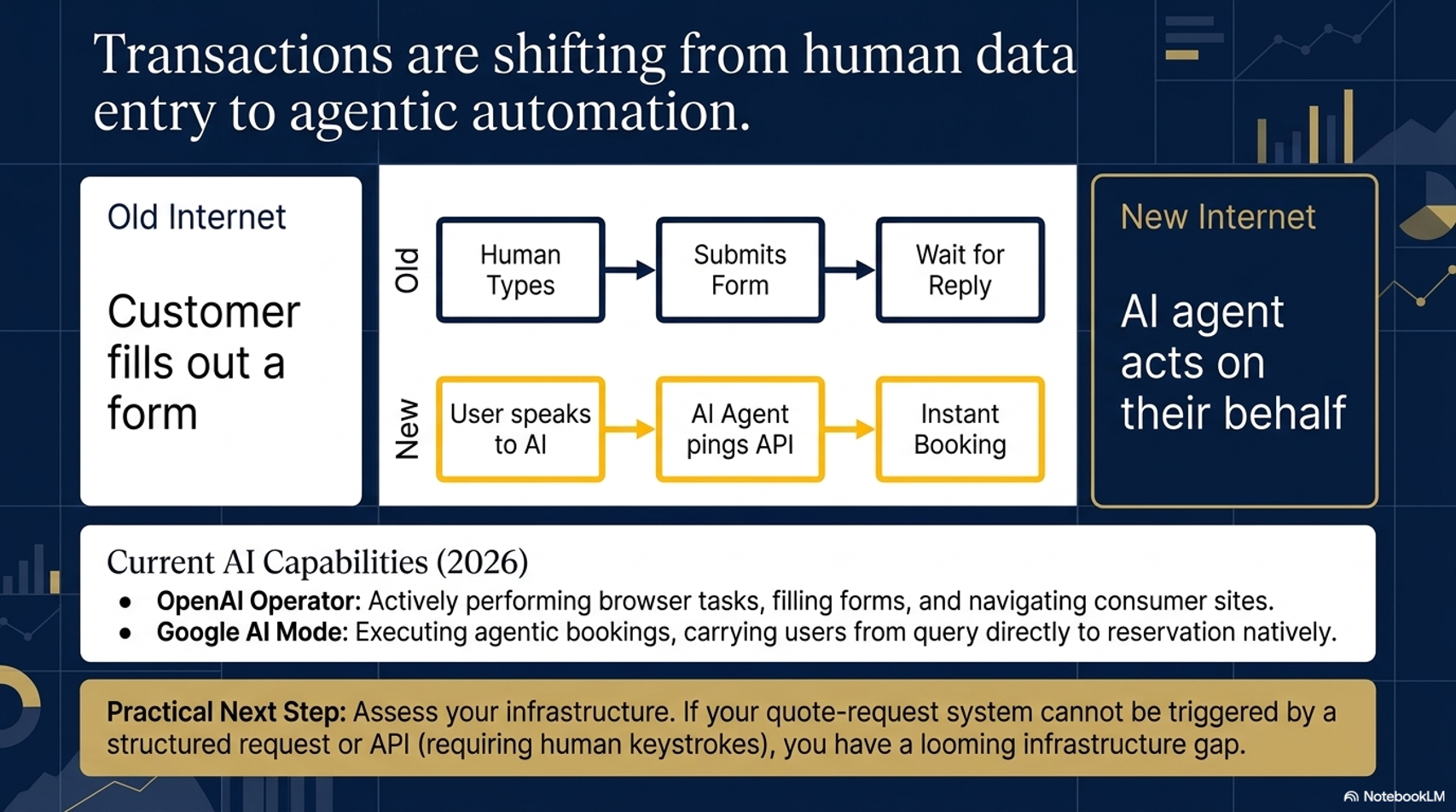
OpenAI's Operator already performs browser tasks like filling out forms and ordering groceries. Google has built agentic booking into AI Mode, carrying a user from a question straight through to a restaurant reservation. Today that's restaurants and groceries. It's a narrower, earlier trend than the marketing hype suggests, but the direction is clear enough that a contact form which only a human can fill out is already a slightly outdated piece of infrastructure.
Practical step: if your booking or quote-request system can't be triggered by an API or a structured request, not just a human typing into a web form, that's your next infrastructure gap, not today's emergency.
Row 6: Competitive advantage
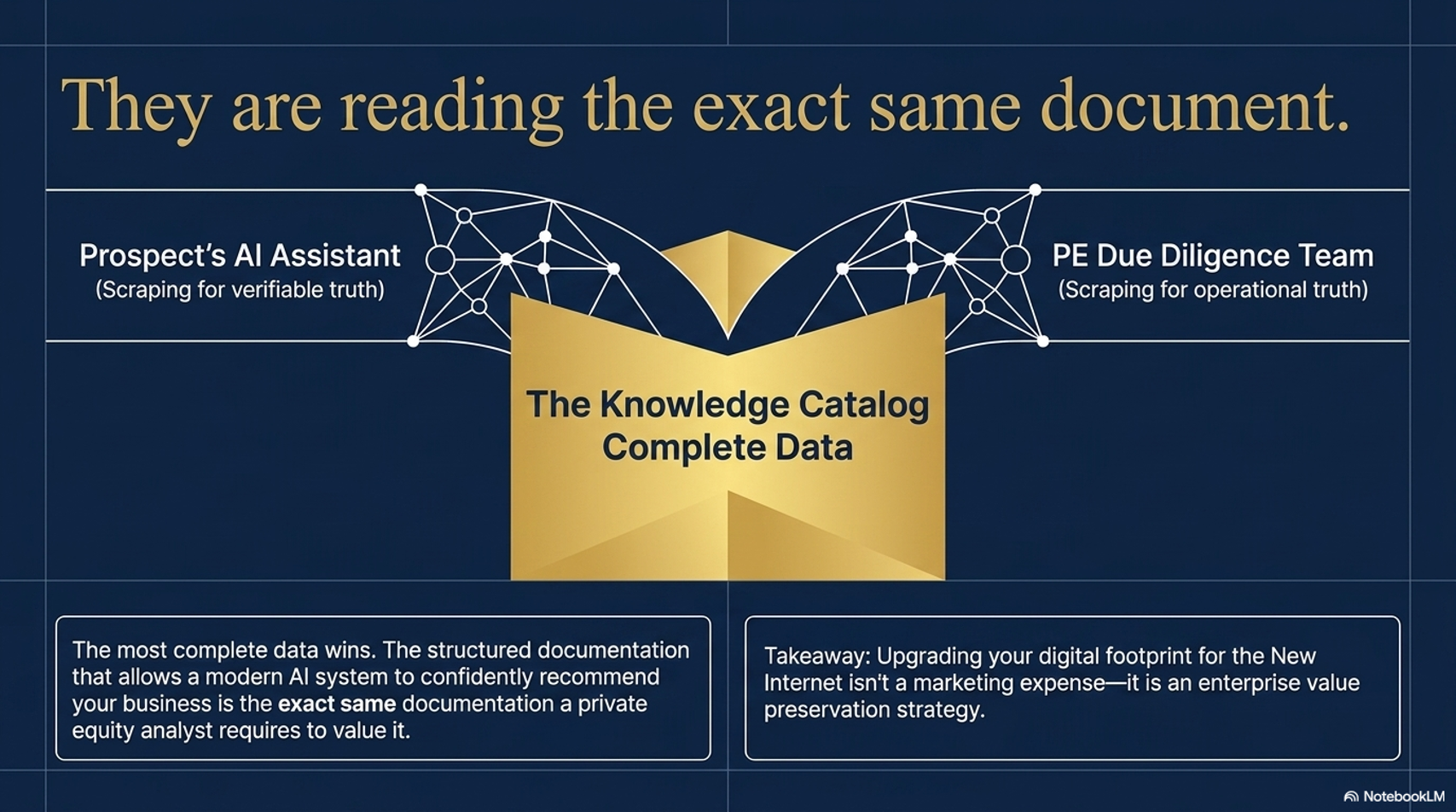
Here's where the two threads in this article, AI visibility and exit-readiness, turn out to be the same thread. "The most complete data" isn't just a marketing edge that helps a prospect find you over a competitor. It's the identical asset a buyer's due diligence team asks for once they've found you: documented pricing logic, SOPs, a decision authority matrix, evidence the business runs without its owner in the room. Business valuation literature, specifically Shannon Pratt's widely used framework, puts the discount for key-person dependency at roughly 10 to 25 percent, not the inflated 20 to 40 percent figure that circulates in broker marketing without new data behind it. On a business valued at two million, that's still 200,000 to 500,000 sitting on the table.
Nobody has published a named, audited case study proving that better documentation directly raised a specific sale price. That's worth admitting plainly rather than pretending otherwise. What is documented, repeatedly, is what buyers ask for during diligence: SOPs, a decision authority structure, evidence customer relationships don't live only in the owner's head, and the informal test that keeps coming up in advisor conversations, whether the business survived a real stretch, often two to four weeks, with the owner genuinely absent.
Building it
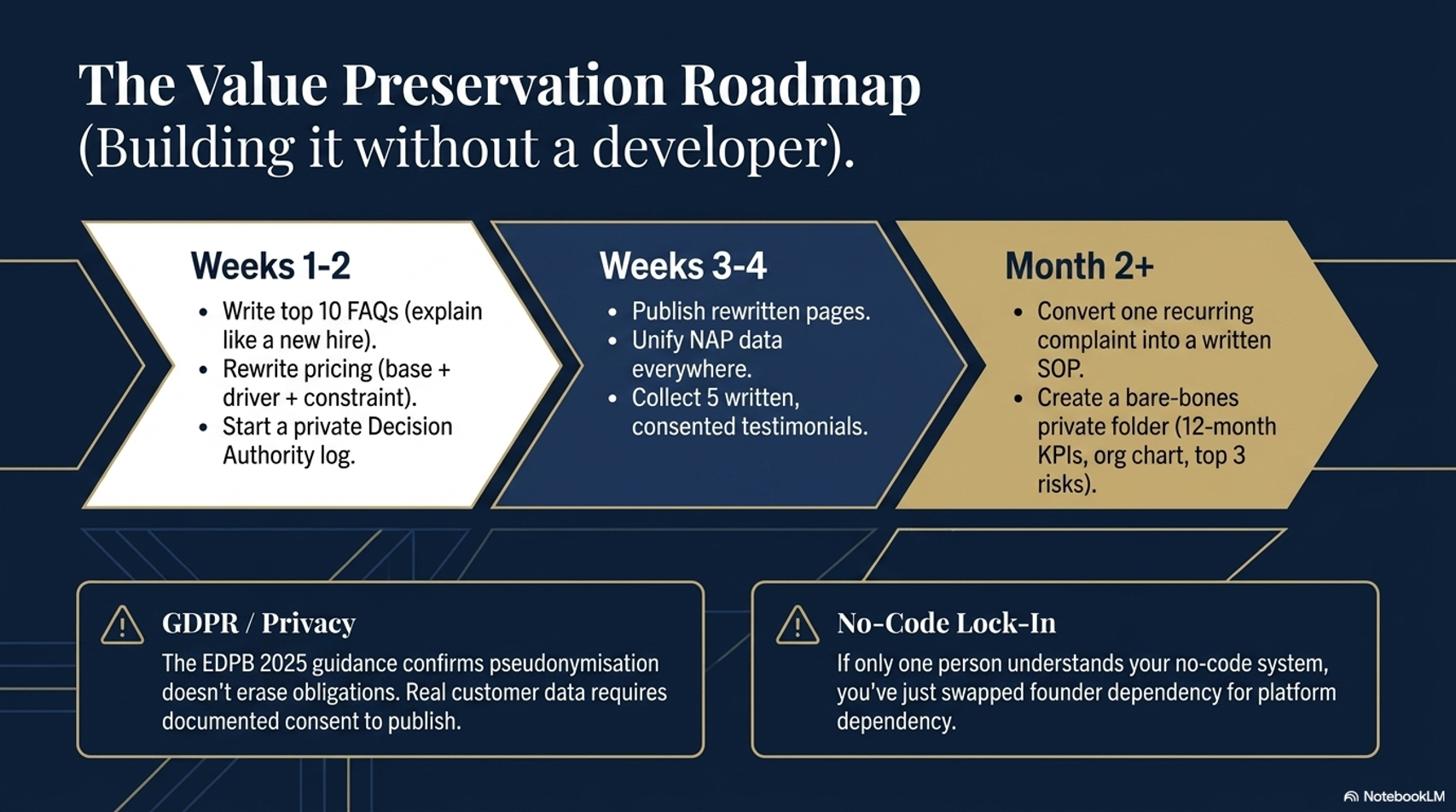
The full version of this, public content plus a private due-diligence file, is a genuine project. The short version that gets you moving this month:
Weeks 1 to 2. Write down your ten most-asked customer questions and answer each one the way you'd explain it to a new hire. Rewrite your pricing as a base fee plus a variable driver plus a constraint, not a vague range. Start a private list titled Decision Authority: every decision that currently requires you personally.
Weeks 3 to 4. Publish the rewritten service, pricing, and FAQ pages. Check your name-address-phone consistency everywhere you're listed. Ask five past customers for a written, consented testimonial rather than lifting quotes from an email thread.
Month 2 onward. Turn one recurring complaint into a written SOP and hand it to someone other than yourself. Pull together a bare-bones private folder: twelve months of KPI data, an org chart, your top three risks. It doesn't need to be polished. It needs to exist before someone asks for it.
Two things worth a single line each rather than a full section. If your Knowledge Catalog includes real customer names, transcripts, or testimonials, that's personal data under GDPR, and publishing it needs documented consent, not a line buried in your terms of service, especially with the European Data Protection Board's 2025 guidance on pseudonymisation making clear that pseudonymising data doesn't erase your obligations. And no-code platforms can quietly create their own lock-in: if only one person understands how the system is organized, you've swapped owner dependency for platform dependency, which isn't much of an upgrade.
Back to Alex
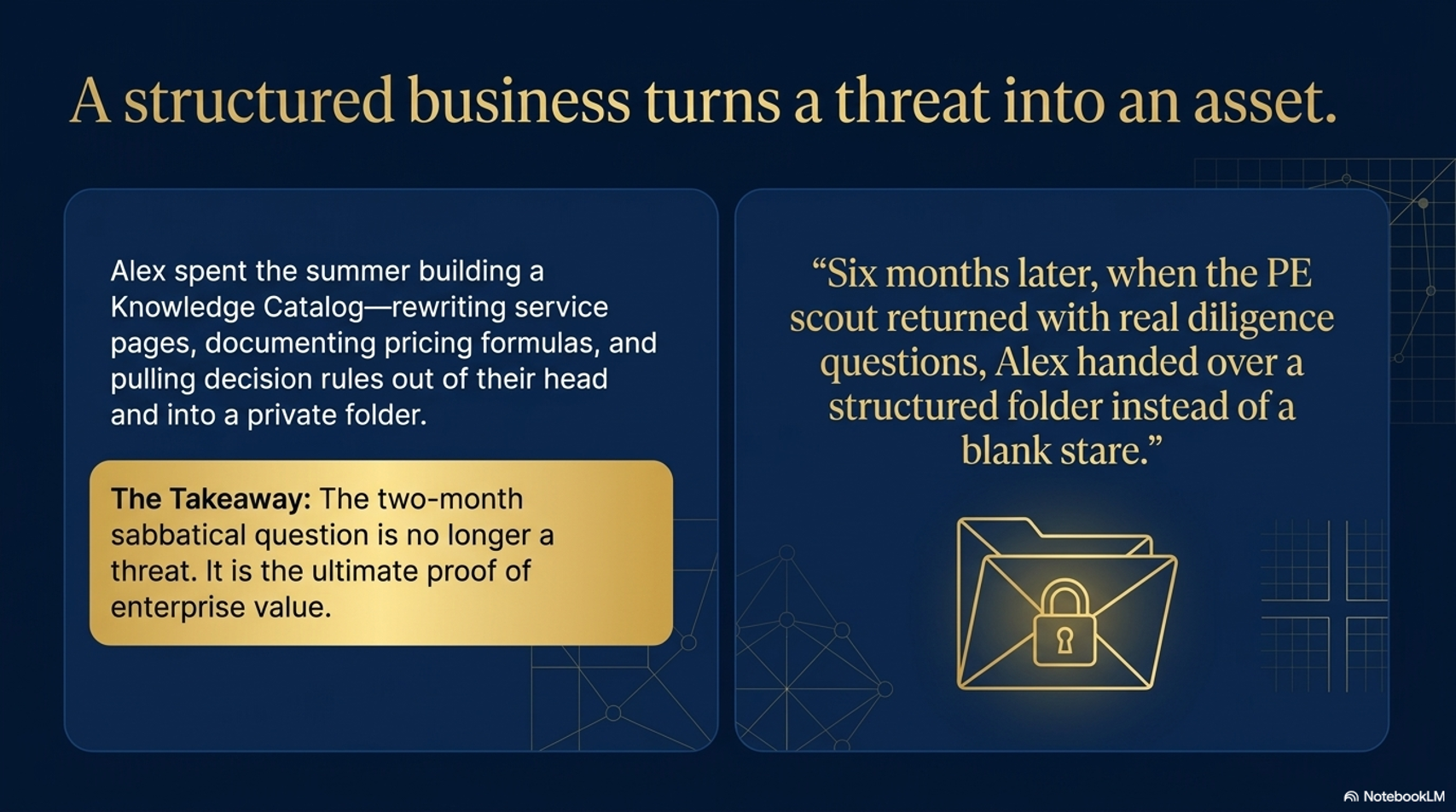
Alex spent that summer building exactly this: rewritten service pages, a documented pricing formula, a private folder of SOPs and decision rules that used to live only in Alex's head. Six months later, when the PE scout came back with real diligence questions, there was a folder to hand over instead of a blank stare. The sabbatical question doesn't cause the same stomach-drop it used to.
Old internet: the best-looking website wins. New internet: the most complete data wins, and it turns out that's true whether the audience asking is a prospect's AI assistant or a buyer's due diligence team. They're reading the same document either way.

If you're one to three years out from a sale and want a structured, buyer-ready version of this built for your business, that's the core of what we do at ExValu. Happy to walk through what your version would look like.
Sources
2026 Home Service Trends Report, Jobber, published March 25, 2026
Jobber 2026 Trades Report: The Four-Channel Stack Of $500K-Plus Shops, Marketing Code, May 21, 2026
HVAC & Plumbing AI Visibility Index 2026, 5W Public Relations
Generative Engine Optimization, Princeton and Georgia Tech, KDD 2024
EDPB guidelines on anonymisation and web scraping for generative AI, July 2026