

Your Website Is Talking to Robots Now
Your Website Is Talking to Robots Now. Does It Know What to Say?
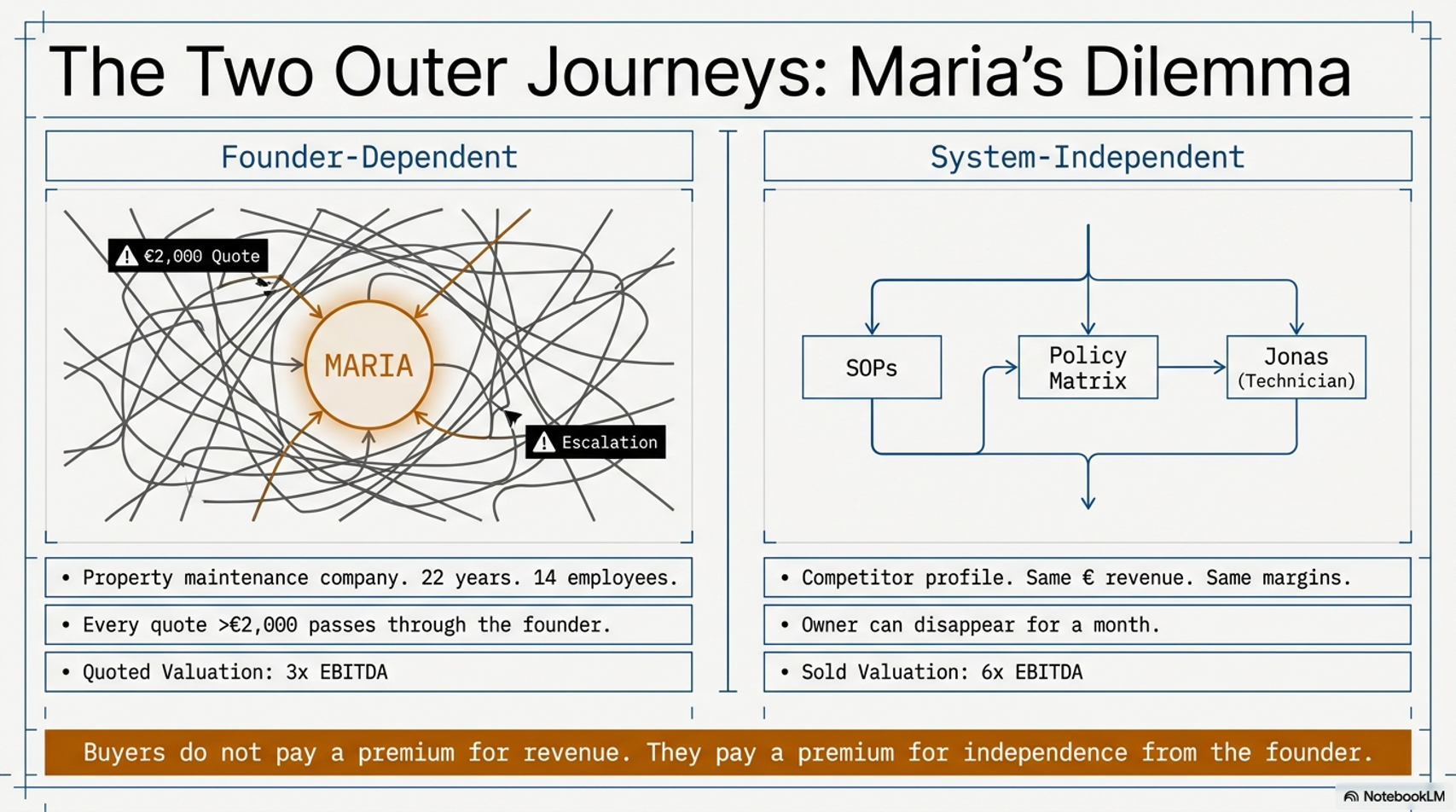
Maria runs a mid-sized property maintenance company. Twenty-two years in. Fourteen employees. The kind of business that quietly keeps a neighborhood's boilers running and its gutters clear, and that nobody thinks about until something breaks.
Two years ago, a broker told her the business was worth 3x EBITDA. Nice number, until she found out a similar company two towns over sold for 6x. Same revenue. Same margins. The only real difference: that other owner could disappear for a month and the business wouldn't notice.
Maria could not. Every quote over €2,000 went through her. Every escalated complaint landed on her phone. Her best technician, Jonas, carried two decades of troubleshooting knowledge that existed nowhere except in Jonas's head.
That gap between 3x and 6x wasn't a market problem. It was a Maria problem.
Why "exit-ready" and "AI-ready" just became the same project ...
This article is about the fix for that problem,
and about a second, unrelated-looking shift that happens to solve it too.
The two journeys every founder is on, whether they notice or not
Every founder heading toward an exit is running two journeys at once.
The outer journey is the one on the checklist: get the numbers clean, find a buyer, survive due diligence, sign.
The inner journey is quieter and usually ignored: stop being the business, and start being the person who built something that works without them.
That shift, from load-bearing wall to architect, is what buyers actually pay a premium for. Not revenue. Independence from you.
Most founders only work the outer journey.
This article is about a tool that forces you to work both at once,
because it happens to be useful for a completely different reason too.
A trend that's real, not hype
Here's the unrelated-looking shift: search is quietly splitting in two.
People still Google things.
But a growing slice of questions, "who does roof repair near me and what does it actually cost," now go through ChatGPT, Gemini, or Perplexity instead.
Gartner predicted a 25% drop in traditional search volume by 2026. Worth flagging though that this is a 2024 forecast, not a measured result, so treat it as directional.
What we can actually measure: ChatGPT handles roughly 2.5 billion prompts a day, about 12% of Google's volume, and its own share of the AI-chatbot market fell from 87% to 62% in a single year as Gemini and Claude ate into it. Whatever this is, it isn't settling down.
Here's the part that matters for a business like Maria's: AI assistants don't crawl a page and improvise an answer.
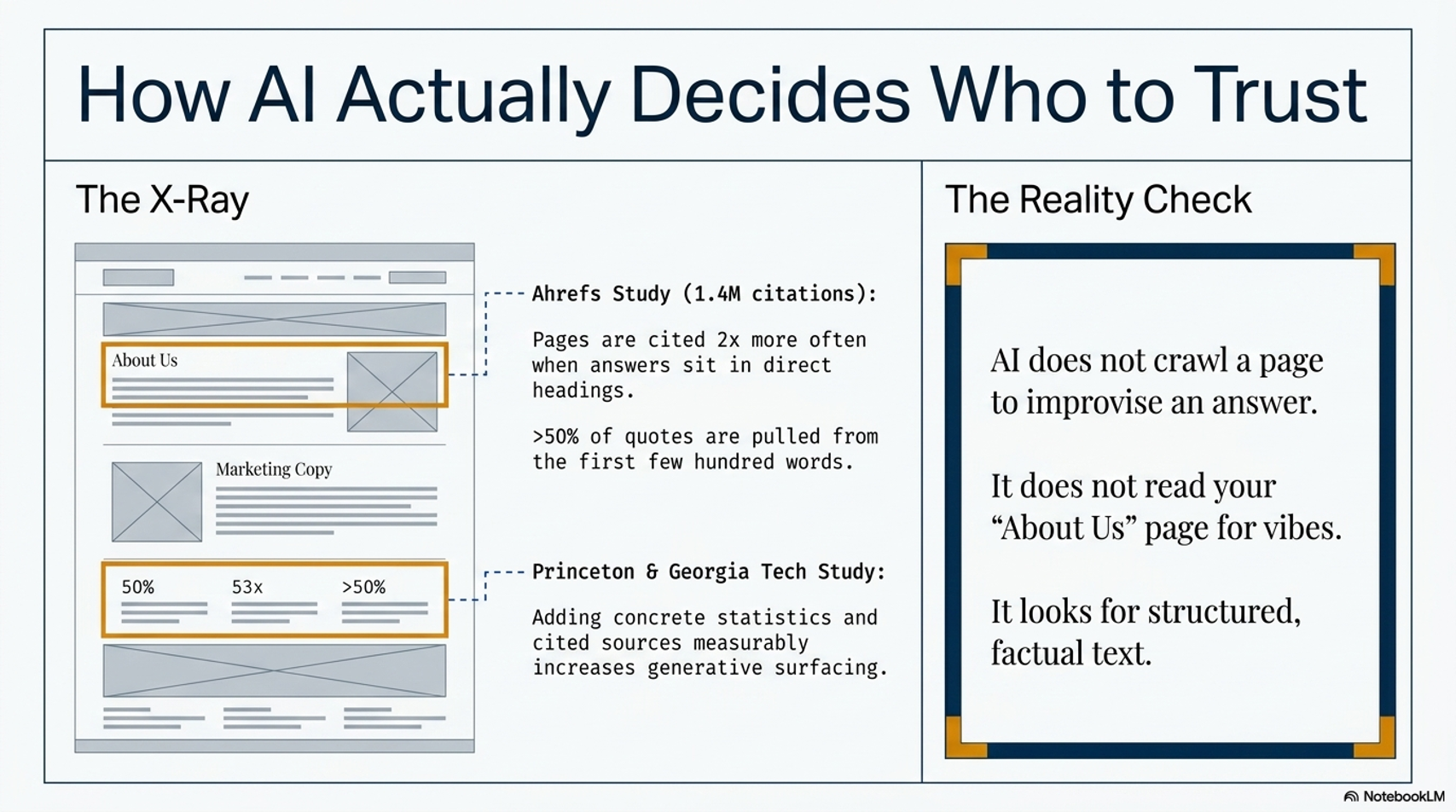
Ahrefs studied 1.4 million ChatGPT citations and found something specific: pages get cited roughly twice as often when they answer a question directly in a heading, and over half of what gets quoted comes from the first few hundred words of a page. Separately, a peer-reviewed Princeton and Georgia Tech study found that adding real statistics and cited sources to a page measurably increases how often generative engines surface it.
Translation: the AI answering your prospective customer's question isn't reading your "About Us" page for vibes. It's looking for a direct, well-structured, factual answer. If your business doesn't have one sitting somewhere findable, the AI answers with whoever does.
So there are two separate problems here:
Whether a buyer trusts the business without you in it.
And whether an AI recommends your business at all.
The fix for both turns out to be the same document.
Introducing the Knowledge Catalog
Call it a Knowledge Catalog: a structured, written-down version of everything your business knows.
Not a slogan-filled homepage, and not a 400-page operations binder nobody opens. A specific, organized set of answers, the same ones a well-trained employee would give, and the same ones a buyer's due diligence team will ask for anyway.
Worth being precise here. There's a real, documented trend called Generative Engine Optimization (GEO) or Answer Engine Optimization (AEO): writing content so AI systems can find, trust, and cite it. That part is well established.
"Knowledge Catalog" isn't yet an industry-standard label for the SME-exit version of that idea, so think of it here as a name for a specific framework rather than a term you'd find in a textbook. The distinction matters because this framework has a second half that ordinary SEO content doesn't: due diligence readiness.
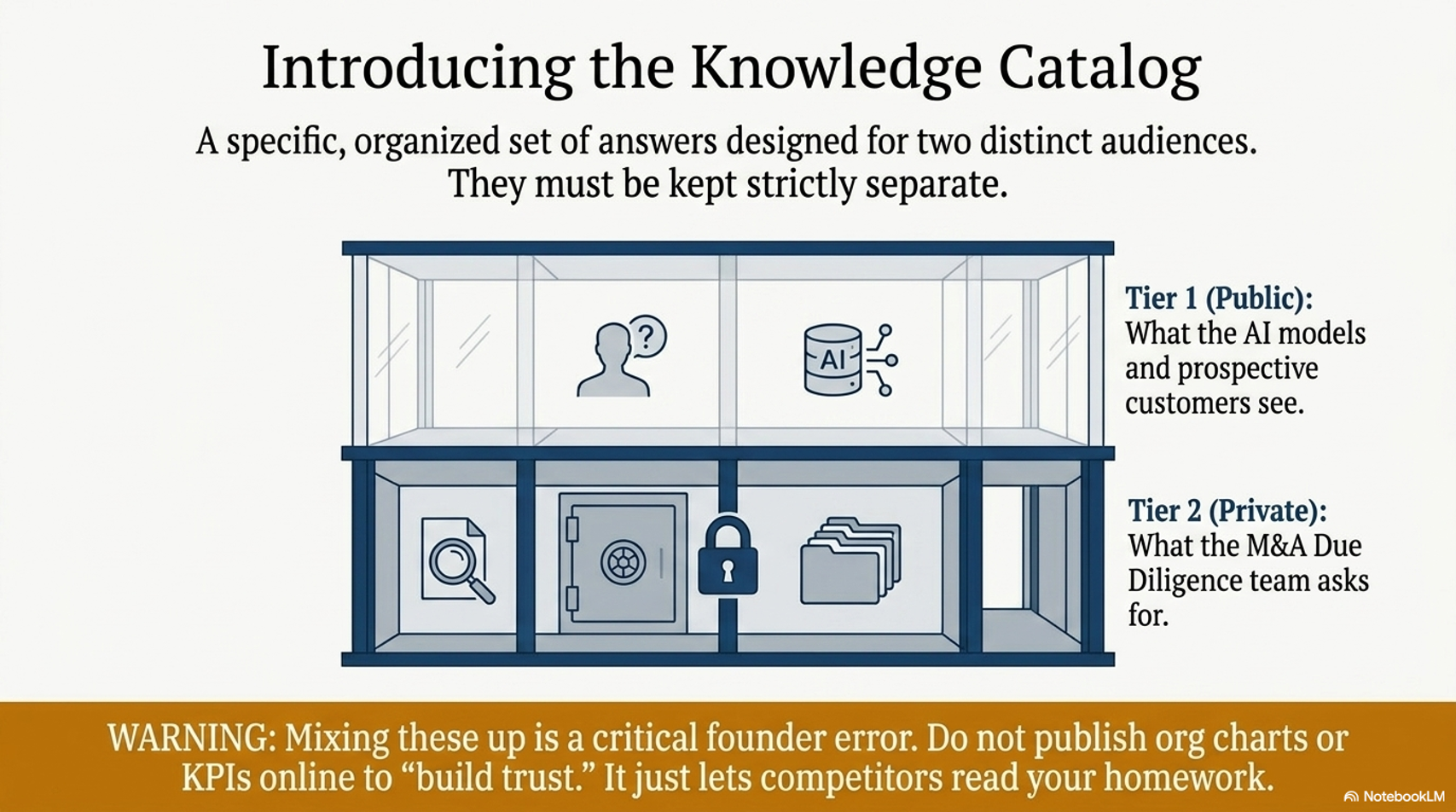
A Knowledge Catalog has two halves,
and mixing them up is the most common mistake founders make.
Half one: the PUBLIC file, what AI and prospects see
Real questions your customers actually ask, not generic blog filler
Transparent pricing logic (more on the right way to do this below)
Services and service areas, stated plainly
Policies, guarantees, credentials
FAQs written as direct questions with direct answers
Half two: the PRIVATE file, what a buyer's due diligence team asks for
Documented SOPs for every core function
A decision authority matrix: who can approve what, without you
Twelve months of KPI history
Customer concentration and pipeline data
A succession plan for every key role, including yours
Keep these separate. One is marketing.The other is confidential and belongs in a locked data room, released in stages as a deal progresses, which is standard M&A practice, not a Knowledge Catalog invention. Publishing your KPI history or org chart on your website doesn't help anyone. It just lets your competitors read your homework too.
Getting the pricing right (this actually changed)
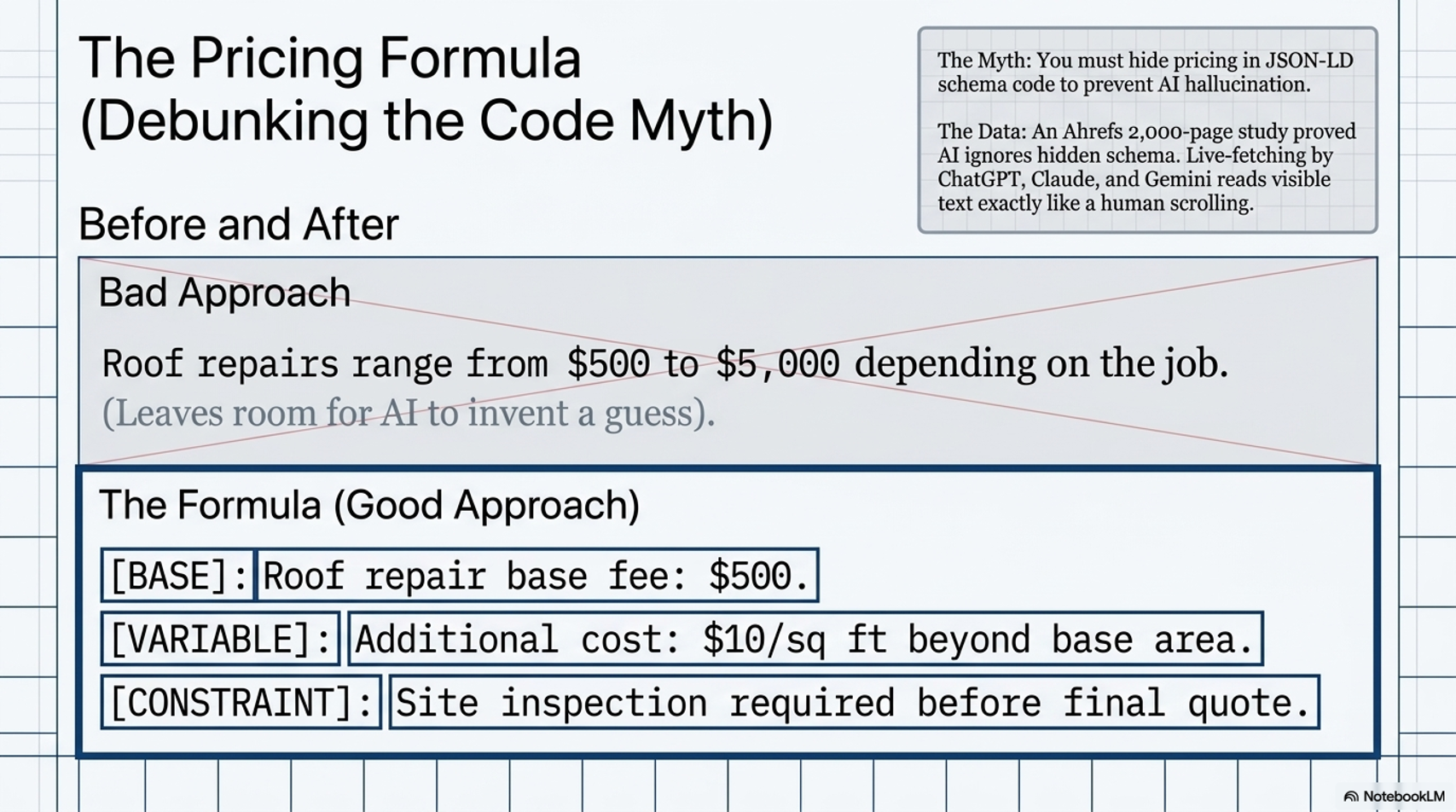
Common advice says to mark up your pricing page with structured data, known as JSON-LD schema, so AI can't hallucinate your prices. Reasonable-sounding. Also, according to a controlled Ahrefs study of nearly 2,000 pages, not true.
Adding that schema produced no measurable improvement in how often ChatGPT or Google's AI Mode cited the page. A follow-up test went further: when ChatGPT, Claude, Gemini, and Perplexity fetch a page in real time, apparently none of them read the hidden schema markup at all. They read the visible text on the page, the same as a person scrolling would.
So the fix isn't buried code. It's how you write the actual sentence.
Compare:
Bad: "Roof repairs typically range from $500 to $5,000 depending on the job."
Good: "Roof repair base fee: $500. Additional cost: $10 per square foot beyond the base area. A site inspection is required before a final quote is issued."
The second version gives an AI, or a human, a formula instead of a guess: base fee, variable driver, constraint. There's nothing left to invent.
What this is actually worth to a buyer
Here's where it gets specific, and what's proven and what isn't.
Business valuation literature, specifically Shannon Pratt's widely used framework, puts the discount for key-person dependency at roughly 10 to 25 percent. Not the 20 to 40 percent figure that circulates in broker marketing content, which stretches Pratt's original range without any new data behind it. Ten to twenty-five percent is still real money. On a business valued at €2 million, that's €200,000 to €500,000 sitting on the table because the business can't run without its owner.
What buyers and their advisors actually ask for during due diligence, consistently, across current M&A guidance:
documented SOPs,
a clear decision authority structure,
evidence that customer relationships don't live only in the founder's head,
and proof the business survived a real stretch, often two to four weeks, sometimes longer, with the owner genuinely absent.
One caveat, worth stating rather than pretending otherwise: nobody has yet published a named, audited case study proving that better documentation directly raised a specific sale price. The logic is sound, and every advisor in the space repeats it, but the receipts, with real numbers attached to a real company, don't exist publicly yet. That's not a weakness in the argument. It's an opening for whoever documents it first.
The GDPR part nobody mentions
If your Knowledge Catalog includes a customer's name, a testimonial quote, or a real call transcript, that's personal data, and publishing it needs a lawful basis, usually documented consent, not just a line buried in your terms of service.
This is freshly relevant: the European Data Protection Board adopted new guidelines on anonymisation and on web scraping for generative AI on 8 July 2026, open for consultation through the end of October. The practical takeaway for a founder building a public knowledge catalog: assume anything you publish will eventually be scraped and used as AI training data, and don't put a real customer's name or story into it without their documented sign-off. Anonymized, composite examples are safer and, done well, just as useful.
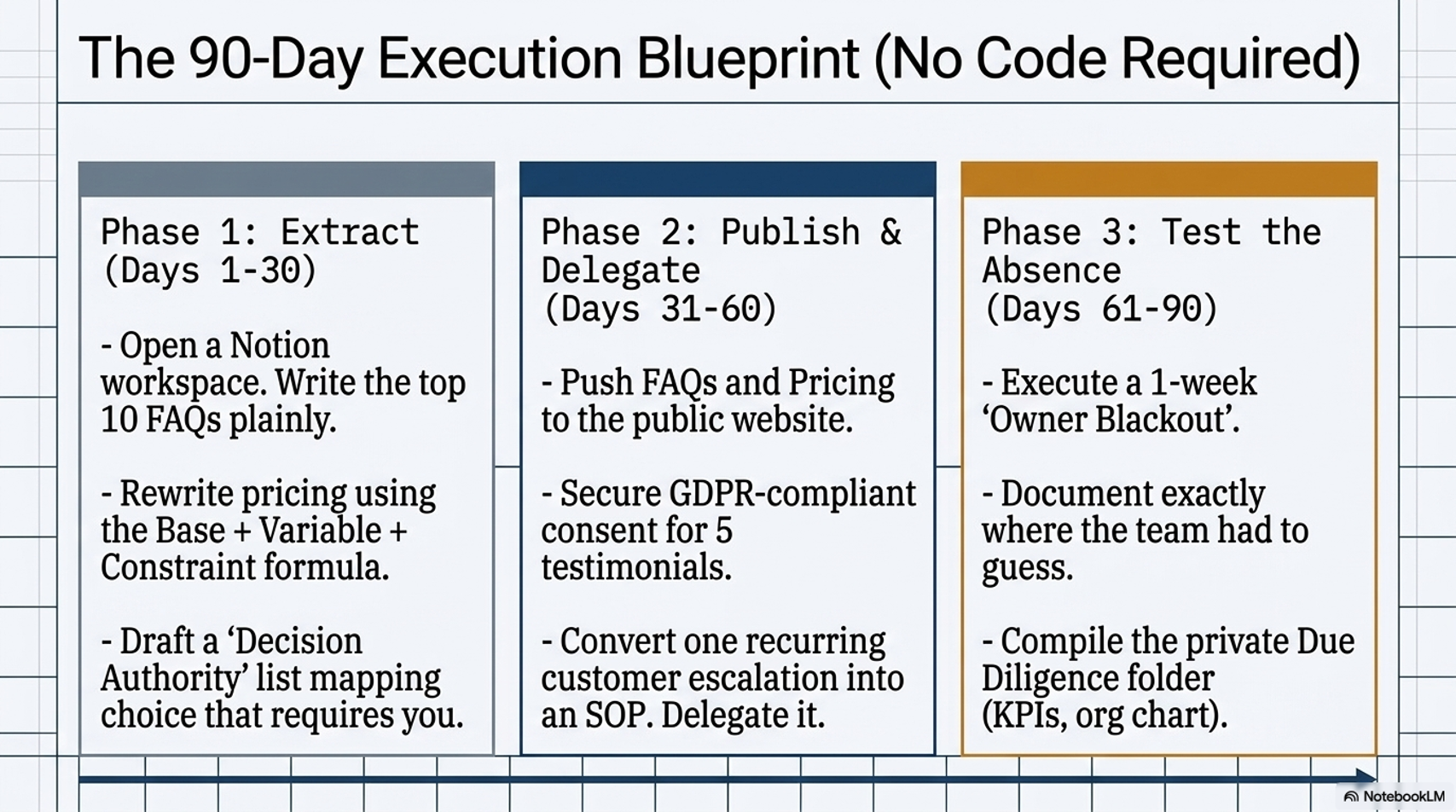
Getting started: a 30/60/90 for a company founder
You don't need a developer. You need a weekend, a spreadsheet, and the discipline to write things down once instead of explaining them out loud for the twelfth time.
Days 1 to 30: get it out of your head
Open a free Notion workspace. One page per topic: Services, Pricing Logic, FAQs, Policies.
Write your ten most-asked customer questions, and answer each one the way you'd explain it to a new hire: plainly, in two or three sentences.
Rewrite your pricing as base fee plus variable driver plus constraint, per the example above. No ranges, and no "it depends" without explaining what it depends on.
Start a second, private Notion page or folder titled Decision Authority. List every decision that currently requires you, personally. That list is your roadmap for delegation.
Days 31 to 60: make it public and provable
Publish the Services, Pricing, and FAQ pages to your website, or share the public Notion pages through a custom domain.
Ask five past customers for a testimonial, with a plain written consent line: "may we publish your name and quote on our website?" Only use the ones who say yes in writing.
Pick one recurring customer complaint or escalation, write it up as an SOP, and hand it to someone other than you the next time it happens. Watch what breaks. Fix that.
Days 61 to 90: test the absence, not just the documents
Block out one full week, tell your team in advance, and don't answer business calls. Note every moment someone had to guess what you would have done. Turn each one into a line in your Decision Authority document.
Pull together a bare-bones private due diligence folder: the last twelve months of KPI data, your org chart, your top three risks. It doesn't need to be polished. It needs to exist.
Reread your public pages as if you were a stranger asking your own AI assistant a question. If the honest answer isn't sitting somewhere on the page, add it.
None of this requires a platform migration or a six-figure project. It requires writing down, once, what's currently only in your head, which happens to be the exact thing that makes a business sellable too.
Back to Maria
Six months into building her version of this, Maria hadn't sold the business yet. But she'd taken a real week off for the first time in four years, and the business ran without a single emergency call to her cell phone. Jonas had a written troubleshooting guide with his name on it. Pricing was a formula, not a guess. And when a broker asked for a decision authority matrix, she had one instead of a blank stare.
The valuation conversation hasn't happened yet. But the gap between founder-dependent and system-independent, the one separating 3x from 6x, had already started closing, well before the business changed hands.
p.s. Mind the Gap: If you're one to three years out from a company exit and want a structured, buyer-ready version of this built for your business, the public layer and the private due diligence layer both, that's what we do at ExValu.