
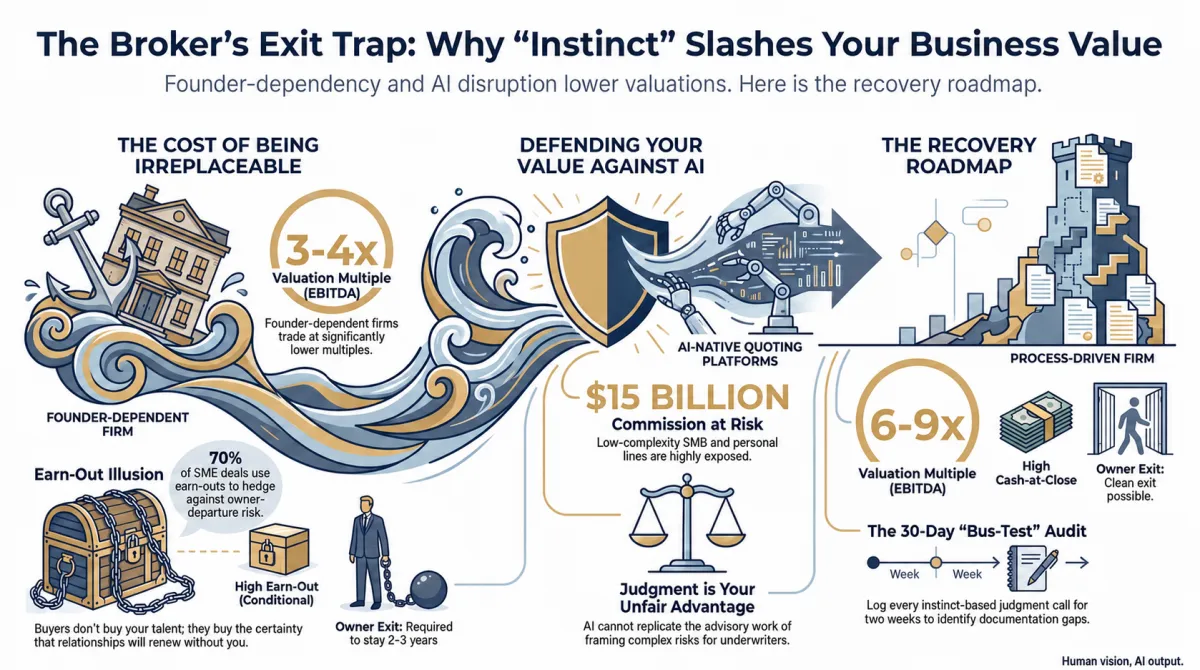
The Broker Who Can't Really Retire
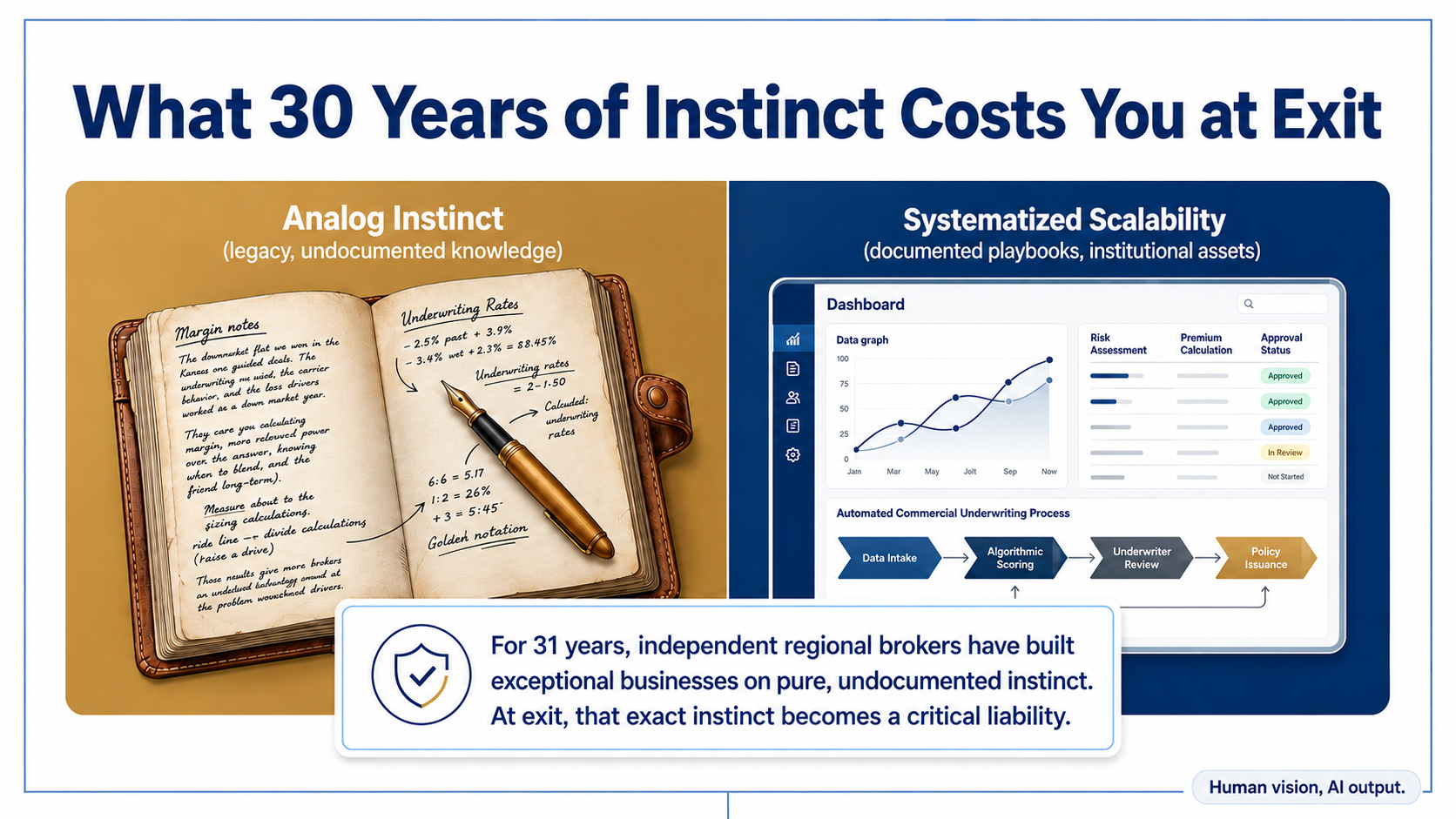
What 30 Years of Instinct Business Building Costs You at Company Exit
The Reality of Success: 31 years of placing regional commercial lines on pure, undocumented instinct.
The Baseline Profile: A look at a composite, highly successful independent commercial brokerage—Hartree & Vance Commercial Insurance Brokers Ltd.
The Impending Transition: Evaluating what happens when a long-time founder prepares to step away.
For over three decades, independent brokers have built highly successful businesses on pure, undocumented instinct. But when it comes time to transition, those years of specialized knowledge can become a liability if they remain locked in the owner’s head. This presentation uses the composite profile of Hartree & Vance to examine how documenting daily operational judgment is the single most critical factor in securing a premium exit valuation.
Case Study Hartree & Vance Commercial Insurance Brokers
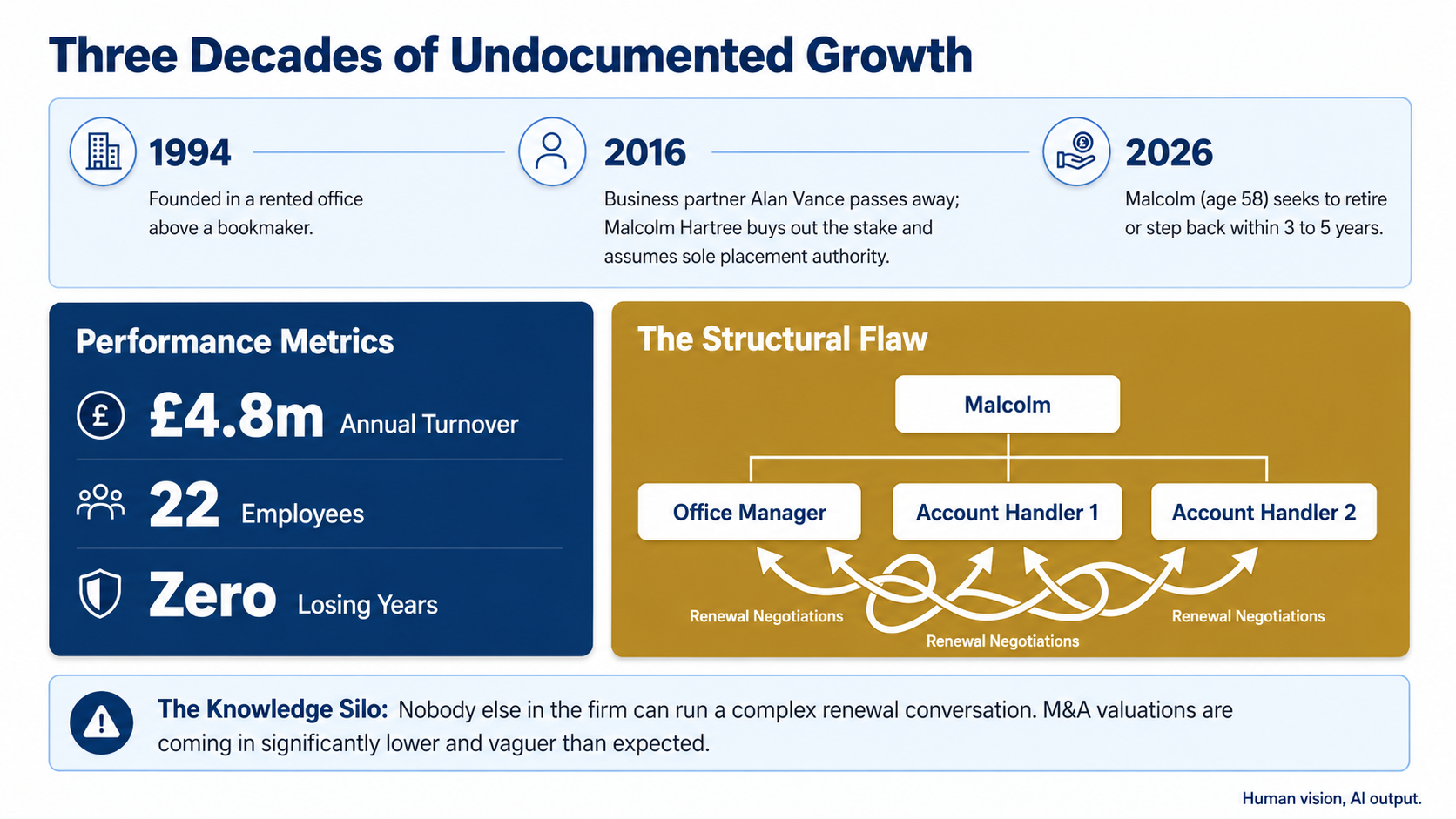
Three Decades of Undocumented Growth
The Firm’s Performance: Established in 1994; turns over £4.8m annually with 22 employees and has never had a losing year.
The Operational Reality: Alan Vance passed away in 2016; Malcolm Hartree bought out his stake and never replaced him.
The Knowledge Silo: While supported by an office manager and two capable account handlers, nobody else in the firm can run a complex renewal conversation.
The Target Exit: Malcolm is 58 years old and plans to retire or stop working full-time in the next 3 to 5 years.
Hartree & Vance is a classic example of a highly successful, independent regional brokerage. It generates £4.8m in annual turnover, supports 22 staff, and has been consistently profitable since its founding in a rented office above a bookmaker's in 1994. However, since his business partner's passing in 2016, Malcolm Hartree has run the placement side of the business alone. At age 58, he is looking to retire in the next 3 to 5 years, only to find that M&A valuations are coming in significantly lower and vaguer than expected.
The Secret Financial Language of Valuation Multiples
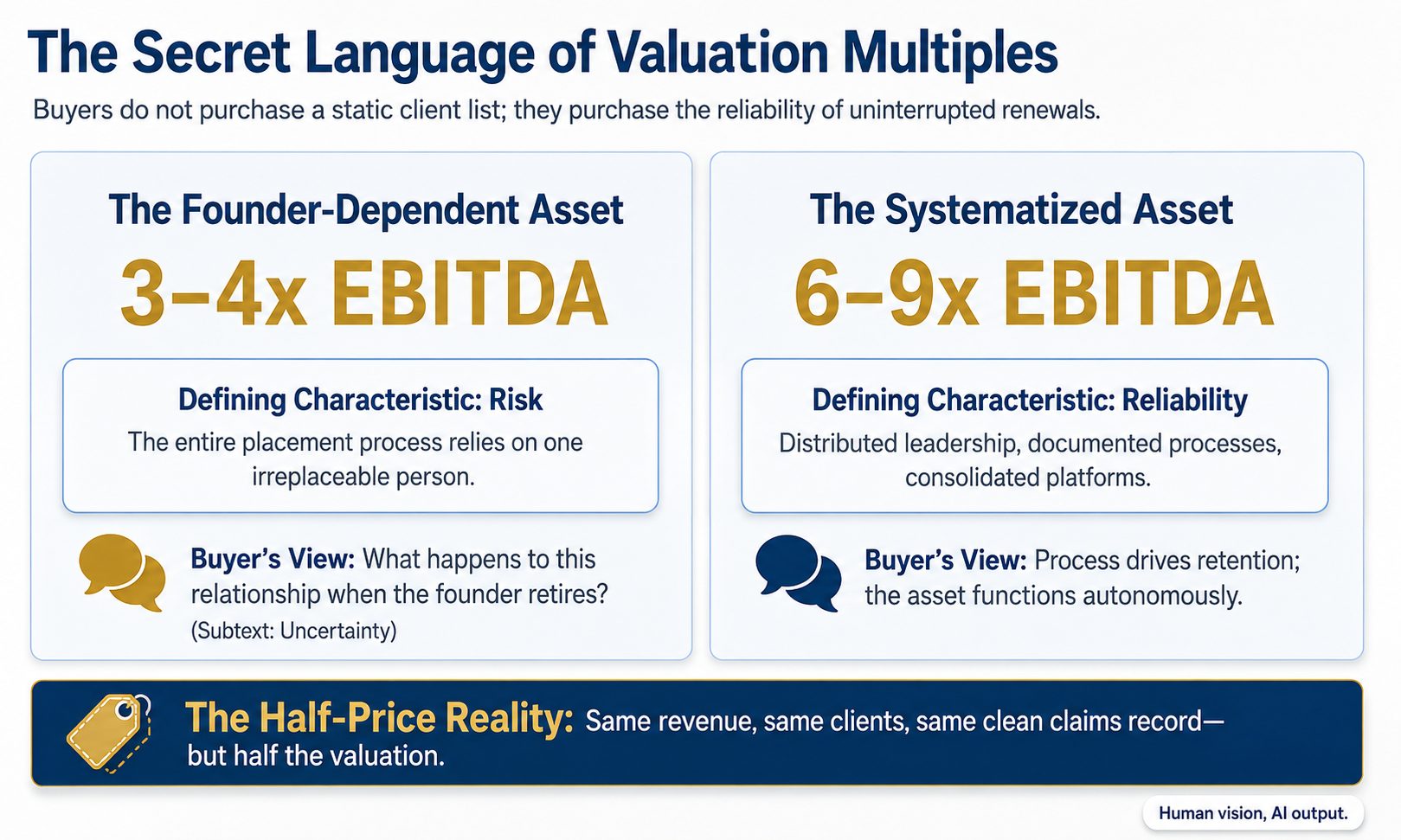
Reliability vs. Risk
The Buyer's Actual Asset: M&A buyers are not purchasing a static list of clients; they are purchasing the reliability of those renewals continuing uninterrupted.
The Key-Person Discount: Uncertainty over whether clients will stay after the founder leaves is priced directly as risk.
The Multiple Split:
6–9x EBITDA: Awarded to firms with distributed leadership, documented processes, and consolidated platforms.
3–4x EBITDA: Applied to firms where the entire placement process relies on one irreplaceable person.
The Half-Price Reality: Same revenue, same clients, same clean claims record—but half the valuation.
Broker owners often expect their business to sell for a standard multiple of what it earns. But a valuation multiple is simply a tool to price the reliability of future cash flows. When a buyer asks "what happens to this relationship when Malcolm retires," and the answer is "nobody knows," that uncertainty is heavily discounted. This key-person discount routinely cuts the sale price of a broker's lifetime work by 50% or more, even if the underlying revenue and clients are identical to a systemized competitor.
The Earn-Out Trap
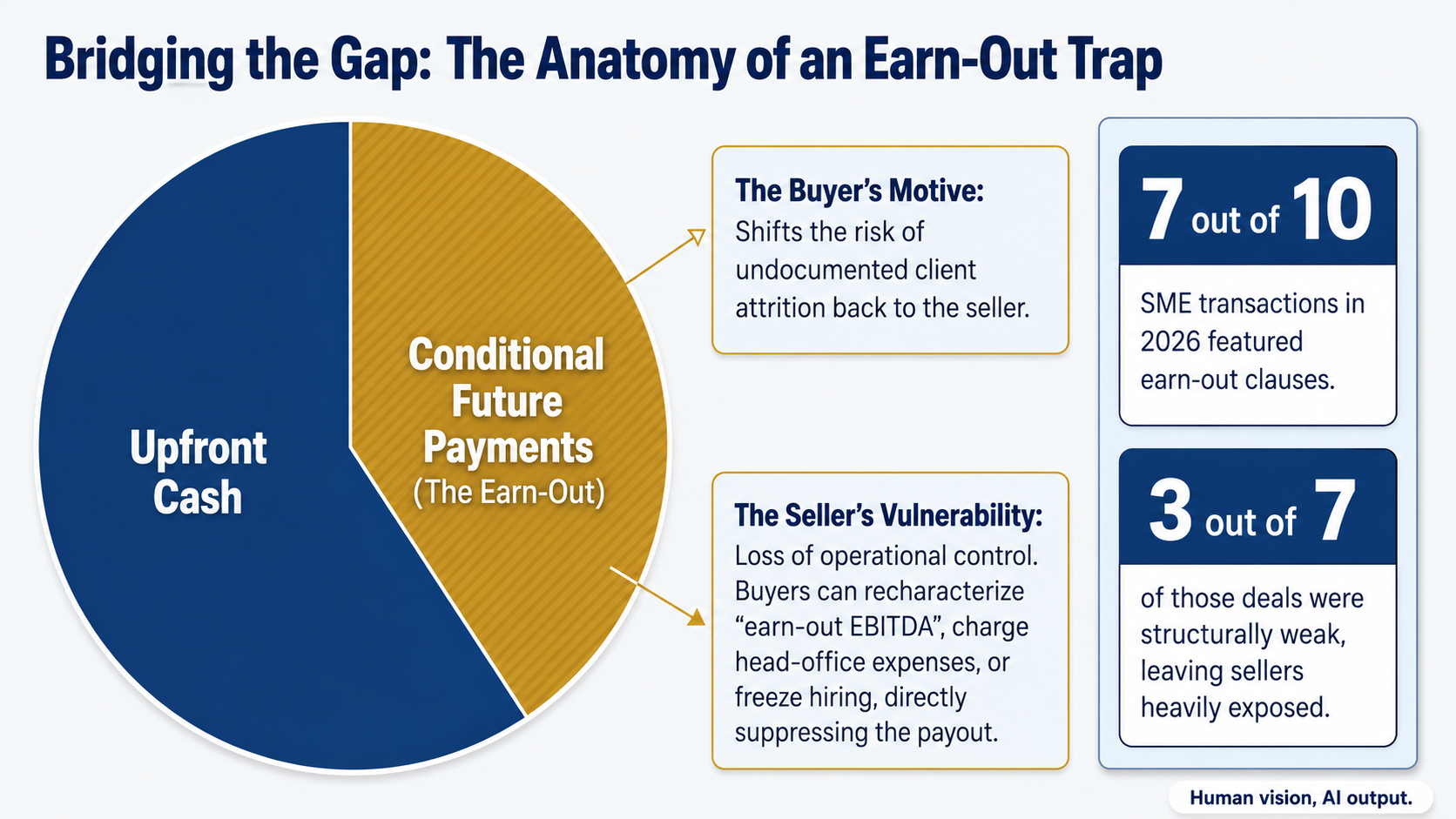
Why Accepting a "Lower Price" Doesn't Offer an Easy Exit
Bridging the Valuation Gap: Buyers use earn-out clauses to shift the risk of undocumented client attrition back to the seller.
High Prevalence in SME M&A: A 2026 review of SME transactions revealed that 7 out of 10 deals featured earn-out clauses.
The Vulnerability Rate: Of those deals, 3 out of 7 were structurally weak, leaving the seller heavily exposed to payout shortfalls.
Loss of Operational Control: Earn-out calculations can be altered by recharacterizing "earn-out EBITDA," charging head-office expenses, or limiting hiring and pricing.
Many founders think they can simply bypass documentation by accepting a lower valuation at sale. However, founder-dependency does not just lower the price—it fundamentally alters the structure of the deal. To hedge against undocumented relationship risk, buyers build earn-outs where a massive portion of the purchase price is delayed and tied to future performance targets. In practice, the seller often loses control over the operational levers—like pricing and headcount—needed to hit those very targets.
Historical Precedents of Earn-Out Reductions
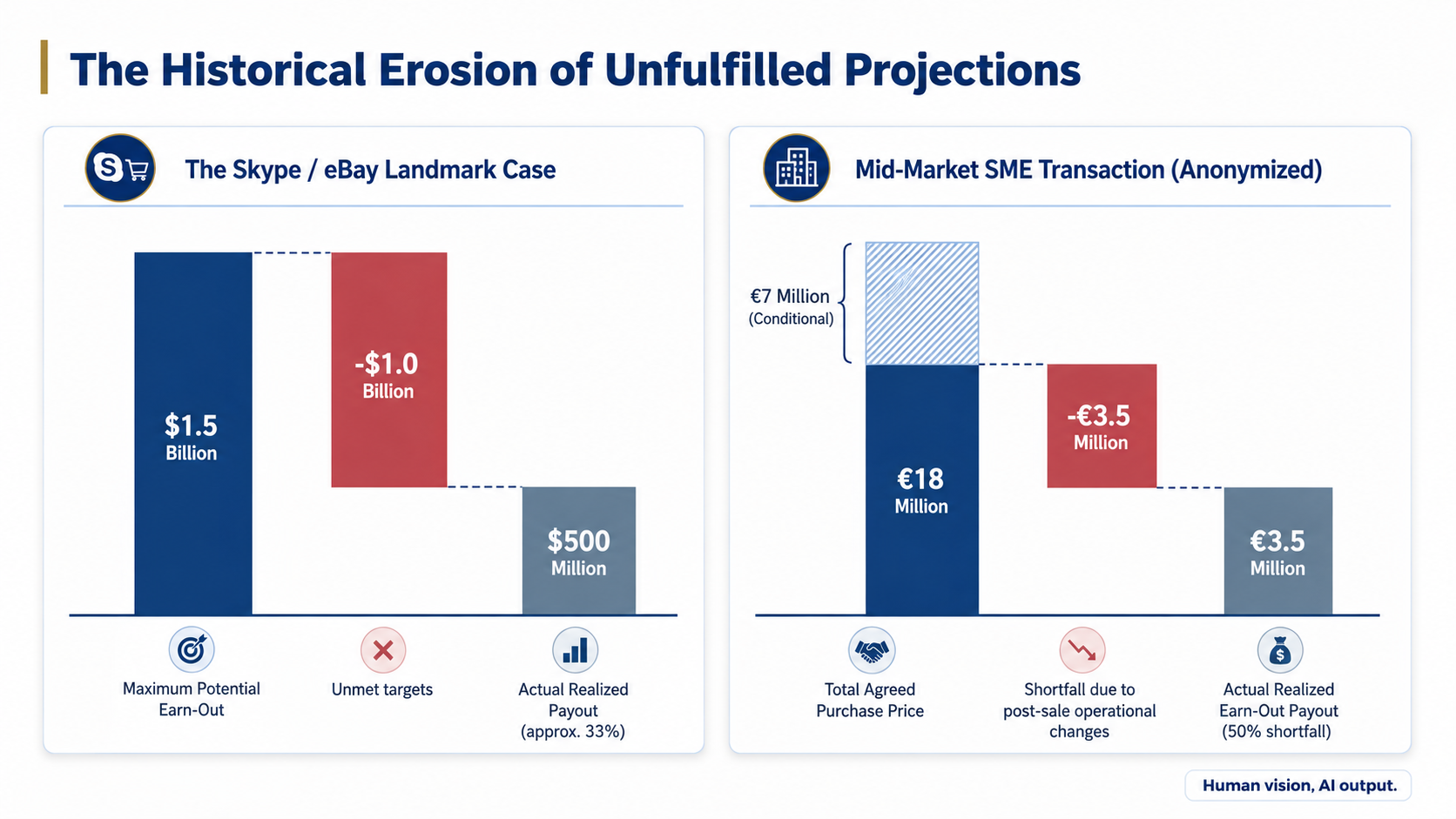
The High Cost of Unfulfilled Projections
The Skype / eBay Landmark Case:
Maximum Potential Earn-out: $1.5 Billion
Actual Realized Payout: $500 Million (approx. 33% of target)
Anonymized Mid-Market SME Transaction:
Total Agreed Purchase Price: €18 Million
Conditional Earn-out Component: €7 Million
Actual Realized Earn-out Payout: €3.5 Million (50% shortfall)
We do not have to look far to see how earn-out structures penalize sellers. In eBay's acquisition of Skype, the maximum potential earn-out was $1.5 billion, but the actual payout was just a third of that at $500 million. In smaller, mid-market transactions, the pattern is identical: one documented €18 million deal saw its €7 million earn-out component cut exactly in half due to post-sale operational changes.
The Post-Acquisition "Legal Illusion"
When the Founder Stays But the Business Declines
Forced Retention Clauses: Earn-outs require the founder to stay on as an employee to hit targets, reporting to corporate buyers on decisions they used to make independently.
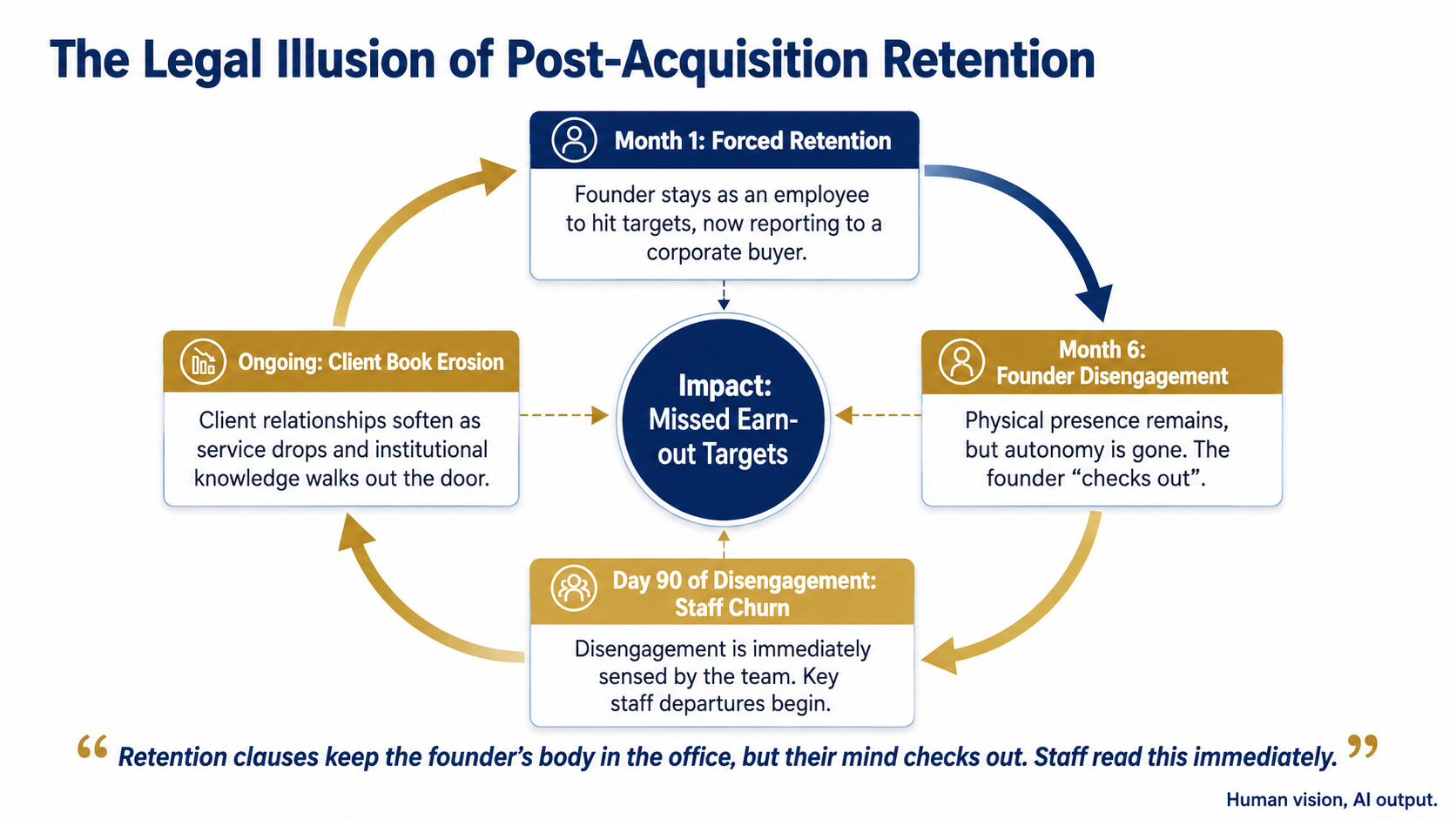
The Disengagement Cycle: Physical presence does not guarantee operational alignment.
Staff and Client Churn:
Within 6 Months: Founders often become visibly disengaged under corporate management.
Within 90 Days: Disengagement is felt by the team, prompting key staff departures.
The Softening of Book Value: Client relationships begin to erode even while the founder is technically in the building.
The most painful part of an earn-out is often not the financial shortfall, but the fact that the founder cannot actually leave. They go from being the autonomous owner to an employee reporting to a corporate buyer. This mismatch creates a "legal illusion": retention clauses keep the founder's body in the office, but their mind checks out. Staff read this immediately and start resigning within 90 days, causing client relationships to soften and eroding the very book of business the founder is trying to defend.
Why the Crisis is Compounding in 2026 ...
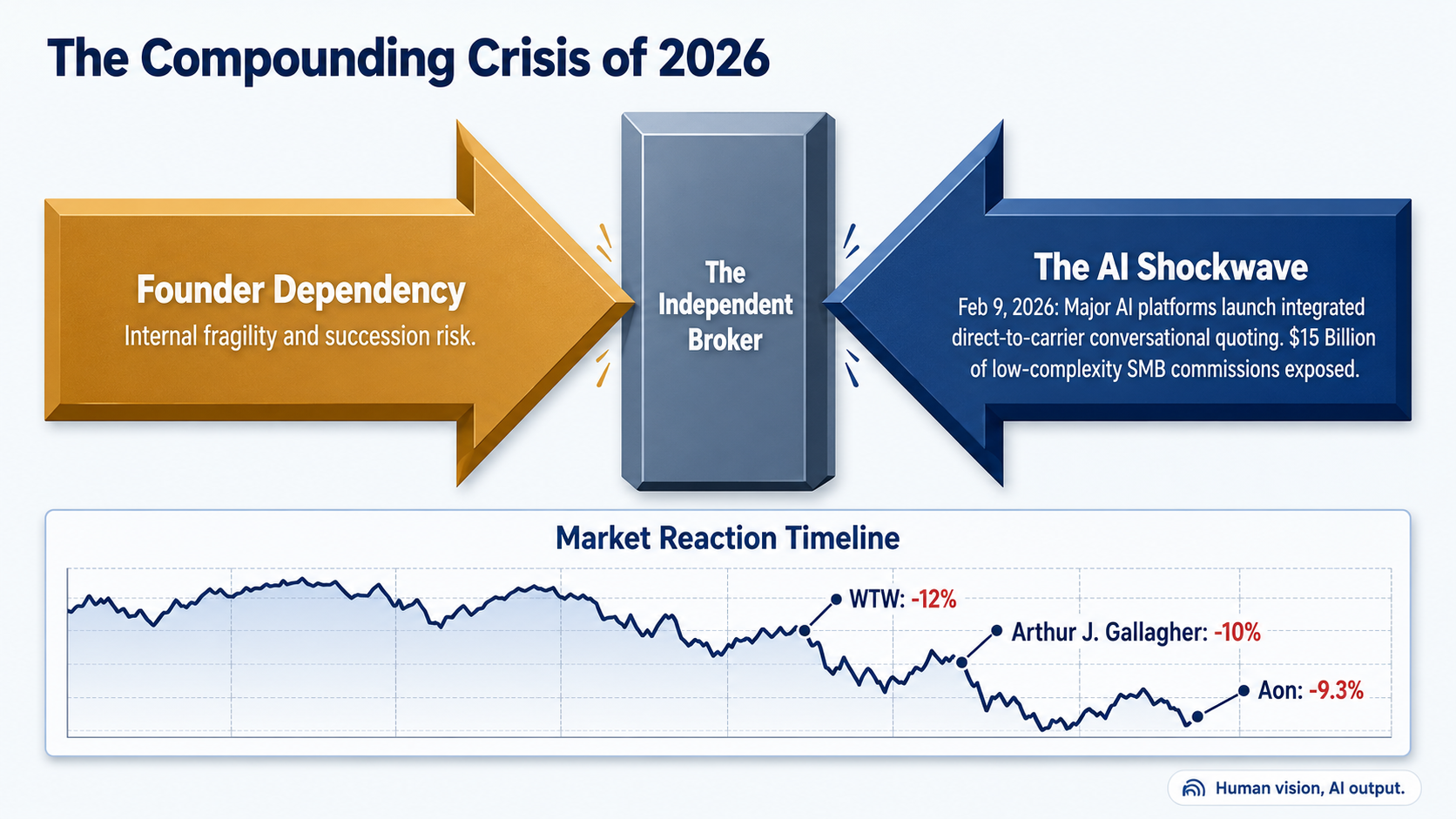
The Technological and Regulatory Pincer Movement
The February 2026 Shockwave: On February 9, 2026, major AI platforms launched integrated direct-to-carrier conversational quoting.
Immediate Public Market Reaction: Publicly traded brokerage groups experienced immediate, sharp share price declines:
WTW: Down ~12%
Arthur J. Gallagher: Down ~10%
Aon: Down ~9.3%
$15 Billion in Exposed Revenue: Global estimates identify $15bn of low-complexity SMB and personal lines commissions as directly exposed to automated disintermediation.
In 2026, the stakes are higher than ever before. On February 9, 2026, major AI platforms launched integrated direct-to-carrier quoting. Public markets reacted immediately, cutting nearly 10% or more off the value of global broking giants in a matter of days. Investors recognized that a massive portion of traditional broker commission income—specifically low-complexity, transactional policies—is now directly vulnerable to being bypassed entirely.
The Regulatory & Market Landscape in 2026
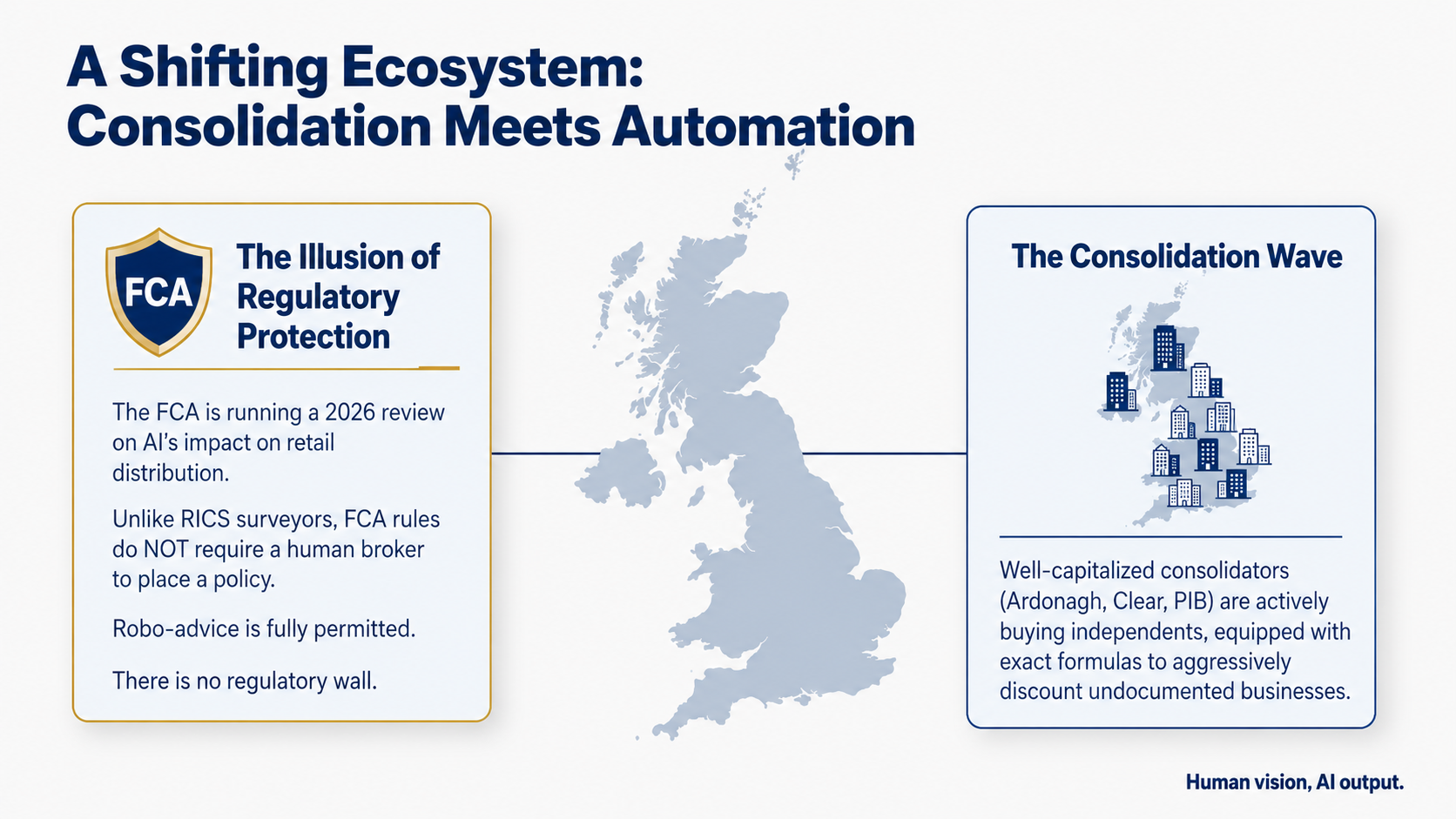
A Shifting Environment for Independent Brokers
FCA AI Distribution Review: The UK's Financial Conduct Authority has launched an active 2026 review into AI’s impact on retail financial services distribution.
The Illusion of Regulatory Protection: Unlike RICS-regulated surveyors or UKAS-accredited engineers, FCA rules do not require a human broker to place a policy; robo-advice is fully permitted.
The Active Consolidation Wave: Well-capitalized regional buyers (such as Ardonagh, Clear, and PIB) continue to actively acquire independents.
Brokers cannot rely on regulatory barriers to protect their commissions. The FCA’s active 2026 review on AI distribution highlights that "robo-advice" is entirely permissible. There is no regulatory wall keeping a human in the middle of a standard transaction. At the same time, major consolidators like Ardonagh, Clear, and PIB are actively buying up independents, creating a highly capitalized buyer pool that knows exactly how to discount undocumented businesses.
The AI Disruption Exposure Index (Part 1)
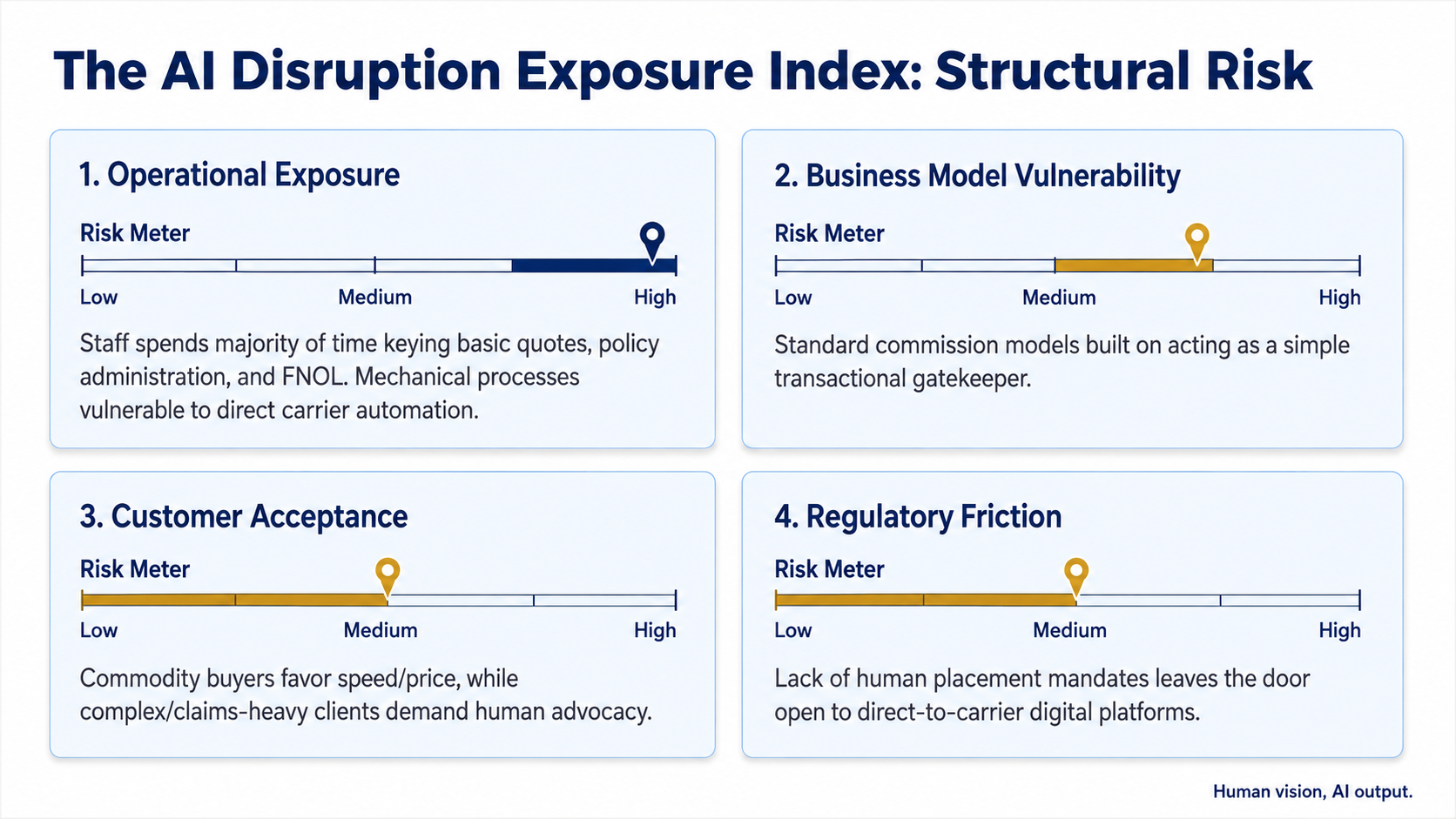
Structural & Customer Risk Dimensions
1. Operational Exposure (High): Mechanical processes like basic quoting, policy administration, and FNOL are rapidly being automated directly by carriers.
2. Business Model Vulnerability (Medium-High): Standard commission models are highly exposed if the broker acts as a simple transactional gatekeeper.
3. Customer Acceptance (Medium): Complex, claims-heavy commercial clients actively demand human advocates, while commodity buyers favor speed and price.
4. Regulatory Friction (Medium): The lack of human placement mandates leaves the door open to direct-to-carrier digital platforms.
To systematically address these threats, we use the AI Disruption Exposure Index. The first four dimensions measure your structural exposure. If your staff spends most of their time keying in basic quotes or processing standard policy paperwork, your operational exposure is dangerously high. If your business model is built on transactional commissions without consultative advice, you are highly vulnerable to digital disintermediation.
The AI Disruption Exposure Index (Part 2)
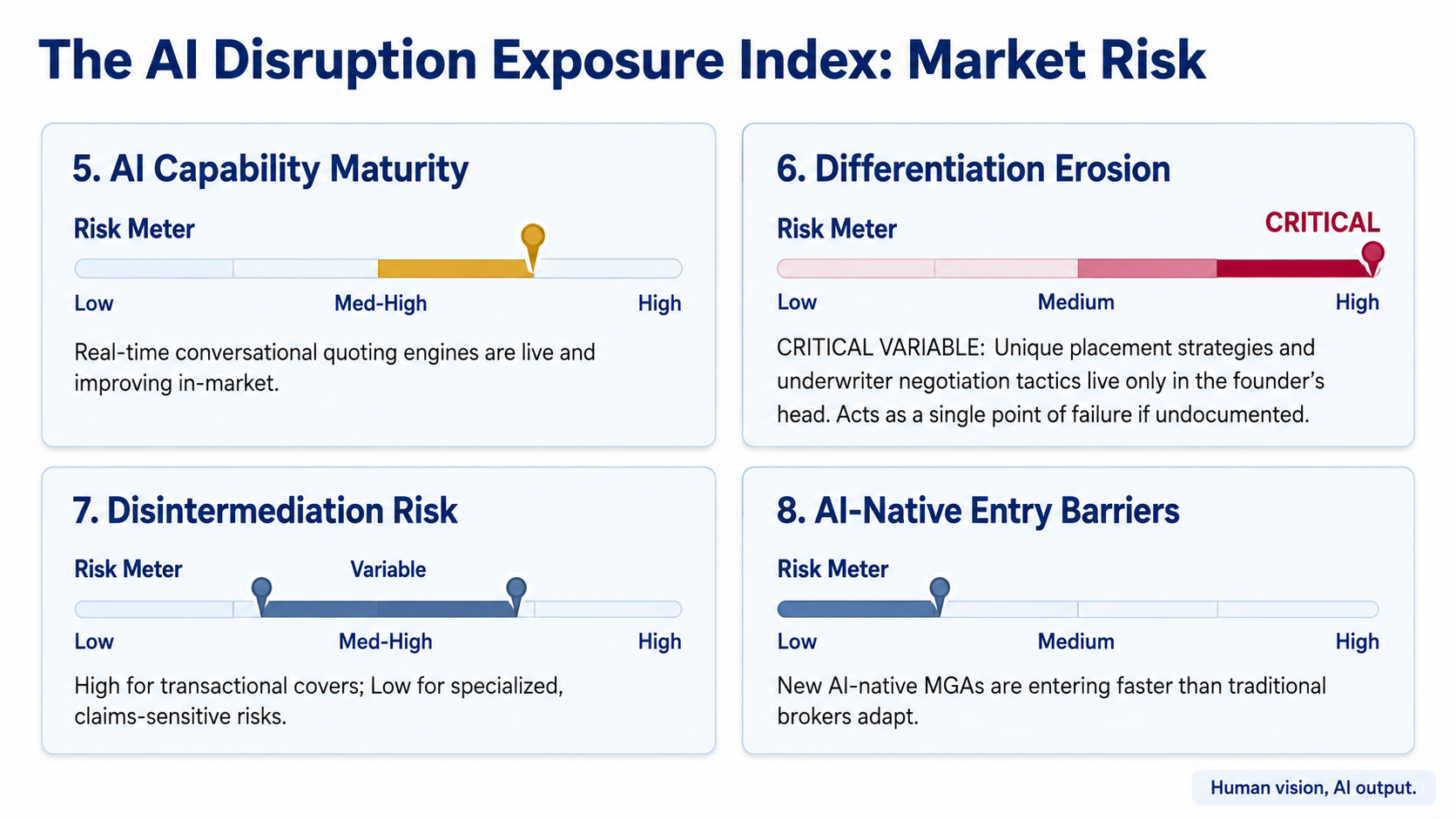
Market & Differentiation Risk Dimensions
5. AI Capability Maturity (Medium-High): Real-time conversational quoting engines are live, active, and continuously improving in-market.
6. Differentiation Erosion (Critical/Variable 🔴): Knowing which underwriter to call and how to negotiate is highly valuable, but acts as a single point of failure if undocumented.
7. Disintermediation Risk (Medium-High / Low): High for transactional commodity covers, but low for specialized, claims-sensitive risks.
8. AI-Native Entry Barriers (Low-Medium): New AI-native MGAs are entering the market faster than traditional brokers can adapt their value propositions.
The second half of the index focuses on your market differentiation. Crucially, "Differentiation Erosion" is the one dimension you have absolute control over. If your unique placement strategies and underwriting relationships live only in your head, they represent a critical valuation risk. But if those strategies are documented, they become highly durable, human-driven assets that AI-native platforms cannot replicate.
The Practical Response — The Month 1 Sequence
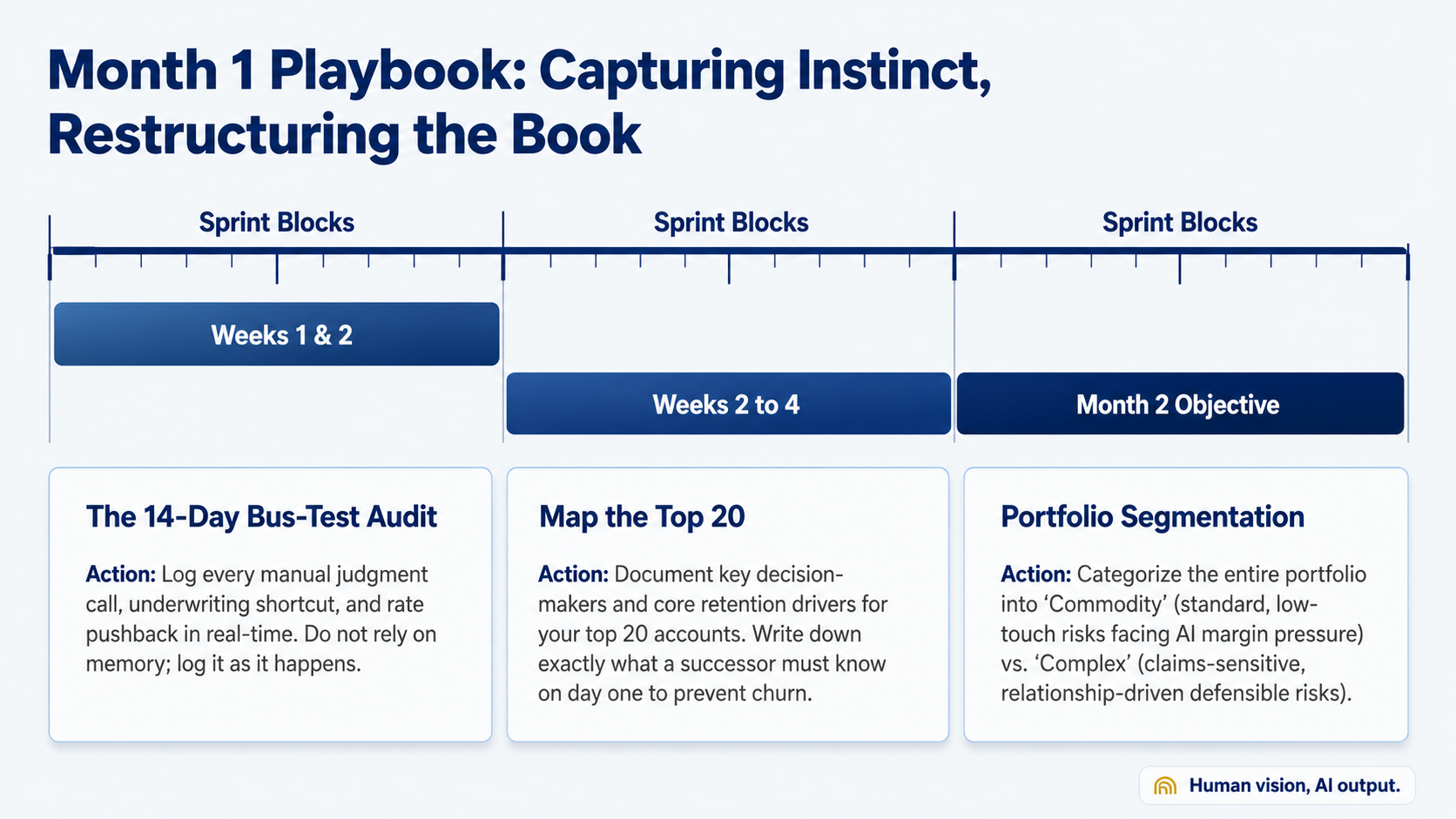
Capturing Instinct and Restructuring the Book
Week 1 & 2: The 14-Day Bus-Test Audit: Write down every single manual judgment call, underwriting shortcut, and negotiation rate pushback as they happen.
Week 2 to 4: Map your Top 20 Client Relationships: Document key decision-makers, core retention drivers (why they stay), and what a successor needs to know on day one.
Month 2: Segment your Book of Business: Categorize your entire portfolio into "Commodity" (standard, low-touch) vs. "Complex" (claims-sensitive, relationship-driven) risks.
You do not need an expensive consultant to begin de-risking your firm; you can start this month. First, run the 14-day "bus-test" by logging your daily, instinctive placement decisions in a simple notebook. Second, map out your top 20 client relationships—writing down why they stay and what a successor needs on day one to keep them. Finally, segment your book into commodity and complex lines so you know exactly where to defend and where you will face margin pressure.
30-90 Day Quick Wins & Structural Playbook Integration
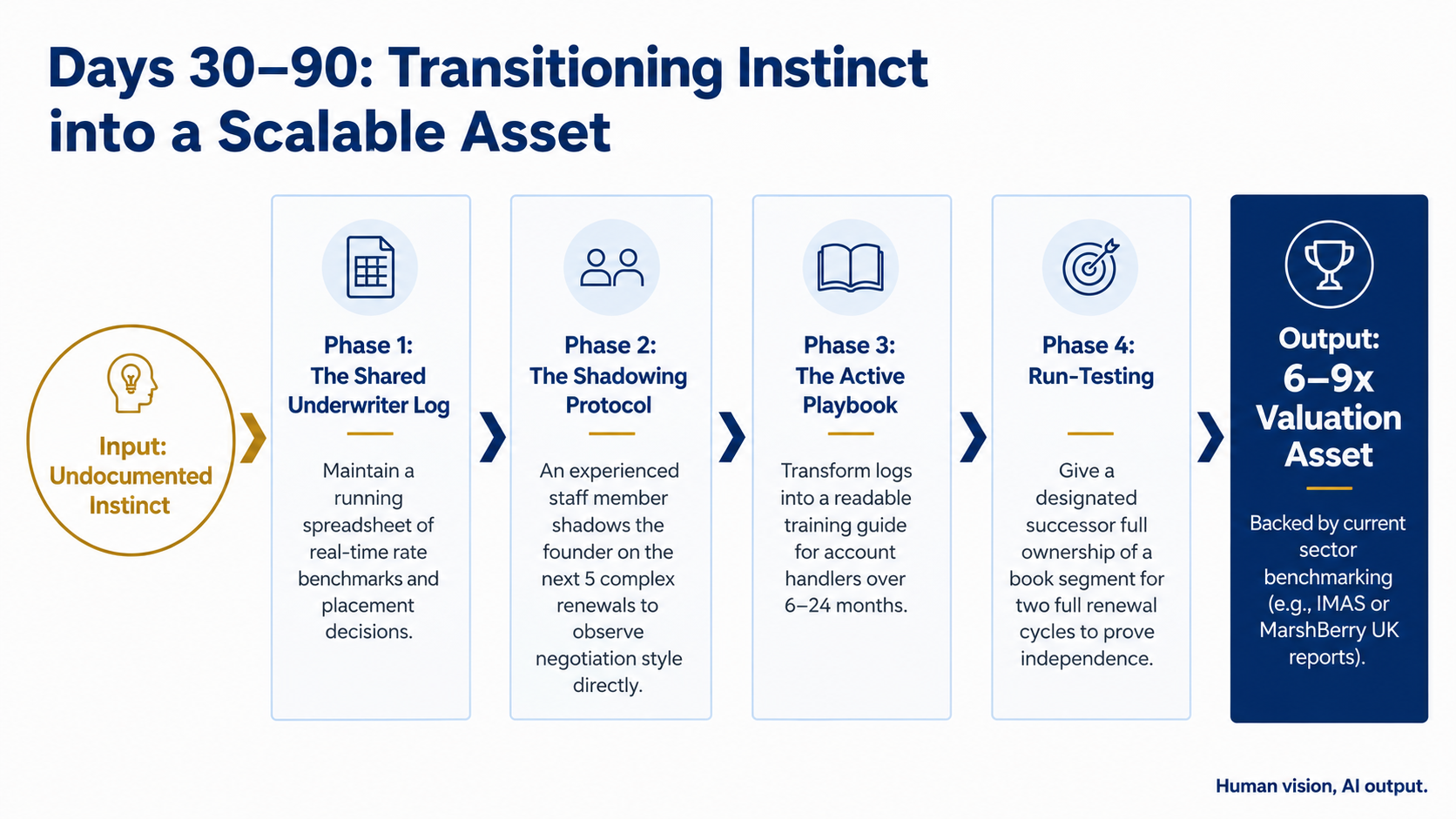
Transitioning Instinct into a Scalable Regional Asset
The Shared Underwriter Log: Maintain a running spreadsheet of rate benchmarks and placement decisions as they occur.
The Shadowing Protocol: Have an experienced staff member shadow your next five complex renewals to observe your negotiation style.
Sector Valuation Benchmarking: Secure current, regional transaction data from M&A experts (e.g., IMAS or MarshBerry UK reports).
The Active Playbook (6-24 Months): Turn your logs into a functional, readable training guide for your account handlers.
Run-Testing a Successor: Give a designated successor full ownership and negotiation authority over a portion of the book for two full renewal cycles.
Over the next 90 days, convert your daily logs into a simple, shared spreadsheet that tracks pricing and underwriter decisions in real-time. Have a senior staff member shadow you during your next five complex renewals. Over the longer term, compile these logs into a readable, working playbook that a competent handler can use to run renewals without your involvement. Prove this capability to future buyers by letting your successor manage a defined portion of your book for two full renewal cycles.
The 6-Question self-Diagnostic Checklist
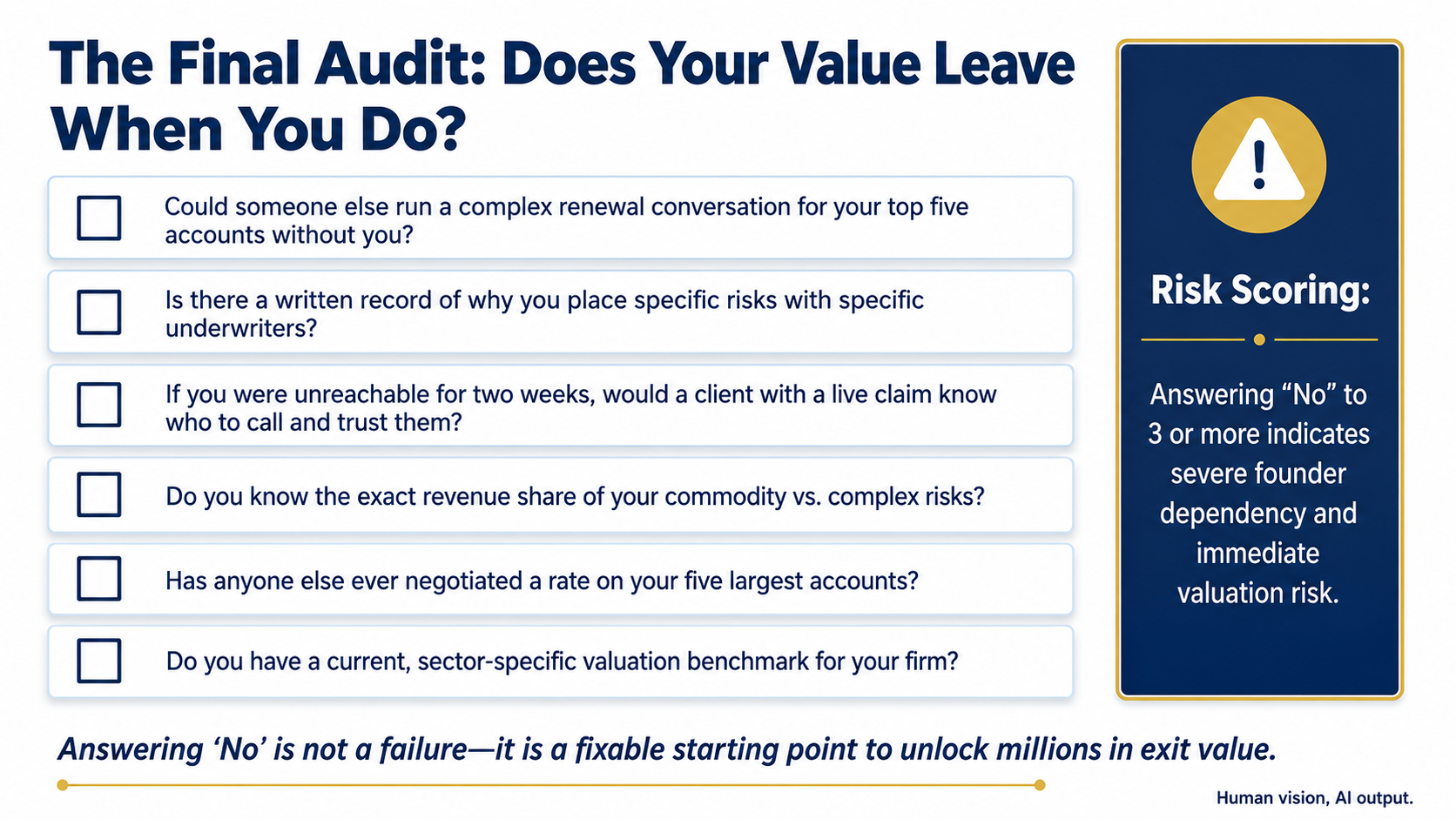
How Much of Your Firm's Value Leaves the Building with You?
Q1: Could someone else run a complex renewal conversation for your top five accounts without you?
Q2: Is there a written record of why you place specific risks with specific underwriters?
Q3: If you were unreachable for two weeks, would a client with a live claim know who to call and trust them?
Q4: Do you know the exact revenue share of your commodity vs. complex risks?
Q5: Has anyone else ever negotiated a rate on your five largest accounts?
Q6: Do you have a current, sector-specific valuation benchmark for your firm?
We close with an honest self-assessment. These six questions identify your firm’s exact, findable gaps. Answering "No" to three or more is not a failure; it is a clear, fixable starting point. It tells you that your business is currently built on a single point of failure. By systematically turning these "No" answers into "Yes" assets, you protect your business from technological threats, preserve your client relationships, and unlock millions in exit value.
Editorial note: this article uses a fictional, composite broker built from patterns typical of UK independent commercial insurance brokers, combined with real 2026 market data. It does not describe, and is not based on, any real identified company, and any resemblance to a real business is coincidental. Images created using AI tools, directed by our team.