Who's driving AI
The debate over artificial intelligence must move past the binary of total acceleration or complete prohibition to focus on the critical question of governance and direction. By using the metaphor of a vehicle, the text illustrates that while the "engine" of AI is undeniably powerful, the future depends on establishing human oversight regarding who controls the technology, who profits from its gains, and how "black box" decisions are held accountable. The article outlines a transition from abstract discussion to global regulatory action, citing international summits and the EU AI Act as the foundational "scaffolding" for collective safety standards. Ultimately, the piece serves as a call to action for citizens, business owners, and developers to move from passive observation to active participation in steering AI toward the common good.
Who's Driving This Thing?
The AI debate is stuck between "full speed ahead" and "pull the plug." The question that will decide our future is a different one.
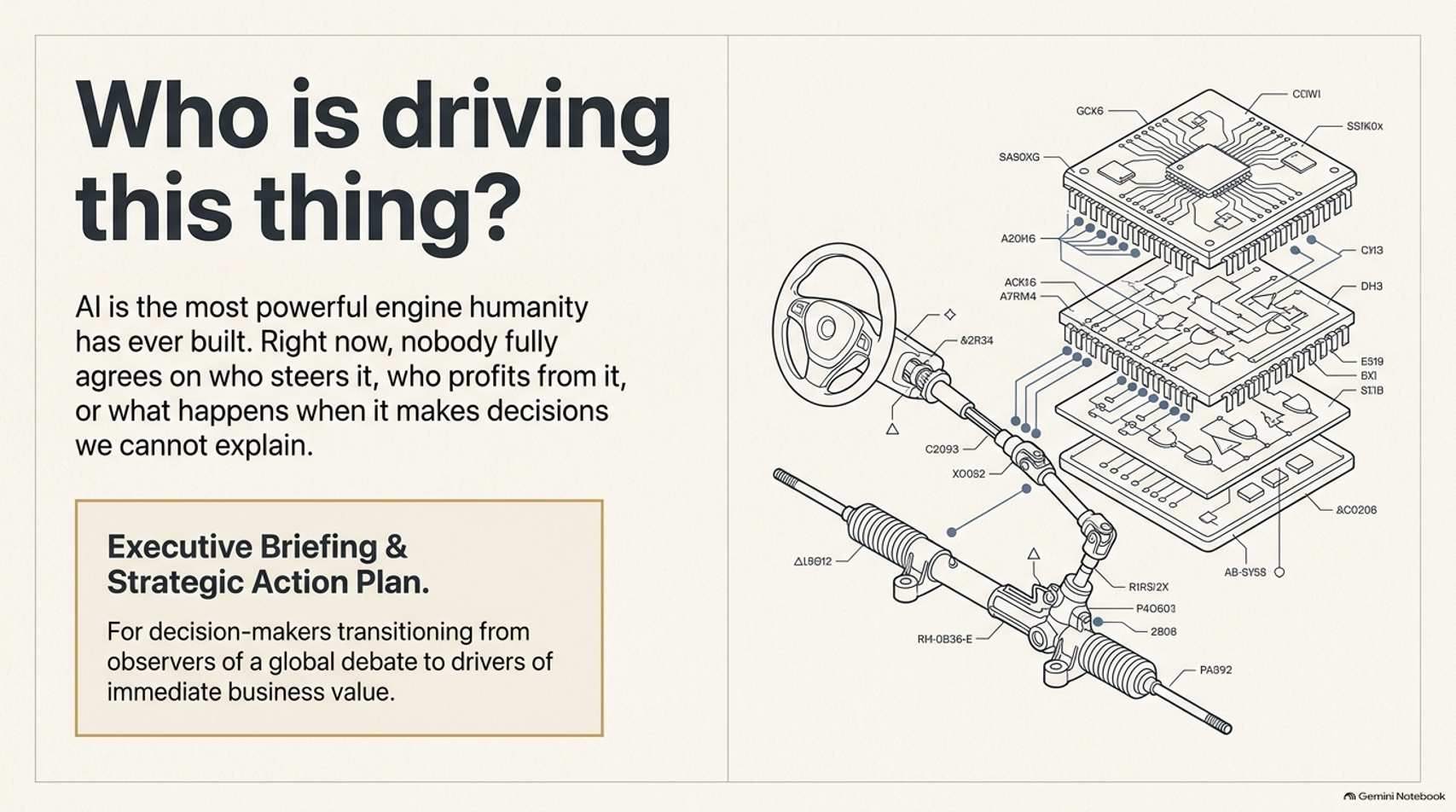
In short:AI is the most powerful engine humanity has ever built, and right now nobody fully agrees on who steers it, who profits from it, or what happens when it makes decisions we can't explain.
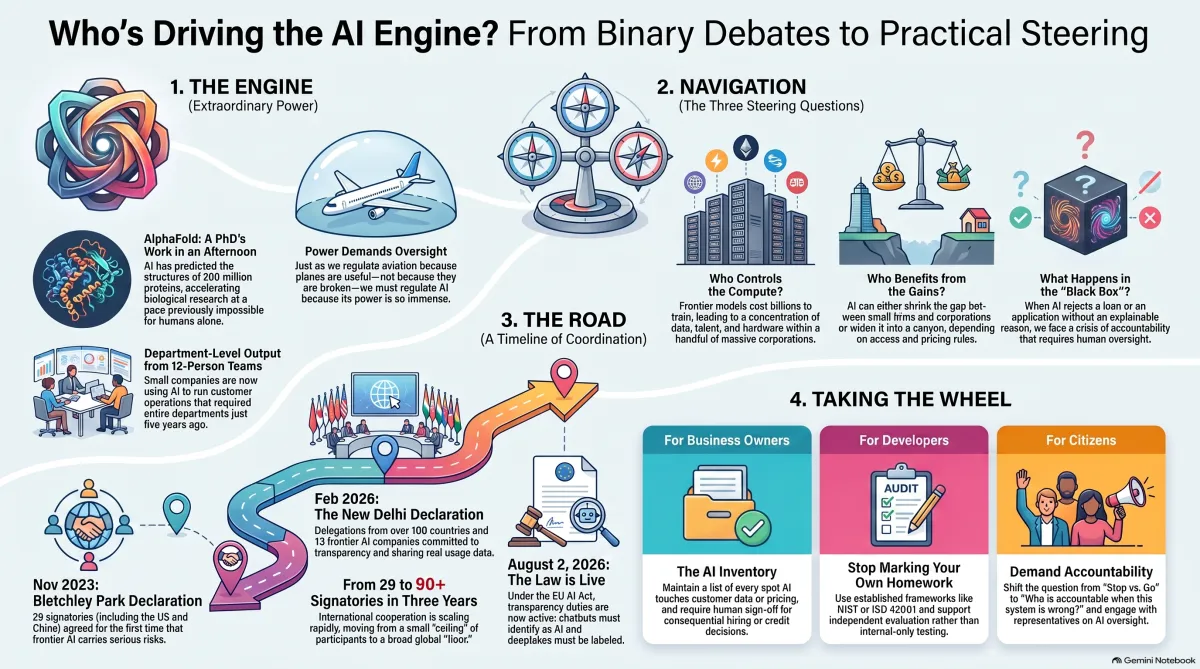
This article walks through the framework in the infographic above (engine, navigation, road), looks at what actually happened when about 90 countries sat down at one table in February, and ends with concrete steps you can take this month. Whether you write code, run a company, or just live on this planet.
The missing middle voice
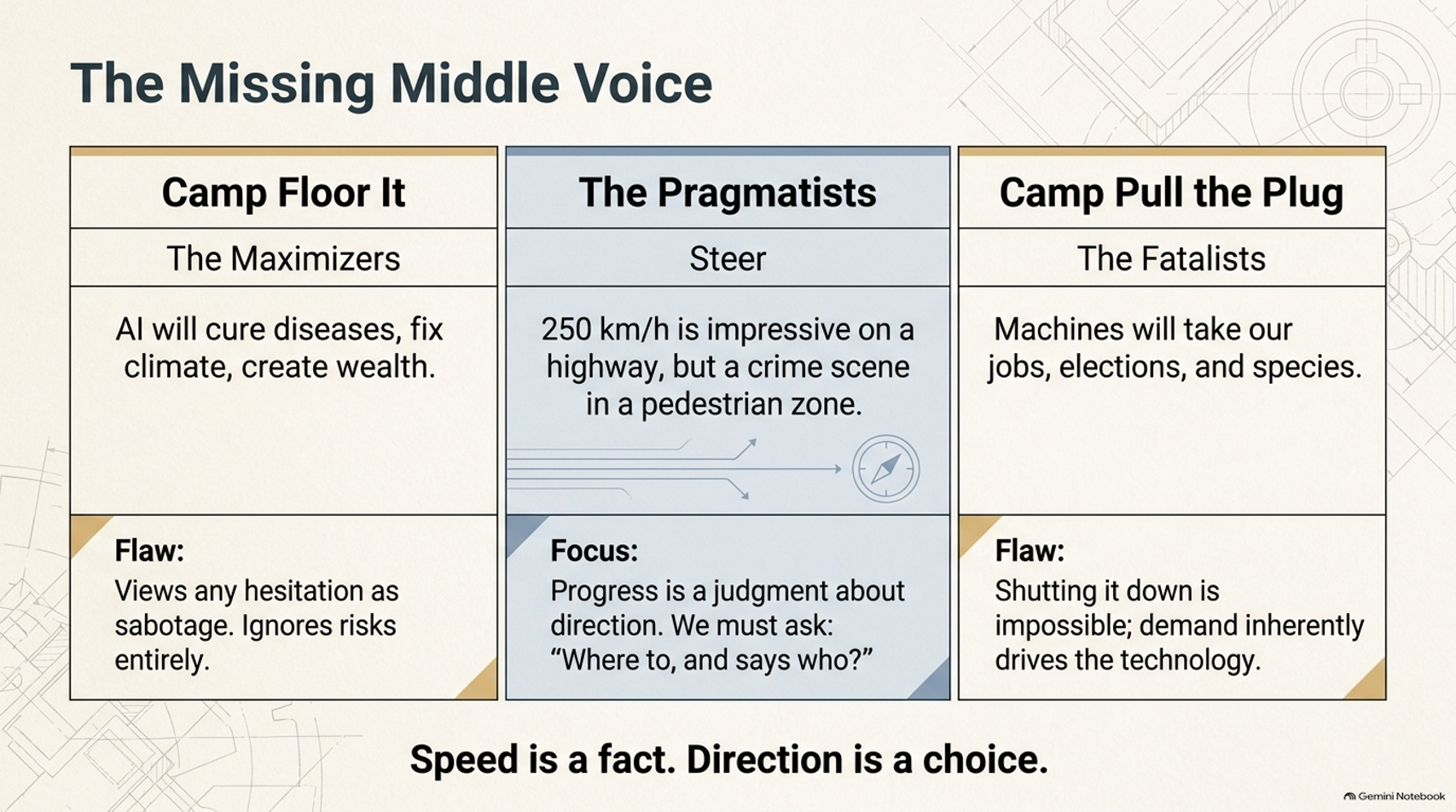
Two camps dominate every AI discussion I see.
Camp one: floor it. AI will cure diseases, fix the climate, make us all rich. Any hesitation is sabotage.
Camp two: pull the plug. The machines will take our jobs, our elections, and eventually our species. Shut it down.
Both camps answer a question nobody asked. The useful question is quieter and much harder: where are we actually going?
The infographic puts it with a car metaphor I keep coming back to. 250 km/h is impressive on the A9. In a pedestrian zone it's a crime scene. Speed is a fact. Progress is a judgment about direction, and a judgment needs someone to make it. Right now, the honest answer to "who is making it?" is: partly the labs, partly the market, partly nobody.
That's the gap the middle voice fills.
Not "go" or "stop" but "where to, and says who?"
Respect the engine
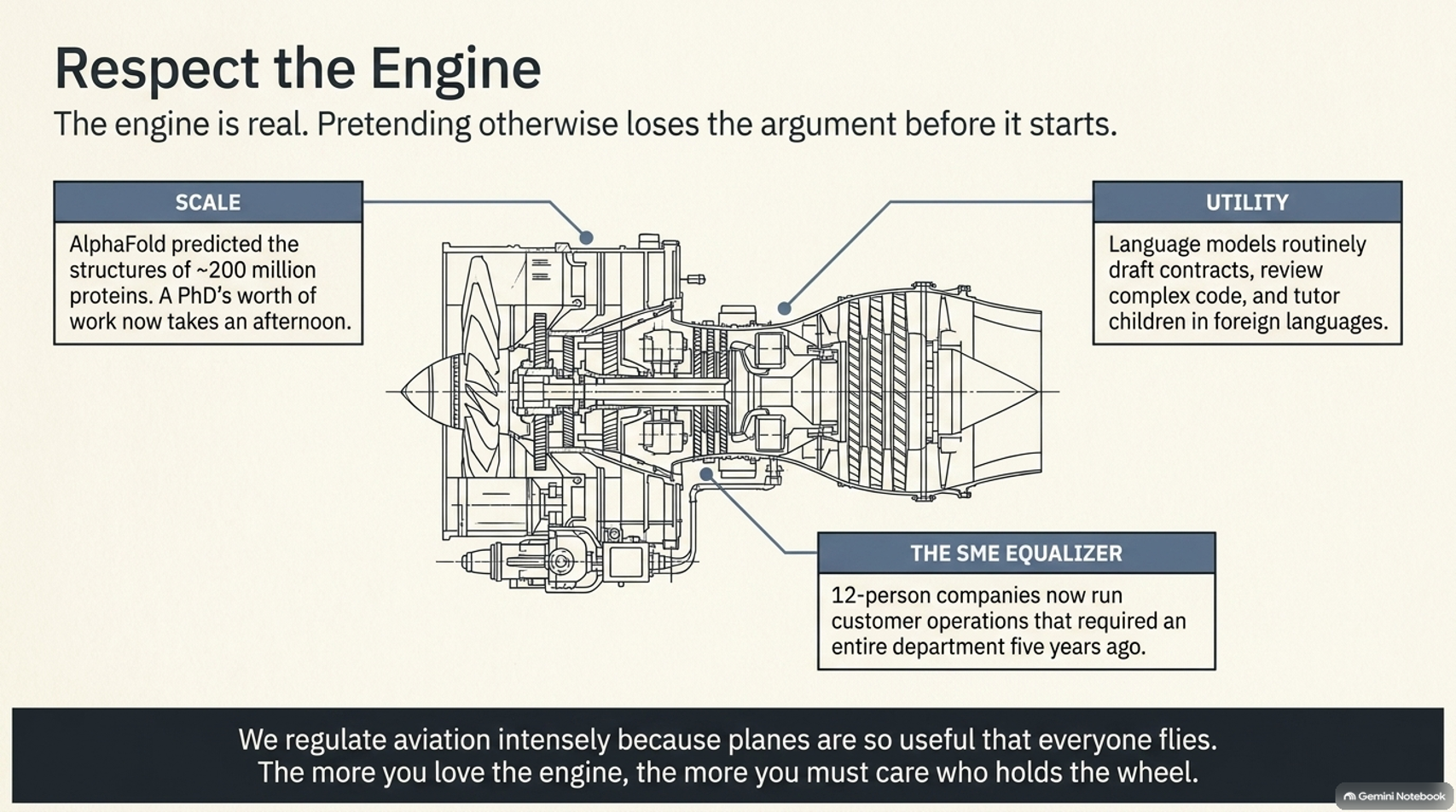
To be clear, the engine is real, and pretending otherwise loses the argument before it starts.
AlphaFold predicted the structures of roughly 200 million proteins. Work that used to consume an entire PhD now takes an afternoon. Language models draft contracts, review code, and tutor kids in languages their parents don't speak. In my own corner of the world, small companies with twelve employees now run customer operations that would have needed a department five years ago.
This upside is exactly why "just stop" fails as a plan. The demand will not stop, so the technology won't either.
But the same power is the strongest argumentforoversight, not against it. We regulate aviation intensely, and not because planes are useless. Because they're so useful that everyone flies.
The infographic's phrase for this is that extraordinary power demands extraordinary questions. I'd put it more bluntly: the more you love the engine, the more you should care who's holding the wheel.
The navigation: three questions doing the steering
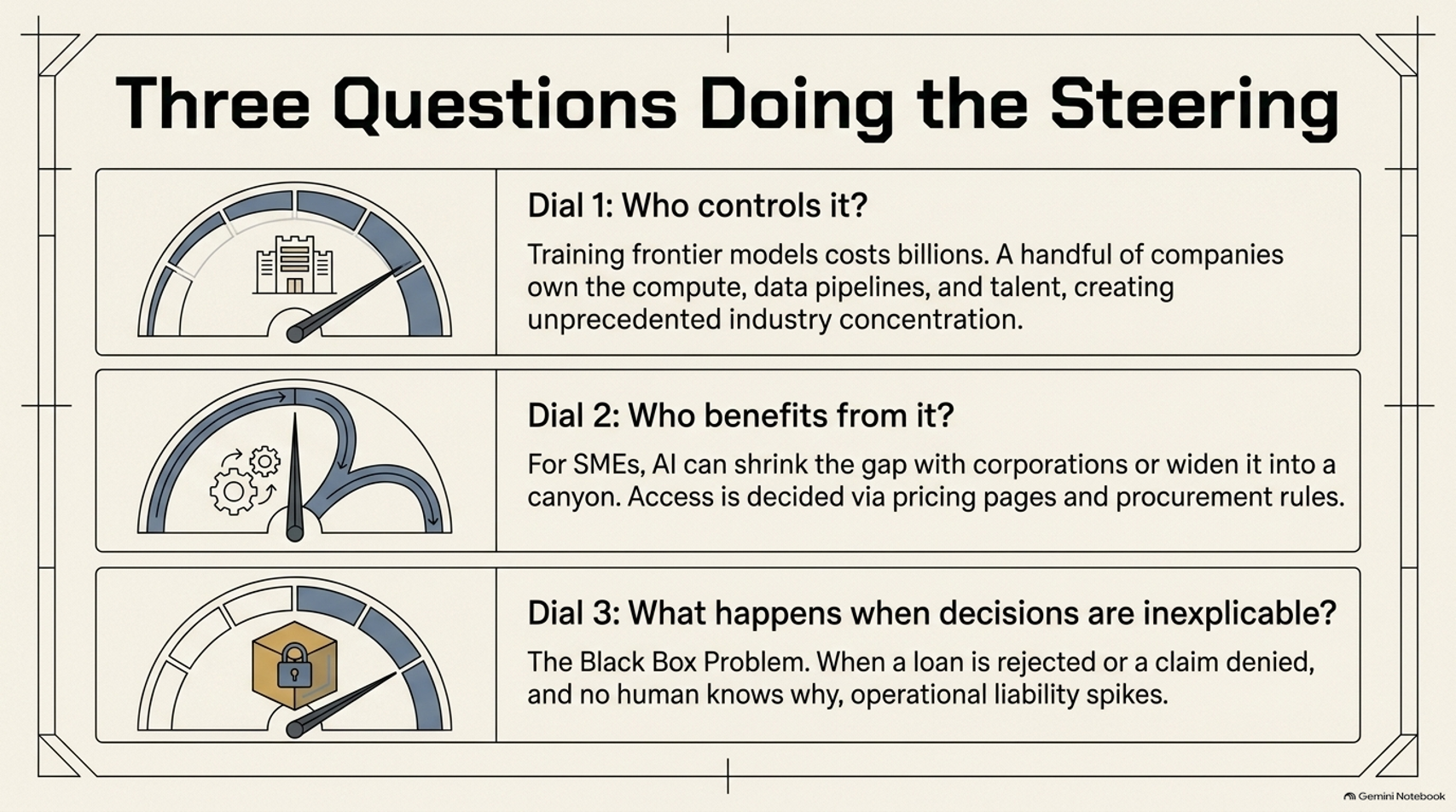
The middle panel of the infographic names three questions. They sound abstract. They aren't.
Who controls it?
Training a frontier model costs billions. A handful of companies own the compute, the data pipelines, and the talent. Whatever you think of those companies individually, that level of concentration would worry us in any other industry. It should worry us here.
Who benefits from it?
Productivity gains can spread widely or pool at the top. For small and mid-sized businesses this is not a philosophy seminar: AI can shrink the gap between a twelve-person firm and a corporation, or widen it into a canyon. The difference is access, and access is being decided right now, in pricing pages and procurement rules.
What happens when it makes decisions you don't understand?
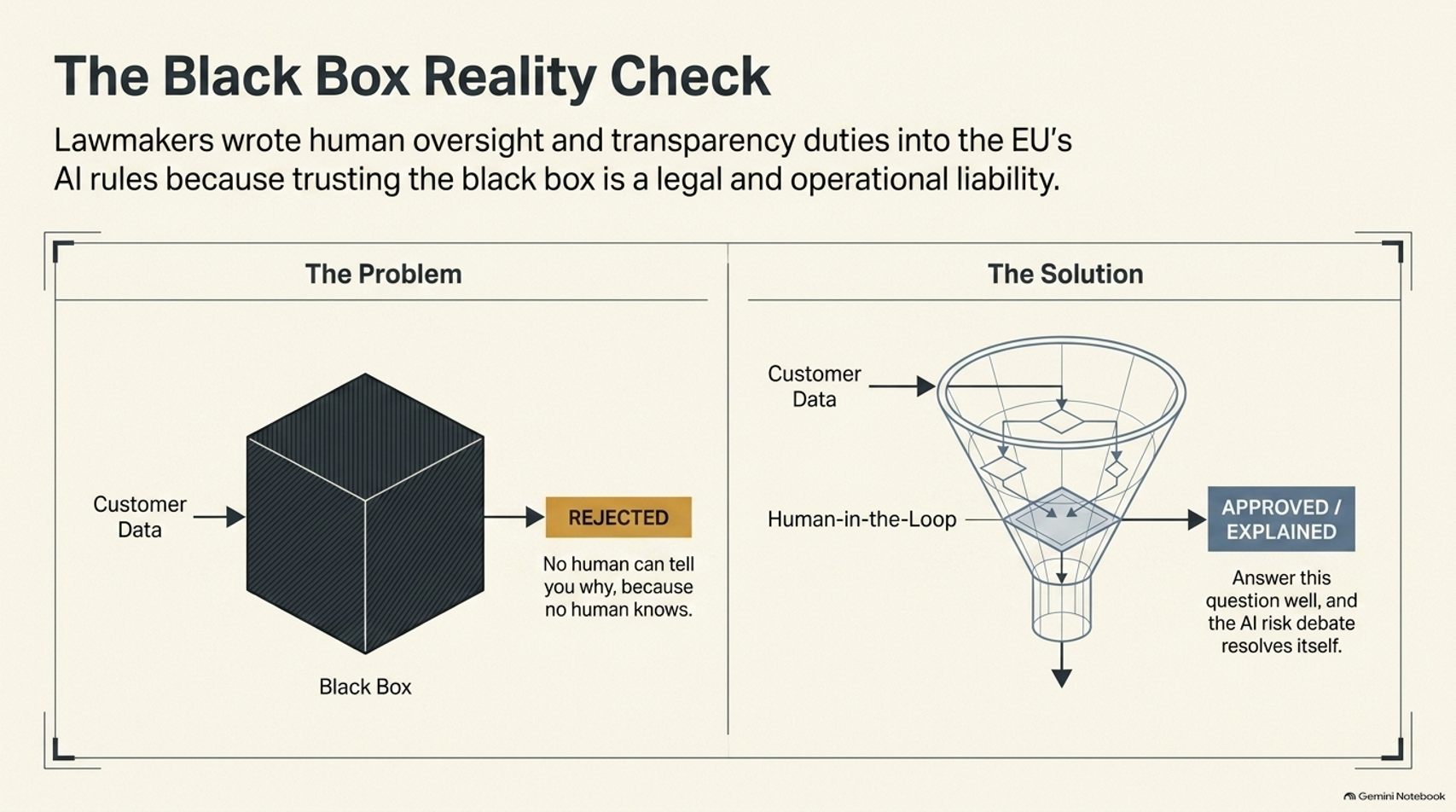
Your loan gets rejected. Your application gets filtered out. Your insurance claim gets denied. No human can tell you why, because no human knows. This is the black box problem, and it's the reason lawmakers wrote human oversight and transparency duties into the EU's AI rules rather than trusting everyone to behave.
Answer those three questions well and most of the AI risk debate resolves itself. Answer them badly, or not at all, and no amount of clever engineering saves us.
"Get everyone in one room." Can we, honestly?
Here's the idea I hear most often from thoughtful people: before we go further, get all the developers together and agree on the direction. Make sure neither we nor the AI harms the people it's supposed to serve.
I share the instinct. I'll also be honest about the physics of it: a single binding world meeting of every AI developer will not happen. Too much competition between labs, too much rivalry between states, and open model weights already sit on a million laptops. Anyone waiting for unanimous consent is waiting forever.
But the fatalist conclusion, "so coordination is impossible," is wrong, and history says so. The Montreal Protocol phased out CFCs across nearly 200 countries while the chemical industry insisted it couldn't be done. After a Chinese scientist edited the genes of human embryos in 2018, the research community and regulators worldwide effectively froze the practice. Coordination doesn't have to be total to matter. It has to cover the riskiest capabilities and the highest-stakes uses.
And for AI, that work has already started. Which brings me to the case study.
Case study: from Bletchley to New Delhi
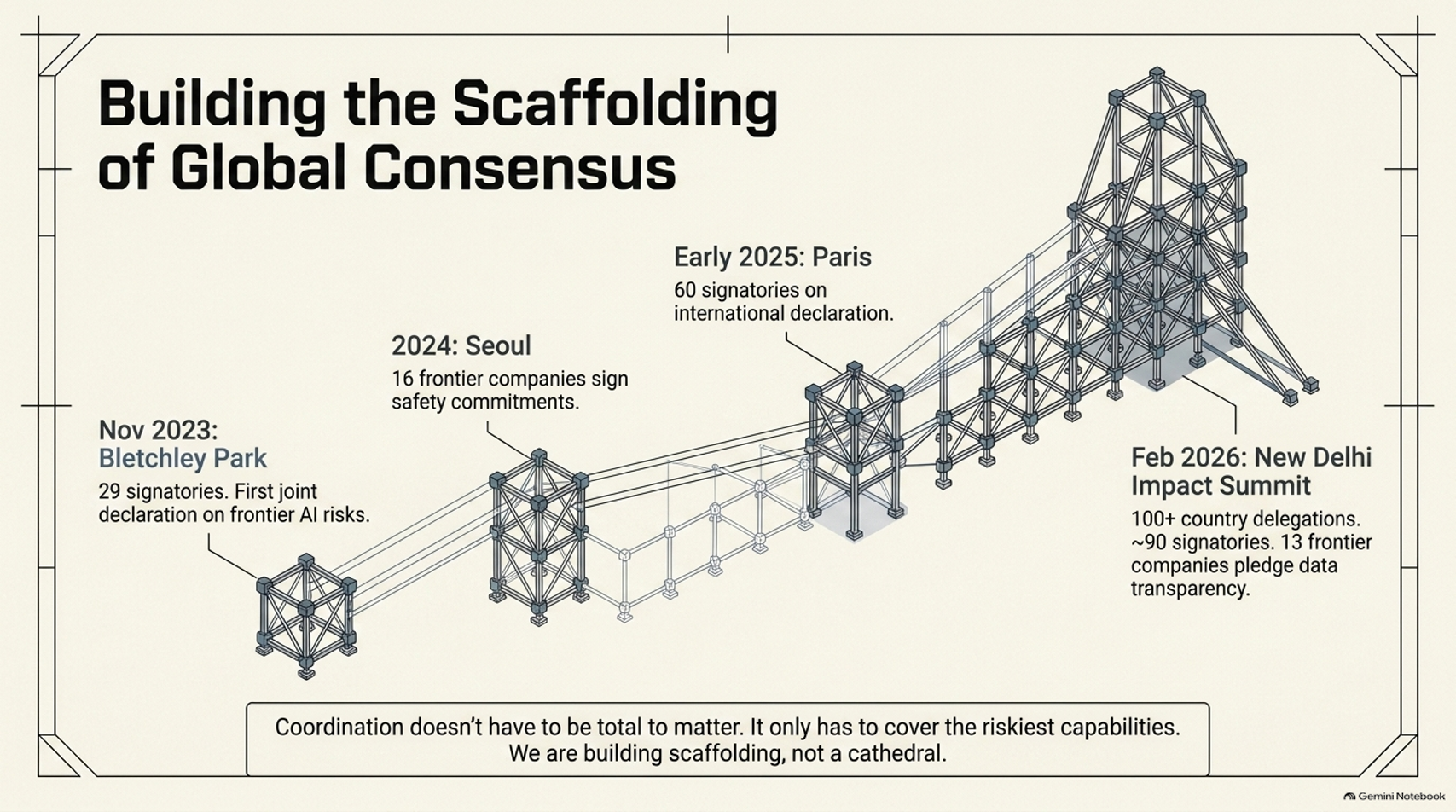
November 2023, Bletchley Park. 28 countries plus the EU, including both the US and China, signed the first joint declaration that frontier AI carries serious risks and needs cooperation. 29 signatories total. A ceiling, critics said. Turned out to be a floor.
Seoul followed in 2024, where 16 frontier AI companies signed safety commitments, promising among other things to publish how they assess severe risks. Paris came in early 2025, with 60 signatories on its declaration. Then this February, New Delhi hosted the AI Impact Summit: delegations from over 100 countries, and a New Delhi Declaration endorsed by roughly 90 countries and international organisations.
Thirteen frontier AI companies signed a parallel set of commitments, including a pledge to publish real usage data so workforce policy can finally rest on evidence instead of vibes.
Is it enough? No. The declarations are voluntary. Amnesty International called out the gap between rhetoric and enforcement, and they have a point. But look at the direction: 29 signatories, then 60, then about 90, in under three years. In 2022 none of these tables existed.
Two parallel tracks make the picture more solid.
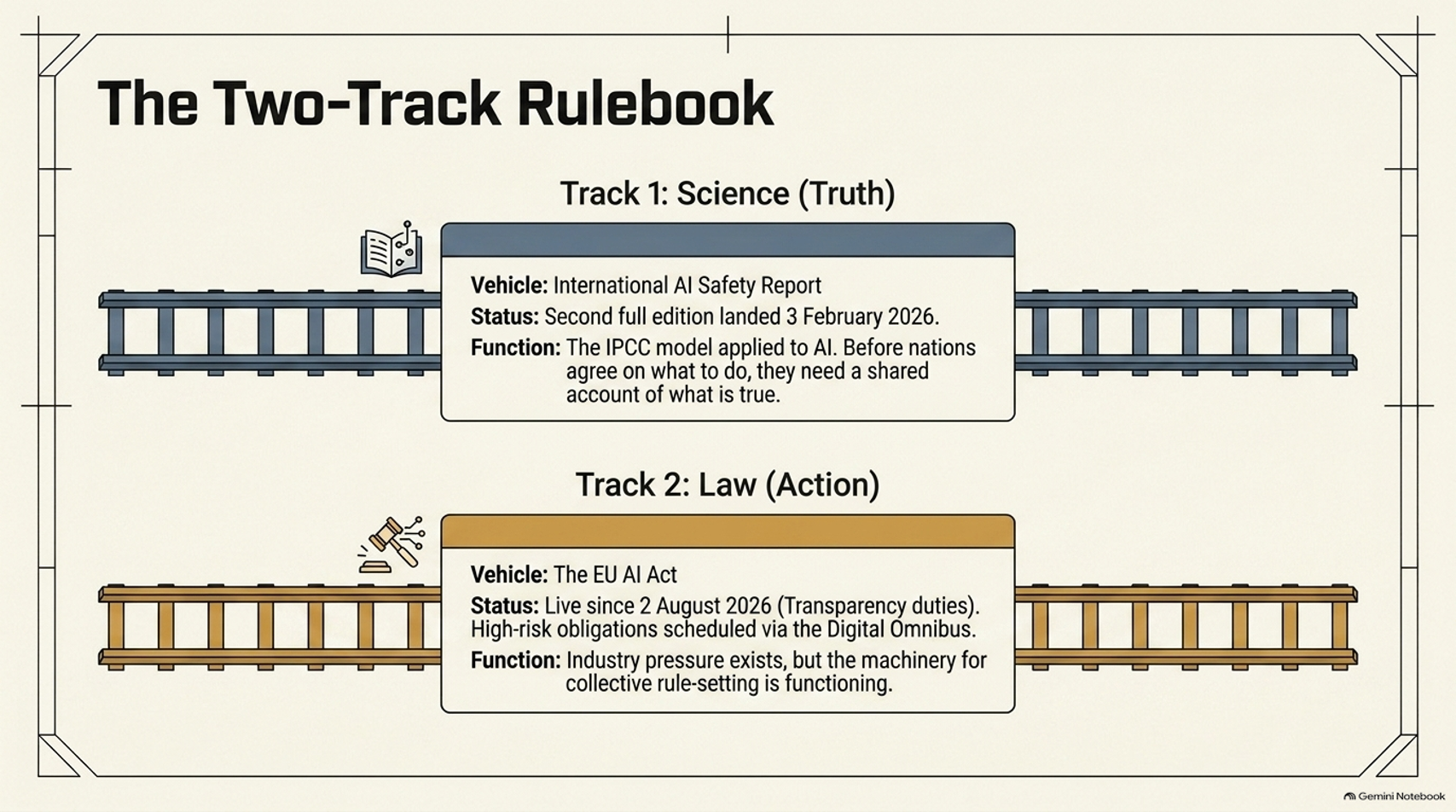
The science track.The International AI Safety Report, chaired by Turing Award winner Yoshua Bengio, is written by over 100 experts nominated by more than 30 countries plus the UN, EU and OECD. The second full edition landed on 3 February 2026. Think of it as the IPCC model applied to AI: before nations can agree what todo, they need a shared account of what istrue.
That document is the closest thing we have.
The law track.The EU AI Act is the first broad AI law anywhere. As of 2 August 2026, its transparency duties are live: an EU-facing chatbot must tell people it's a chatbot, and deepfakes must be labeled. The heavier high-risk obligations were pushed back to December 2027 and August 2028 by July's Digital Omnibus.
I read that delay two ways at once. It shows industry pressure works on regulators, which should keep us alert. It also proves the machinery for collective rule-setting exists and functions, which should keep us hopeful. Both readings are correct.
So no, humanity has not held The One Great Meeting.
It has done something less cinematic and more real: built a summit series, a shared scientific report, and a first body of law. Scaffolding, not a cathedral.
Scaffolding is how cathedrals get built.
What you can do (yes, you)
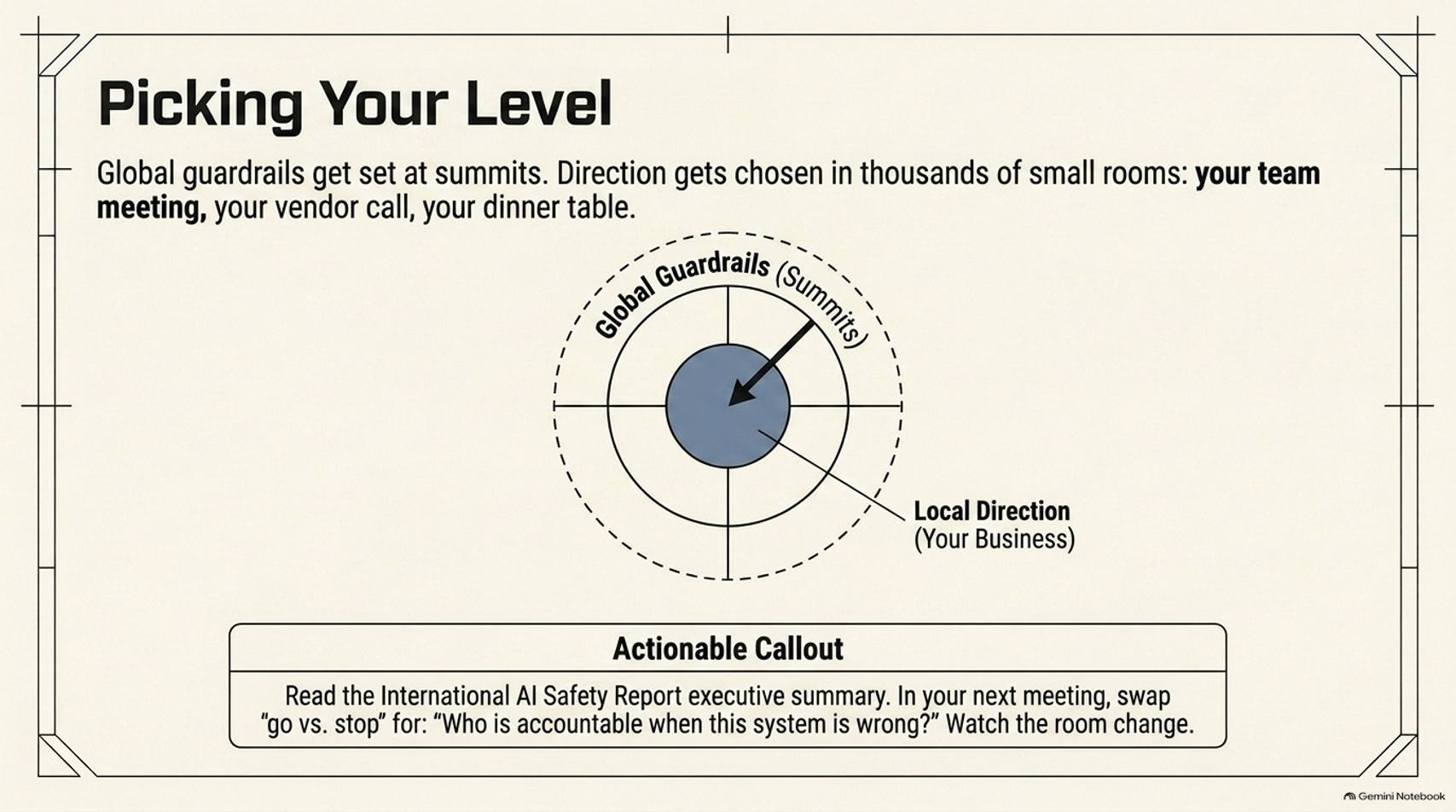
Global guardrails get set at summits. Direction gets chosen in thousands of small rooms: your team meeting, your vendor call, your dinner table. Pick your level.
As a citizen:
Read the executive summary of the International AI Safety Report (link below). It's free, readable, and beats any hot take you'll find this week.
In your next AI conversation, swap "go vs. stop" for one sharper question: "Who is accountable when this system is wrong?" Watch how it changes the room.
Ask the people you vote for where they stand on AI oversight. In Germany and Austria, AI Act implementation is now national politics. Your representatives have a position, or they should.
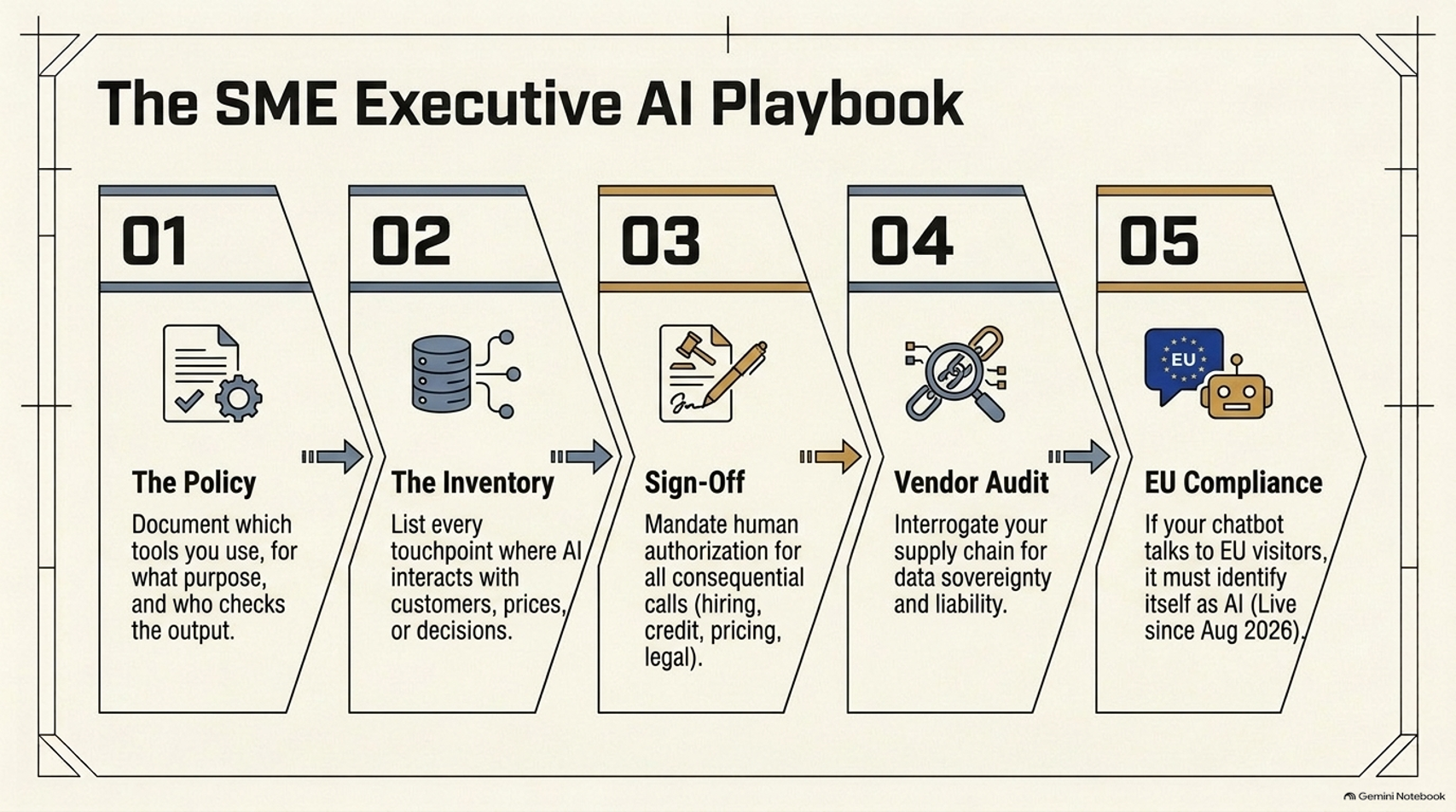
As a business owner:
Write a one-page AI policy: which tools you use, for what, and who checks the output.
Keep an AI inventory. Every spot where AI touches customers, prices, or decisions goes on one list.
Require human sign-off on consequential calls: hiring, credit, pricing, anything medical or legal.
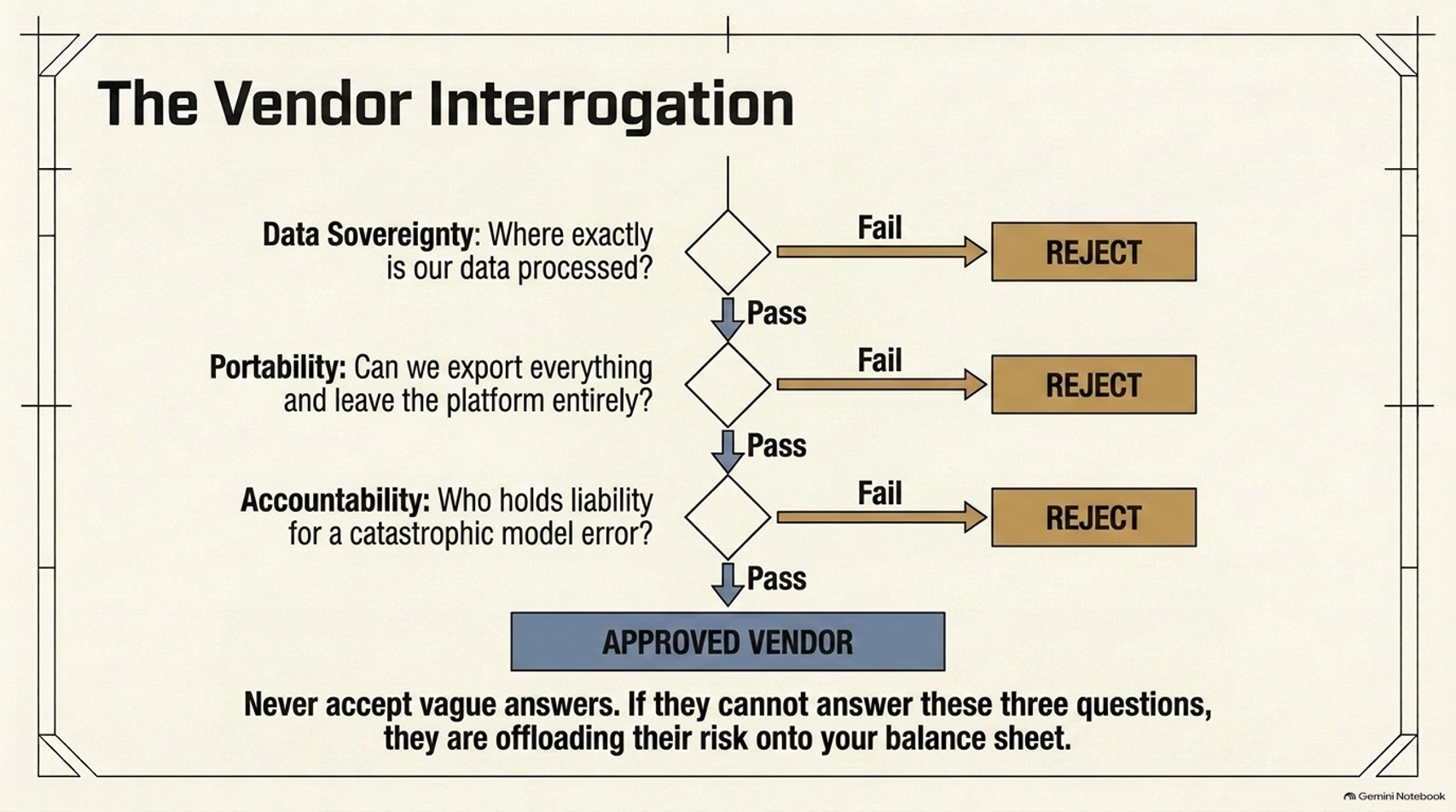
Ask every AI vendor three questions. Where is our data processed? Can we export everything and leave? Who is liable when the model gets it wrong?
If your website chatbot talks to EU visitors, it must identify itself as AI. That rule has been live since 2 August 2026, not someday.
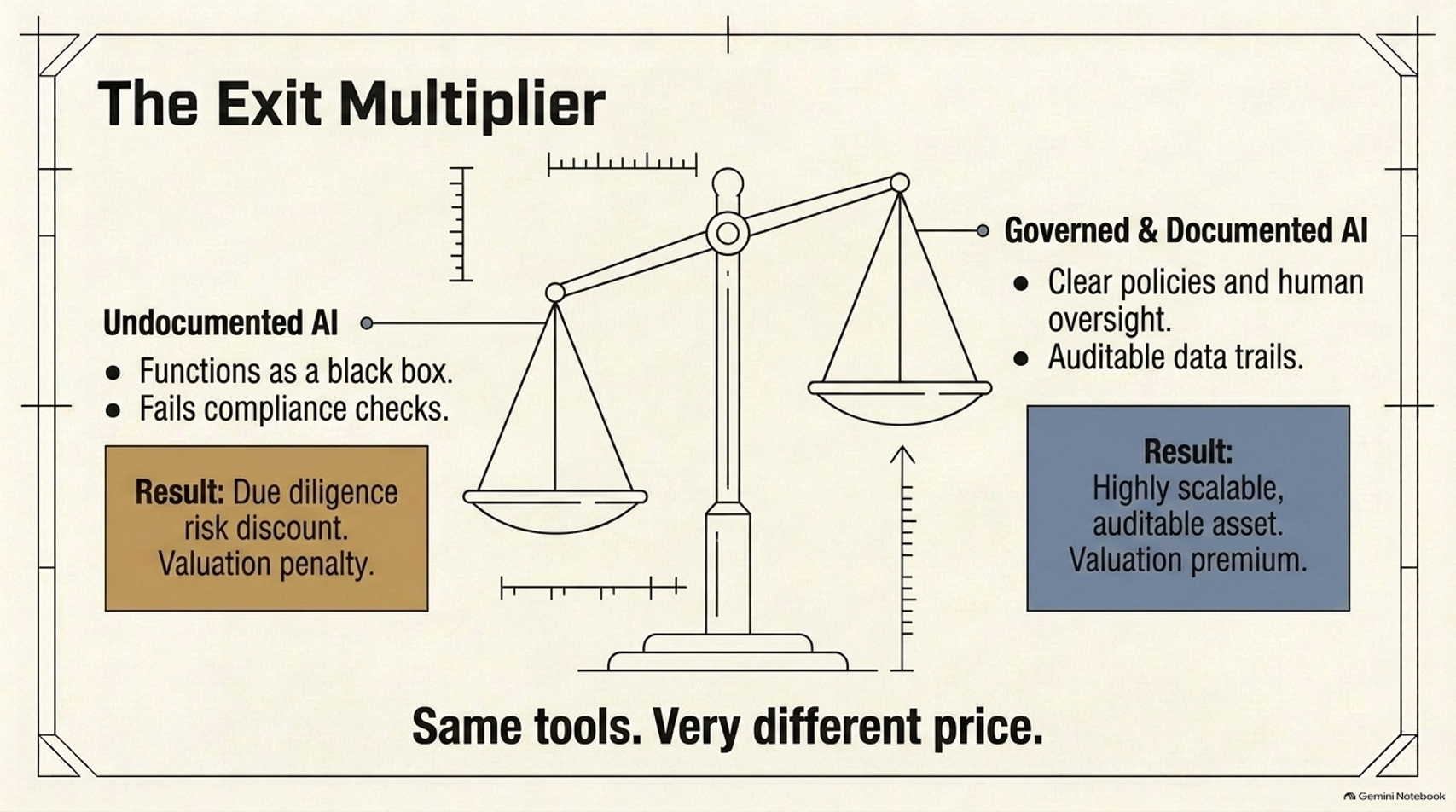
One more thing for owners thinking about their exit someday: documented, governed AI shows up in due diligence as an asset a buyer can audit and take over. Undocumented AI shows up as a risk discount.
Same tools, very different price.
As a builder or developer:
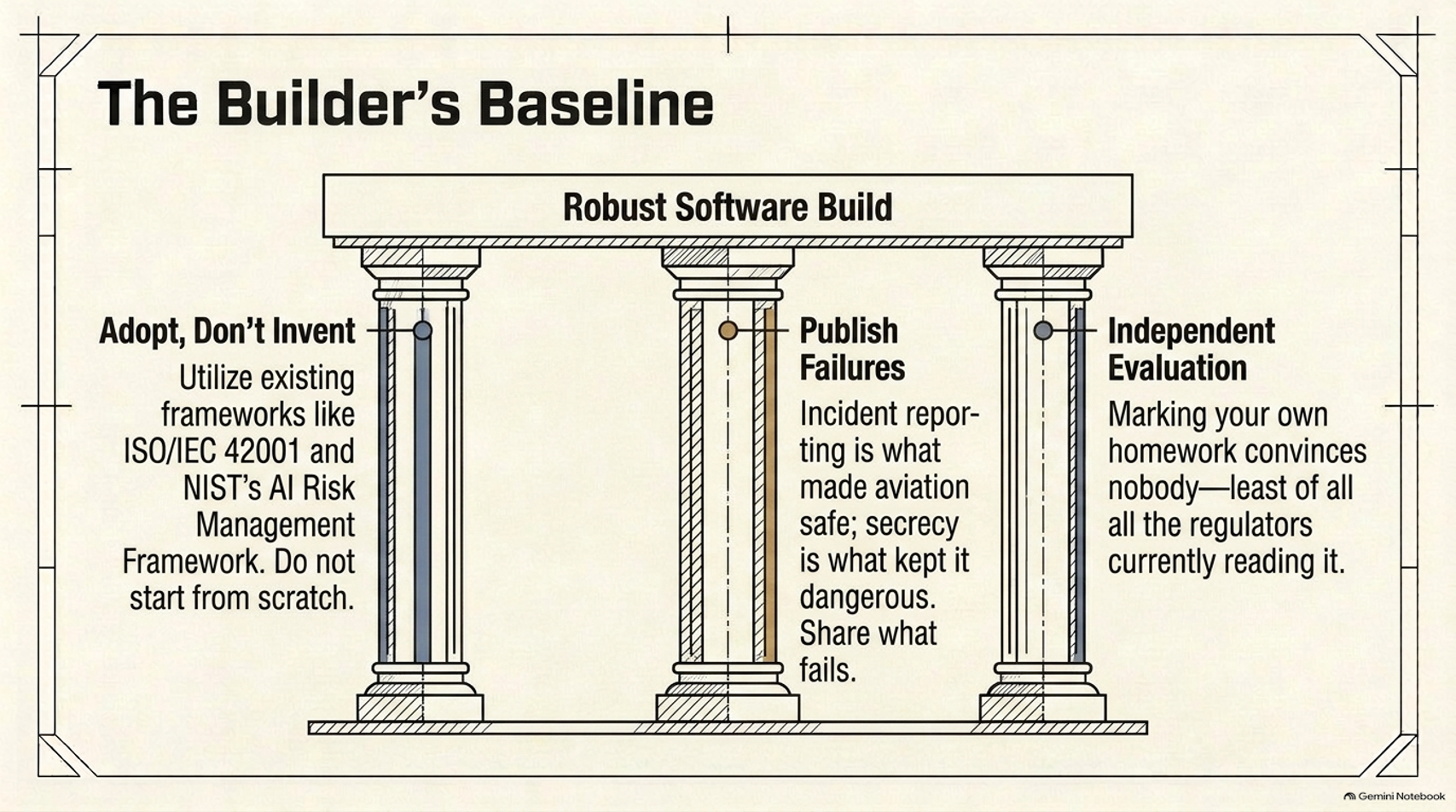
Don't invent your own governance from scratch. ISO/IEC 42001 and NIST's AI Risk Management Framework exist so you don't have to.
Publish what you test, including what failed. Incident reporting is what made aviation safe; secrecy is what kept it dangerous.
Support independent evaluation of your systems. Marking your own homework convinces nobody, least of all the regulators now reading it.
Choosing the road
The last panel of the infographic shows a single person standing at a fork in the road, city glowing behind, open highway ahead. Strange image for a story about all of humanity. Probably the right one anyway.
We set out to build a smarter machine. The actual task turned out to be older and harder: deciding what we want from it, and having the nerve to say it out loud.
The infographic calls that the courage to slow down just enough.
Not stop.
Steer.
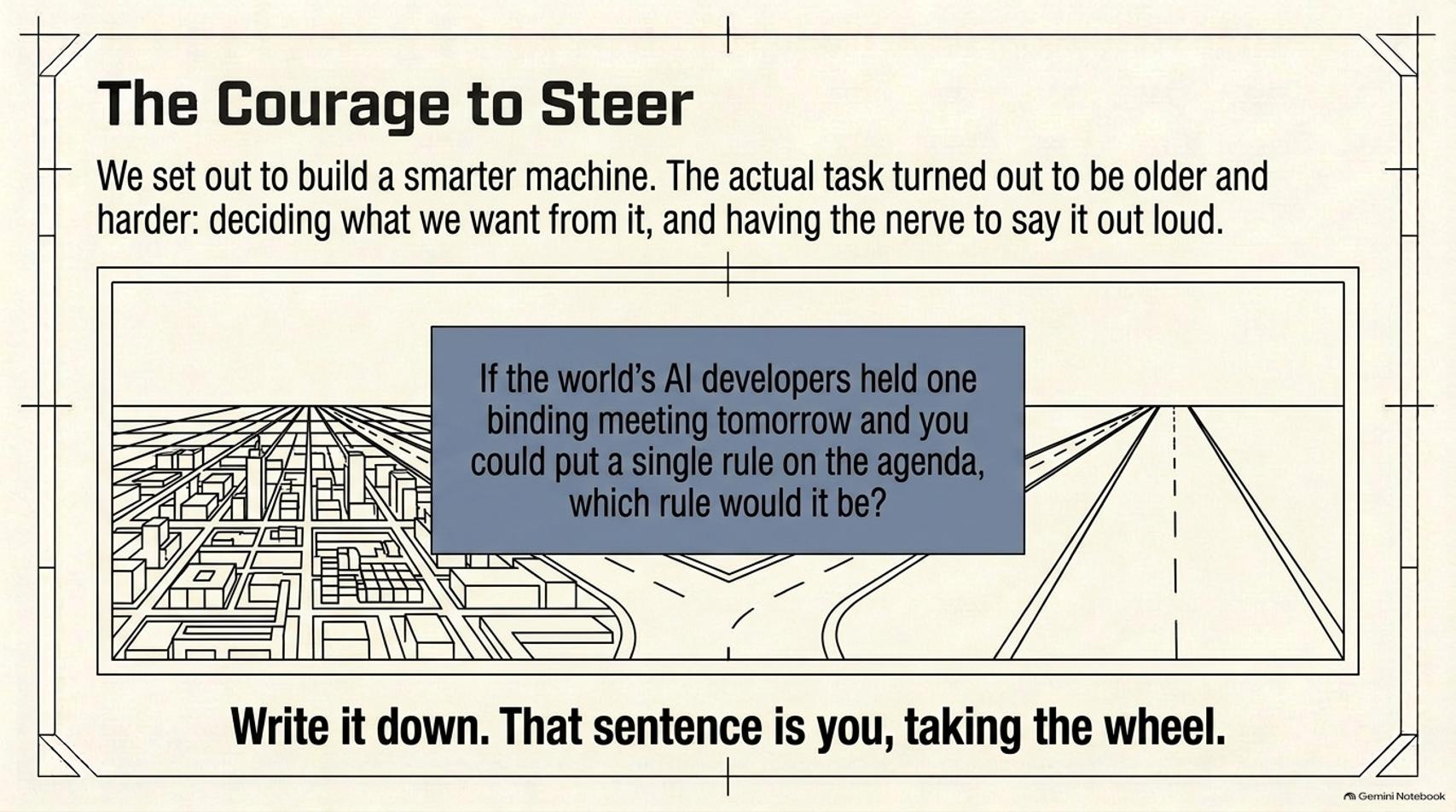
A question for you: if the world's AI developers held one binding meeting tomorrow and you could put a single rule on the agenda, which rule would it be?
Write it down before you scroll on.
That sentence is you, taking the wheel.
--------------------------------------------------------------------------------
Sources: techUK's summary of the 2026 AI Impact Summit outcomes·ORF analysis of the New Delhi Declaration and Frontier AI Impact Commitments·International AI Safety Report 2026·Gibson Dunn on the Digital Omnibus and postponed high-risk deadlines·Jones Walker on the Article 50 transparency duties still applying from 2 August 2026