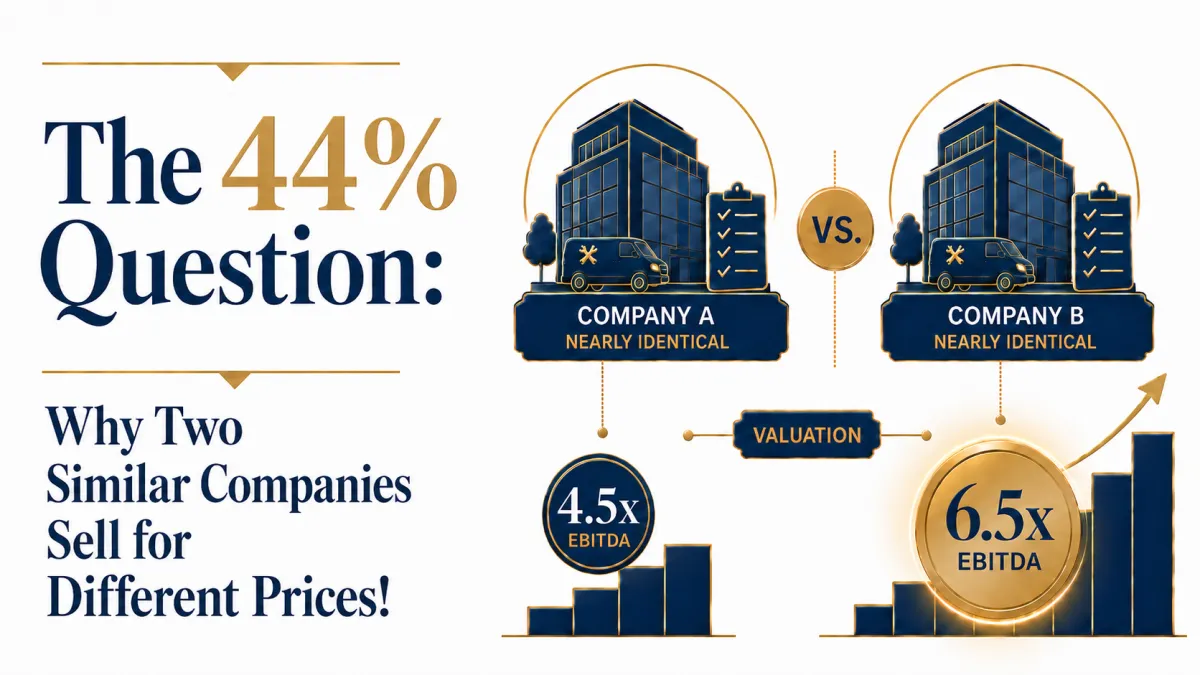
Why Two Nearly Identical Companies Sell for Different Prices
A breakdown of what it actually takes to move from a 4.5x business to a 6.5x+ one.
Two facility services companies.
Same revenue.
Same city.
Same margins on paper.
One sells for 4.5x EBITDA.
The other sells for 6.5x or more.
Same industry, same size bracket, sometimes even the same buyer at the table.
The difference isn't luck, and it isn't market timing.
It's whether the business can run without its founder in the room.
That's the core finding behind ExValu's LMM Valuation Framework, and it's worth unpacking properly, because most owners find out about this gap far too late to do anything about it.
The market right now
Lower middle market (LMM) transactions in facility services are currently trading in a fairly wide band.
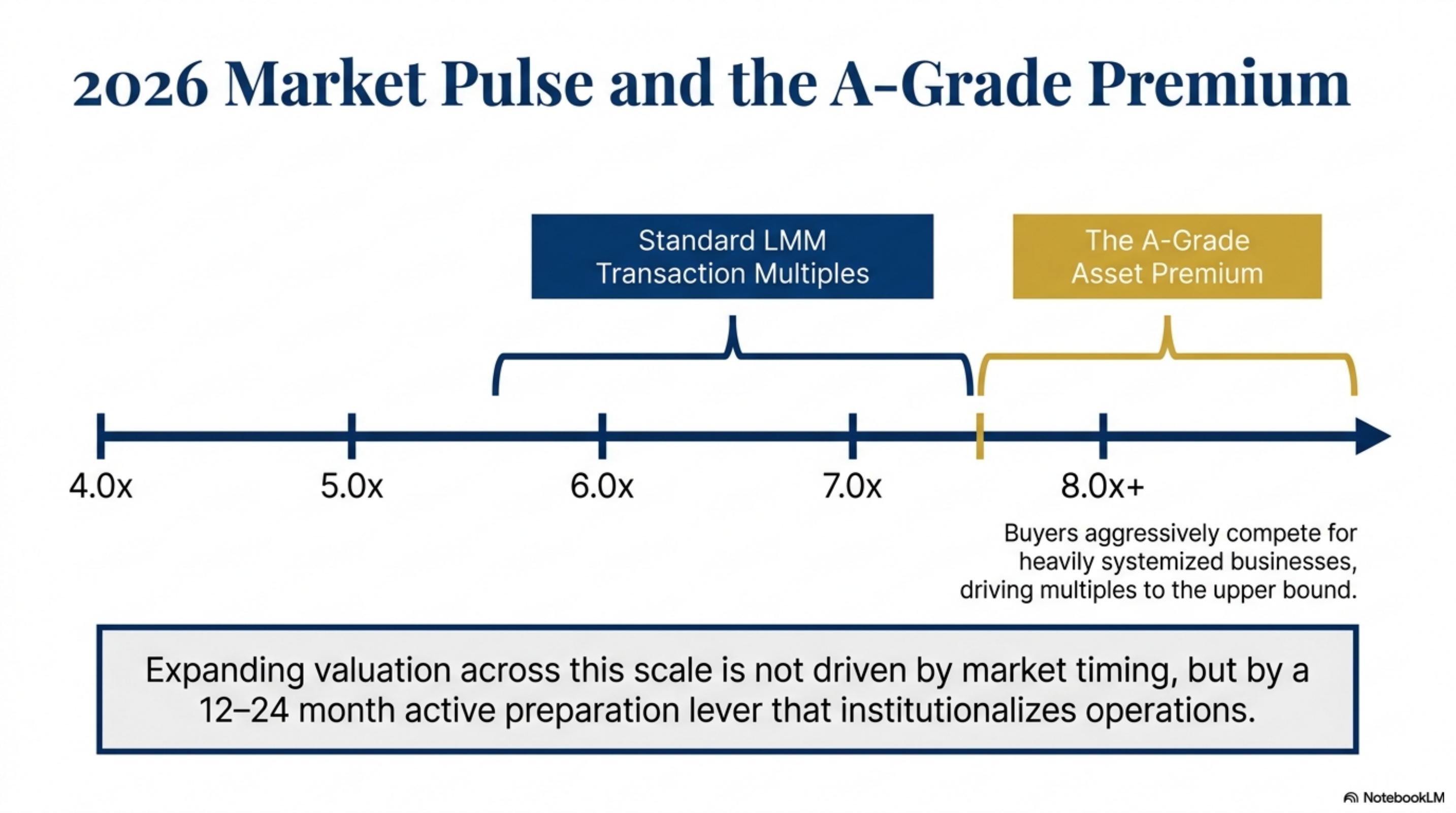
Commercial cleaning and facilities services with multi-year contracts are trading around 5-7x EBITDA. At the strategic-buyer end, ABM Industries has been paying roughly 6-8x for facility services and industrial cleaning bolt-ons, and Aramark roughly 7-9x for facility and industrial services acquisitions.
Client concentration hits the multiple directly, not just the risk narrative.
Once a single customer passes 20-25% of revenue, buyers typically discount the multiple by 0.5-1.0x to compensate for the risk of losing them.
Once the top three customers combined pass 40-50%, that discount can reach 1.0-2.0x.
On a business doing $1M in Adjusted EBITDA that would otherwise trade at 6x, a single client at 30% of revenue can turn a $6M offer into something closer to $5.25M, a loss with nothing to do with how the business performed and everything to do with who it depends on.
An example:
Say a business does $1M in Adjusted EBITDA, and without any concentration issue it would reasonably trade at 6x, so $6M in enterprise value.
Now say one client is 30% of revenue. That crosses the 20-25% threshold, so a buyer discounts the multiple by roughly 0.75x (mid-point of the 0.5-1.0x range). Instead of 6x, the buyer offers something closer to 5.25x. Same EBITDA, same business, but now it's worth $5.25M instead of $6M. That's $750K gone, purely because of who's on the client list, not because the business performed any worse.
These aren't a fixed formula, they're informal rules of thumb that M&A advisors use when they talk to buyers, but they show up consistently enough to be worth planning around.
These figures come from US lower-middle-market advisory sources, firms like CT Acquisitions and Parkland Capital, publishing what they describe as buyer and transaction data. They're not a primary database like GF Data or PitchBook, and they're US market figures, not a DACH/UK/EU dataset. Treat this as directional context rather than a promise about what any specific business will fetch.
Here's the part that actually surprises most owners: the gap isn't primarily about growth rate, or even about margin. It's about whether a buyer believes the business will still run the same way six months after the founder stops showing up.
From EBITDA to money in the bank
Before getting into what drives the multiple, it's worth being clear about what the multiple is actually multiplying.
A lot of owners think of valuation as "my EBITDA times some number I've heard about" and stop there. The real path from operating performance to a wire transfer has several more steps, and a buyer's advisor will contest every one of them.
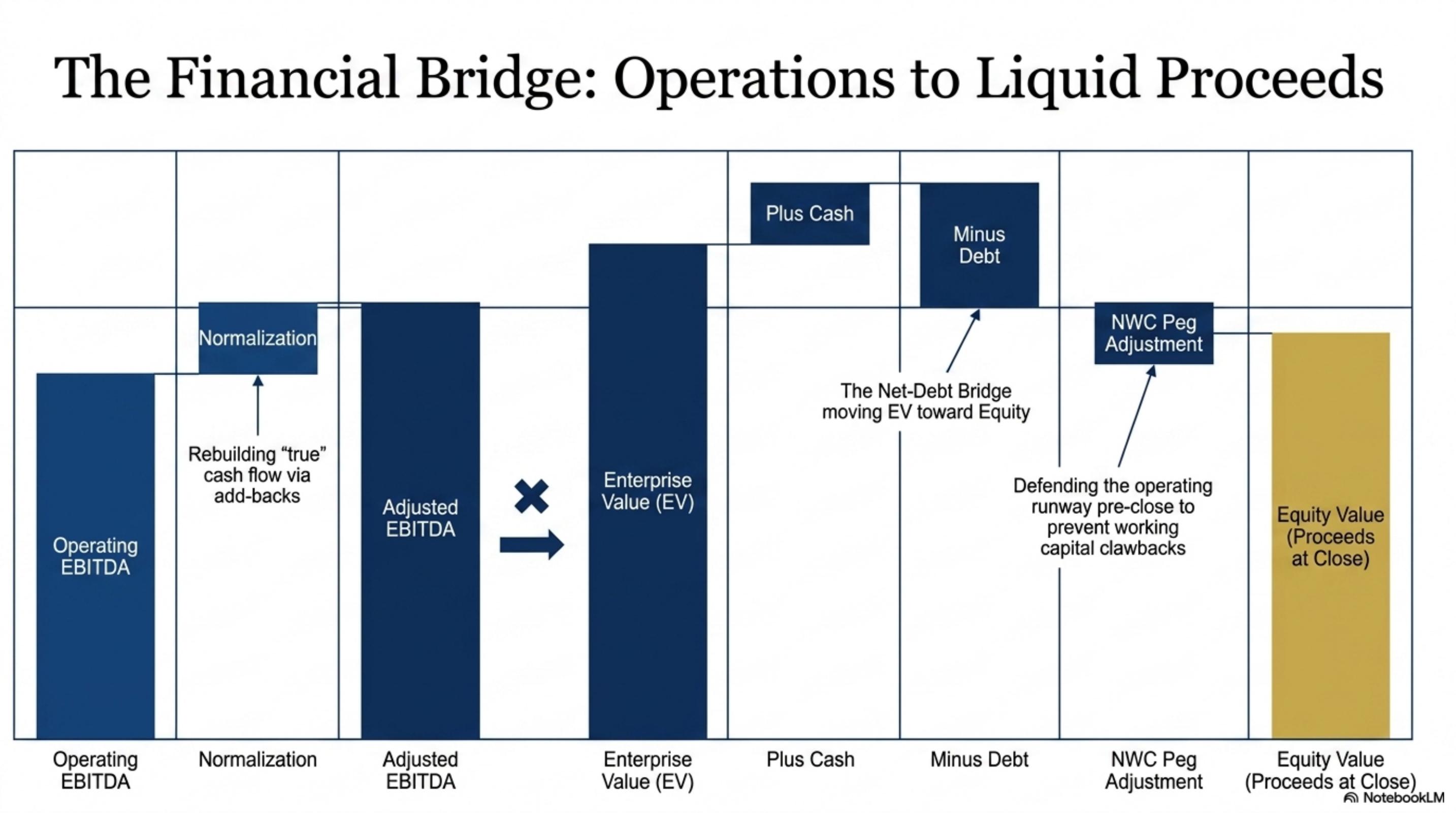
Start with Operating EBITDA, what the books show today. Normalization adds back one-off costs, above-market owner compensation, and other items that wouldn't exist under new ownership; this produces Adjusted EBITDA, and it's the single most argued-over number in any deal.
Multiply that by the agreed multiple and you get Enterprise Value.
Add back cash, subtract debt, and EV becomes Equity Value: what the seller actually walks away with.
One more adjustment sits in there too, the Net Working Capital (NWC) peg, which makes sure the seller hands over a business with enough working capital to keep running, rather than stripping cash out right before close and leaving the buyer to fund day-to-day operations.
A lot of unprepared sellers lose money at this last step without ever realizing it was at risk, not because anyone did anything wrong, but because nobody defined the target working capital level clearly until the buyer's team did it for them, in their favor.
The #1 valuation killer
If there's one variable that explains more of the multiple spread than anything else, it's this.
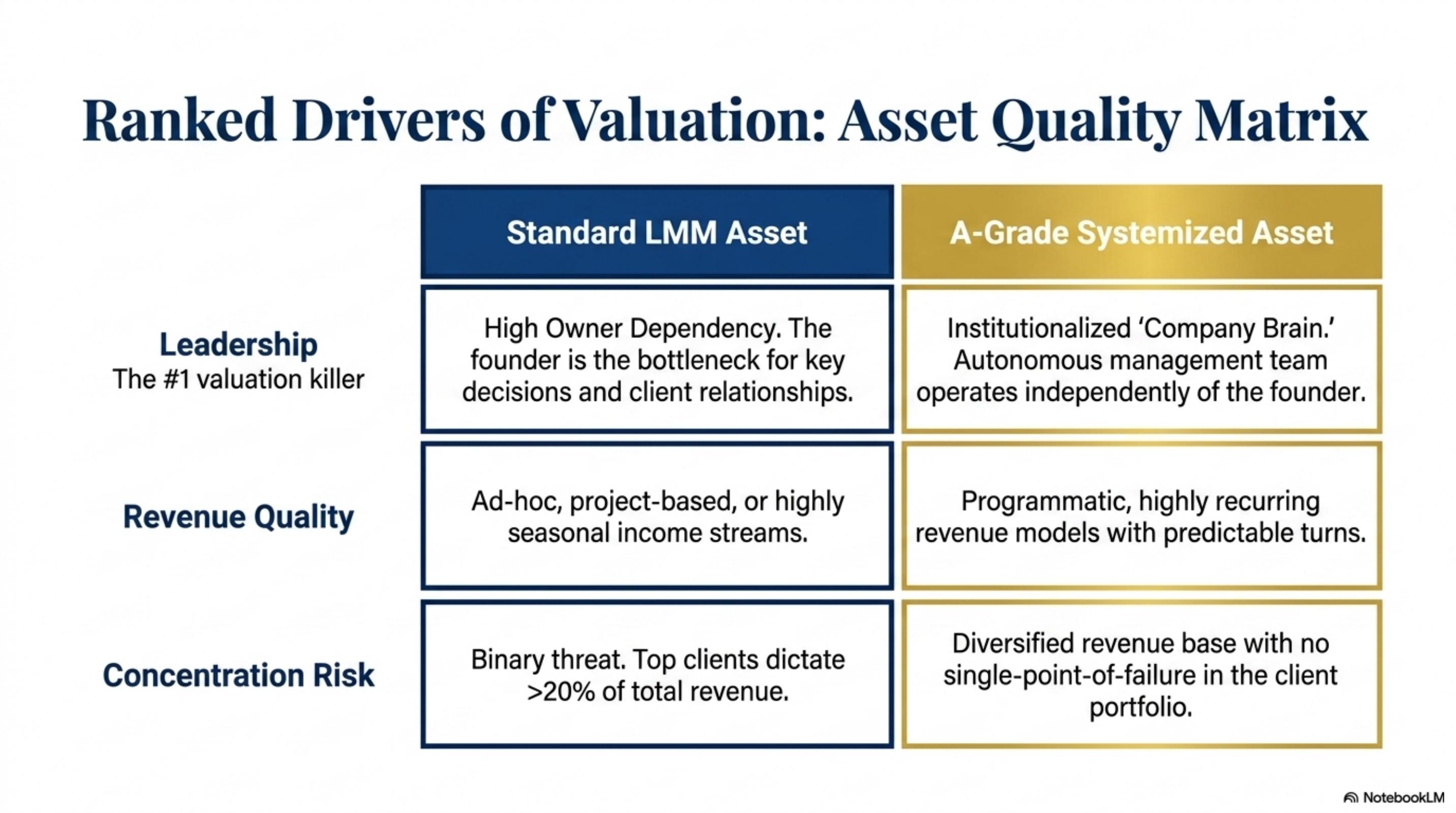
Leadership dependency is listed first for a reason.
A buyer underwriting a deal isn't just buying last year's cash flow. They're underwriting a forecast, and every forecast for a founder-dependent business carries an implicit discount for what happens the day the founder stops answering the phone.
That discount shows up as a lower multiple, a bigger earnout tied to founder retention, or both!
And there is a third outcome nobody puts in a brochure. Some buyers, particularly those without an operational plan to replace you, simply pass. They do not negotiate you down. They read the file, see that the business and the founder are the same thing, and move to the next opportunity.
Which means the choice you are actually making is not always between 4.5x and 6.5x. Sometimes it is between 4.5x and no offer at all.
The other two rows compound it. Project-based revenue makes next year harder to predict, and concentrated clients make the whole forecast dependent on a handful of relationships the founder personally holds.
Removing yourself as the bottleneck is the hardest part of this work, and it's tempting to treat it as the finish line.
It isn't.
The three rows in the Asset Quality Matrix aren't independent problems you can solve one at a time and call it done. They're three separate discounts a buyer applies, and fixing only one still leaves the other two sitting on the table.
Say a founder does the hard work of building the company brain: documented decision rules, a management team that can run client relationships without him, real delegation. That's genuinely difficult and it's the single biggest lever, since leadership dependency is the "#1 valuation killer." But if that same business still runs on ad-hoc, project-based contracts with no recurring structure, and still has one client at 30% of revenue, a buyer will still discount the multiple for those two things. The founder walks into the room having removed one risk and finds two more waiting.
This matters practically because it's tempting to stop after the first, hardest win. Systemizing leadership is the most visible, most talked-about piece of exit prep, so owners naturally throw most of their energy there and treat revenue quality and concentration as secondary. But a buyer's model doesn't grade on effort. It prices all three independently, and an unaddressed concentration risk or a book full of one-off projects will pull the multiple down regardless of how well-documented the org chart is..
What actually closes the gap
This isn't a one-quarter fix. ExValu's execution plan treats it as a structured 12 to 24 month build, not a pre-close scramble.
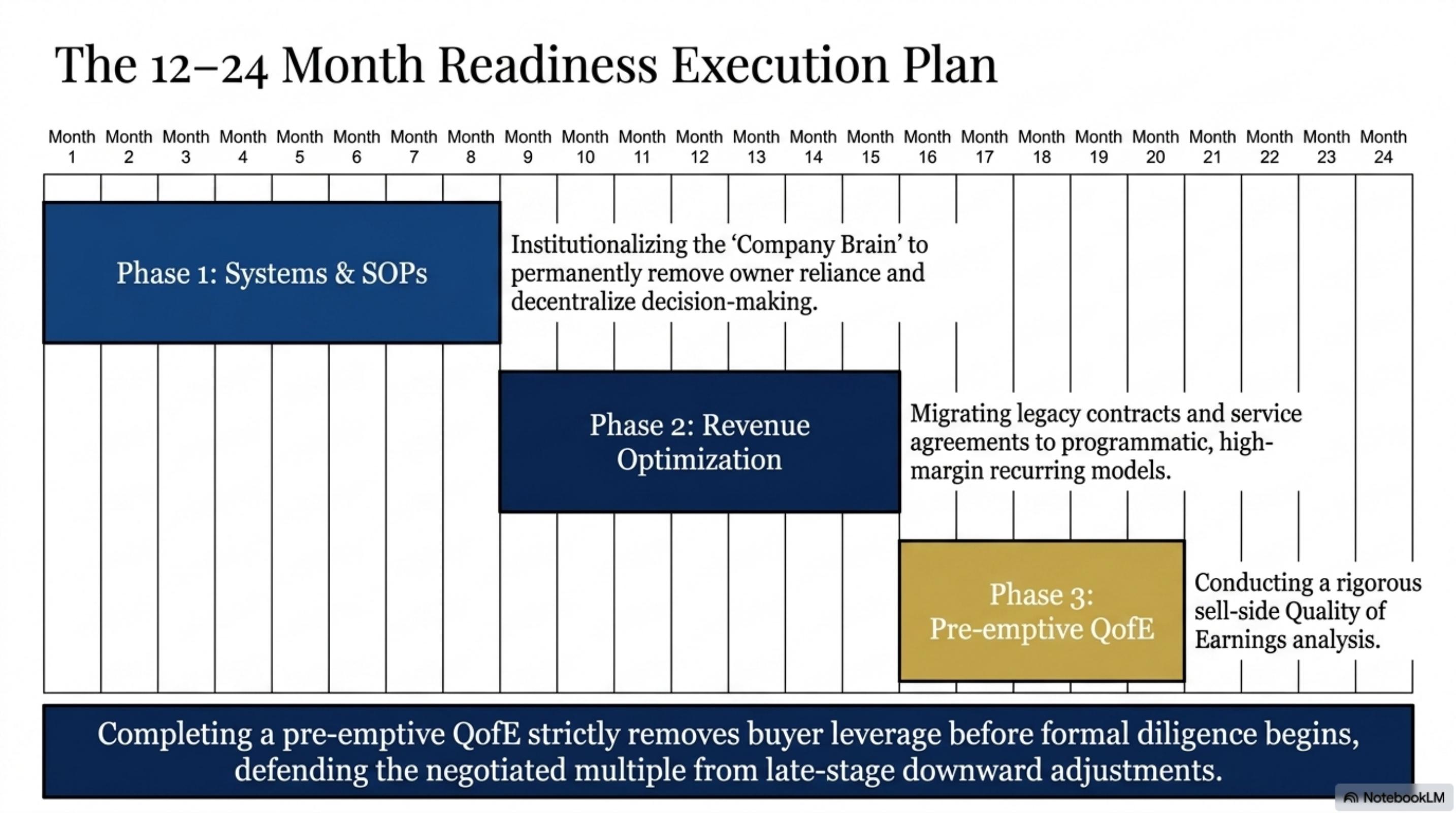
Phase 1: Systems & SOPs, roughly months 1 to 8. Build the "company brain," documented processes, decision rules, and knowledge capture that let the business run without the founder holding it all in their head. This is where key-person risk actually gets removed, not just described in a pitch deck.
Phase 2: Revenue Optimization, months 9 to 15, overlapping Phase 1. Migrate legacy, one-off contracts toward recurring, programmatic agreements. This is what turns "we did well last year" into "here's what next year predictably looks like," which is exactly what a buyer's model needs.
Phase 3: Pre-emptive Quality of Earnings, months 16 to 24. Run a QofE analysis before a buyer's team does. Finding your own EBITDA add-back issues and working capital surprises in month 18 costs you nothing. Having a buyer's diligence team find them in month 23 costs you leverage, and often costs you basis points on the multiple.
The sequencing matters. Trying to run a QofE before the systems and recurring-revenue work is done, just documents the problems you haven't fixed yet.
What is a QofE, exactly?
A Quality of Earnings analysis (QofE) is an independent check on whether your reported profit is real, repeatable profit, or whether some of it is one-off, inflated, or about to disappear once the business changes hands. It's the financial equivalent of a mechanic checking a used car before you buy it, except the buyer's mechanic is checking your books.
What it actually looks at:
Are your EBITDA add-backs legitimate (a genuine one-off cost) or a stretch (personal expenses run through the business, discretionary spending relabeled as "non-recurring")?
Is revenue really recurring, or does it look recurring on paper but depend on informal handshake renewals?
Are there timing tricks, revenue pulled forward, expenses pushed back, that make a quarter or year look better than the underlying trend?
Does working capital behave the way the business claims it does across a full seasonal cycle?
Why it matters for the multiple, not just the number: every add-back a buyer's QofE team rejects lowers Adjusted EBITDA, and since Enterprise Value is Adjusted EBITDA times the multiple, a rejected add-back doesn't just cost you that euro, it costs you that euro multiplied by 5, 6, or 7x. A $50K add-back a buyer disallows at a 6x multiple is $300K of enterprise value gone in one sentence of a diligence report. Run this yourself before a buyer does, and you fix what's fixable on your own terms instead of watching it get used as a negotiating lever against you.
Why this hits facility services particularly hard
Facility services is a genuinely fragmented industry: lots of small, capable, founder-run operators, and disproportionate buyer demand for the rare ones that don't depend on the founder. That combination is what creates room for real multiple expansion when a business closes the systemization gap.
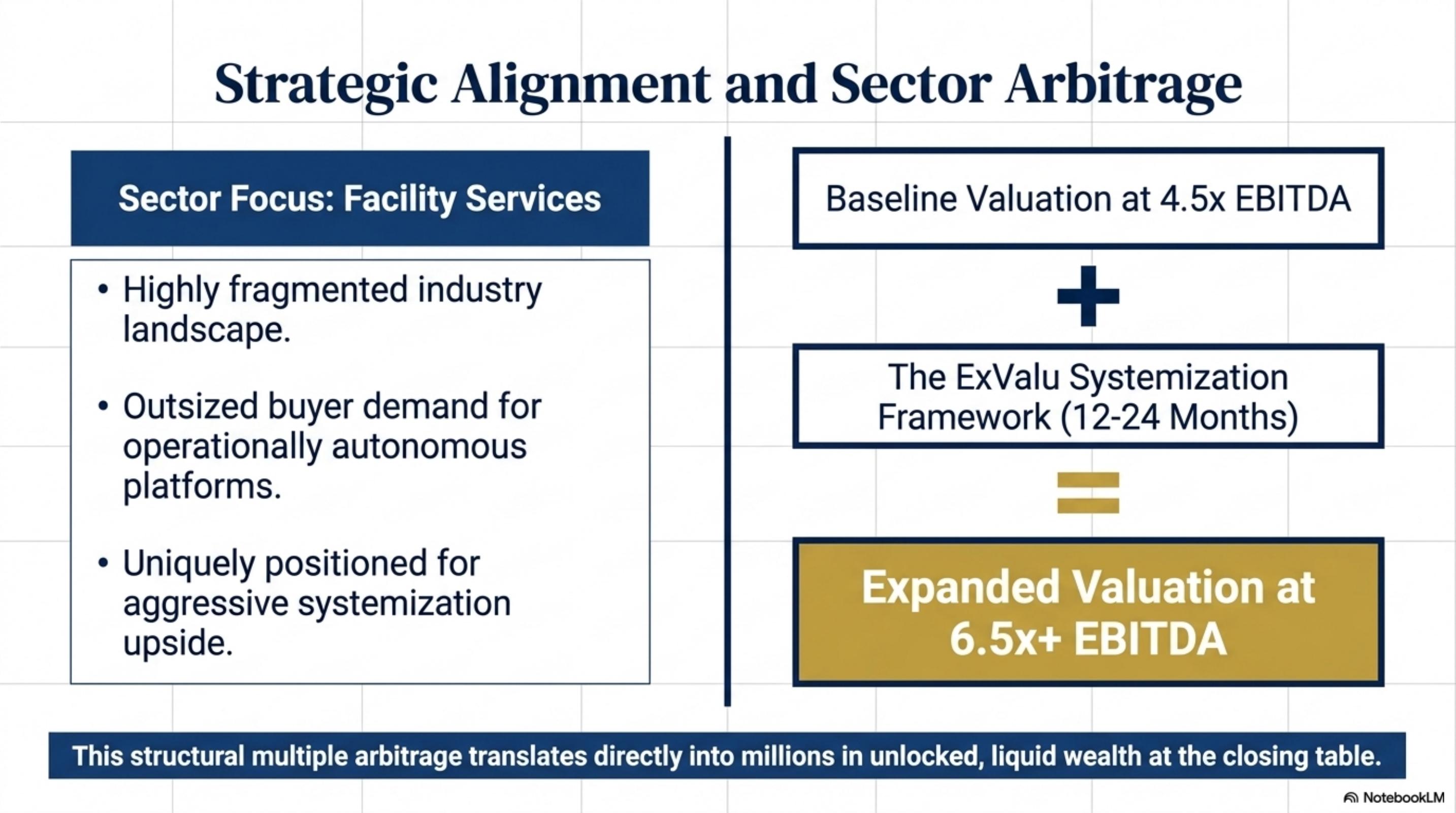
To make this concrete, here's an illustrative example. "Nordic FM Solutions GmbH" is a fictional company we're using to walk through the math, not a real ExValu client, and not a claim about any specific transaction.
Nordic FM starts where a lot of owner-run facility services businesses start: $1.5M in Adjusted EBITDA, one founder handling every major client relationship, roughly a third of revenue on ad-hoc project contracts, and its largest customer at 28% of revenue.
Given the concentration and revenue-quality profile, a buyer would reasonably price this in the lower part of the market range, call it 4.5x, below the 5-7x band the sector generally sees. That's roughly $6.75M in enterprise value.
Over 18 months, Nordic FM's owner documents decision rules into a shared operating manual, migrates half its ad-hoc contracts into multi-year service agreements, and brings its largest client down to 18% of revenue by growing the rest of the base.
None of that changes trailing EBITDA much.
What it changes is what a buyer is willing to pay for it: Nordic FM moves out of the discount zone and into the upper half of the standard range, say 6.5x. That's roughly $9.75M in enterprise value, a $3M swing, without the business growing its underlying cash flow at all.
That's the mechanism worth internalizing. The multiple, not the EBITDA, is where most of the pre-exit work should be aimed.
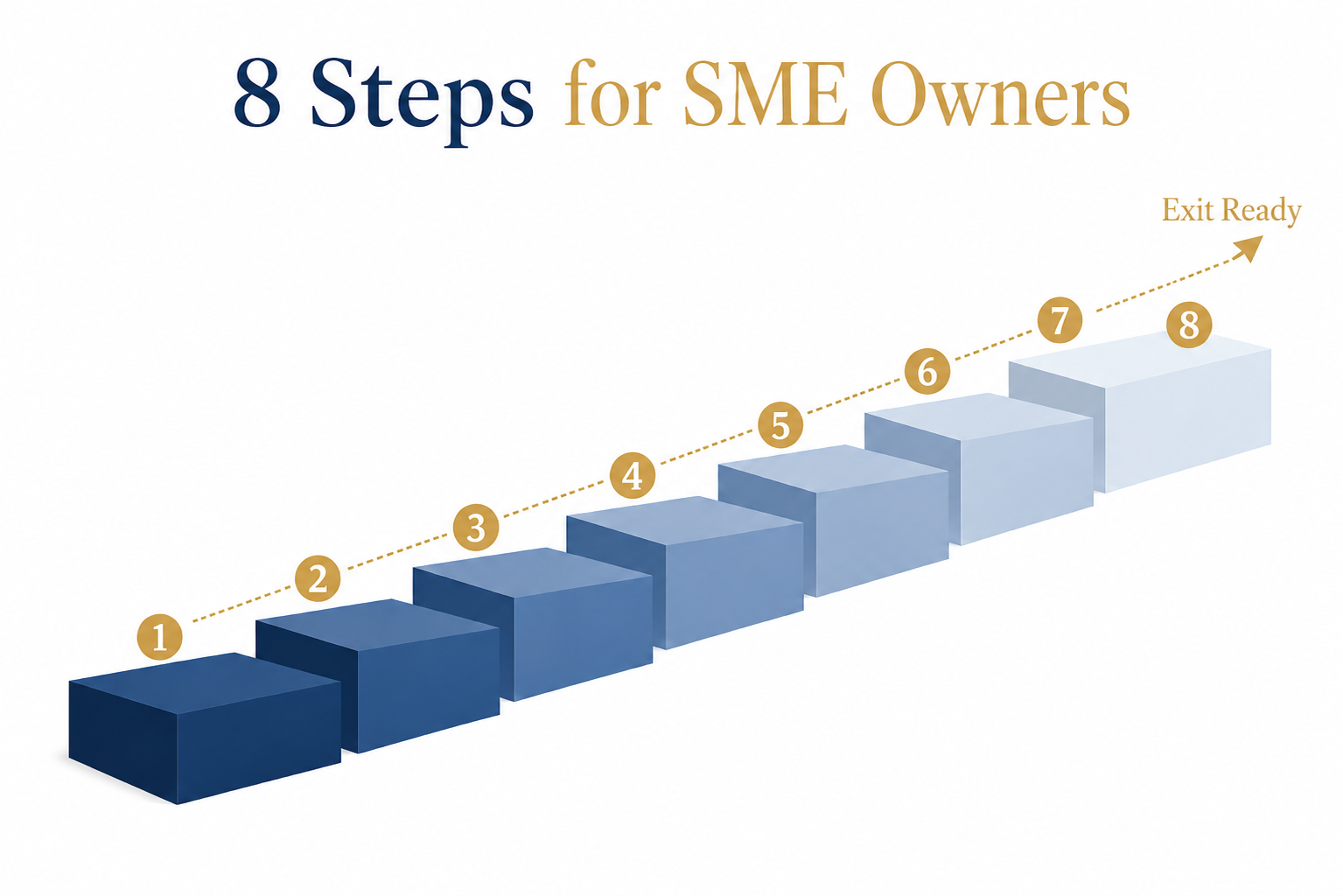
A step-by-step plan for SME owners
If you're 12 to 36 months from a potential exit, or just want the option to sell on YOUR terms rather than someone else's timeline, here's a concrete sequence. This deliberately doesn't require you to hire a technical team. Everything here is process and documentation work, with AI-based automation layered in where it removes founder-dependency fastest.
Step 1: Get an honest baseline (Month 1). Before fixing anything, know where you actually stand. List every decision in the business that currently requires you personally: pricing exceptions, key client calls, vendor negotiations, hiring calls.
This list is uncomfortable to write.
It's also the single most useful diligence document you'll produce this year, because it's exactly what a buyer's team will try to build independently during due diligence.
Step 2: Build the company brain (Months 1-6). For each item on that list, document the decision rule, not just the decision.
"I approve discounts up to 8% for repeat clients, more than that goes to a manager review" is a rule.
"I use my judgment" is a bottleneck.
Where possible, capture this in a shared, searchable system rather than in your head or a folder of emails. An internal knowledge base or CRM-linked wiki works fine; no custom software needed.
Step 3: Route routine decisions through automation, not through you (Months 3-9). This is where AI-driven ops work earns its keep, and it's the fastest way to prove key-person independence to a skeptical buyer. Concretely:
Deploy an AI voice agent or chatbot for inbound service requests and quote inquiries, so client contact doesn't route to your personal phone by default.
Set up CRM workflows so that lead intake, scheduling, and follow-up happen on rules, not on your memory.
Use automated callback and textback sequences to make sure stalled leads get revived without you personally chasing them.
Each of these does double duty: it improves near-term margin, and it's tangible evidence in a data room that the business doesn't stop when you're on a plane.
Step 4: Convert contracts to recurring where you can (Months 6-15). Go through your top 20 clients by revenue. For each ad-hoc or project-based relationship, identify a plausible recurring or subscription structure: maintenance retainers, service-level agreements with auto-renewal, tiered support plans. You won't convert everyone. Converting even a third of ad-hoc revenue to programmatic contracts materially changes how a buyer's model treats your forecast.
A programmatic contract is a service agreement that runs on a set structure and auto-renews, rather than something you negotiate fresh each time. The word "programmatic" here just means "runs on a program," i.e. rules and a schedule, rather than being decided case by case.
The contrast that matters:
Ad-hoc / project-based work: a client calls when they need something, you quote it, you do it, the relationship resets to zero once the job's done. Nothing obligates them to come back, and nothing tells a buyer's forecast what next year looks like.
Programmatic / recurring work: a signed agreement with a defined scope, a fixed or tiered price, a term (often 1-3 years), and auto-renewal unless someone actively cancels. A maintenance retainer, a service-level agreement, a subscription-style support plan. The client doesn't have to re-decide to work with you every month; the default is that the relationship continues.
Why buyers care so much about this distinction: a forecast built on programmatic contracts is something a buyer's model can actually project forward with confidence. A forecast built on ad-hoc work is really just "last year's total," dressed up as a prediction, because there's no contractual reason next year will look the same. That's exactly why revenue quality is one of the three rows in the Asset Quality Matrix, and it's what Phase 2 of the readiness plan (and Step 4 of the practical plan) is aimed at: converting one-off relationships into signed, auto-renewing agreements.
Step 5: Address concentration risk directly (ongoing). If any single client is above 15-20% of revenue, that's a named risk in every term sheet you'll see. You don't need to fire the client. You do need a documented plan to grow the rest of the base so that client's share shrinks over time, and you need that plan in writing before a buyer asks for it.
Step 6: Run your own Quality of Earnings review (Months 16-20). Before a buyer's advisors do it for you, have an independent finance professional walk through your add-backs, your working capital trend, and any revenue recognition edge cases. Fix what you find. Every issue you catch here is one less thing a buyer's team uses as a negotiating lever later.
Step 7: Set your working capital peg deliberately (Months 18-22). Work out, in advance, what "normal" working capital looks like for your business across a full seasonal cycle. Don't let this get defined for the first time inside a term sheet negotiation, because by then you're negotiating from a position of not having thought about it.
As you know, working capital is the cash tied up in day-to-day operations, money sitting in unpaid invoices (receivables), inventory or supplies, minus what you owe suppliers (payables). It goes up and down through the year as business ebbs and flows. The "peg" is the number both sides agree on, in the sale contract, as the normal amount of working capital the buyer should expect to receive at closing.
Why this exists as a mechanism: when a buyer agrees to pay a price for your business, that price assumes the business comes with enough working capital to keep running on day one, enough cash to cover payroll, pay suppliers, and fund operations while new invoices work their way through the pipeline. If the seller quietly drains working capital right before close (delays paying suppliers, rushes collections, cancels planned stock orders), the buyer effectively gets a business that's about to hit a cash crunch, even though the purchase price didn't account for that.
So the deal sets a peg: an agreed target level of working capital at closing, usually based on a historical average. If actual working capital at close comes in below the peg, the purchase price gets reduced euro for euro. If it comes in above, sellers sometimes get paid more, though buyers push back harder on that direction.
Why "across a full seasonal cycle" matters: if your business has any seasonality (most facility services businesses do, staffing up for summer contracts, slower in Q1, whatever your pattern is), working capital naturally swings across the year. A peg calculated from your slowest month looks nothing like a peg calculated from your busiest month. If you don't define this yourself in advance, using a full 12-month view, the buyer's team will calculate it using whatever period is most favorable to them, and by the time you're in a term sheet negotiation, you're arguing against a number someone else already anchored.
Why doing this at Month 18-22 specifically: by then, Phase 1 and 2 systemization work should already be stabilizing your operations and revenue mix, so your working capital pattern is more predictable and defensible. Doing this too early means pegging against a messier, less representative baseline.
Step 8: Get a real valuation baseline and gap analysis (Month 18+). Once systems, revenue mix, and QofE work are underway, get a confidential valuation and systemization audit to see where you actually land against the 6.5x+ bracket, and what's left to close the gap.